

A serving Punjab cadre IAS officer was summoned before the Enforcement Directorate for 18 August 2026 to answer questions about a permission most property buyers in this region have never examined and could not describe. Not a title deed. Not a RERA registration. A change of land use approval.
The officer is Kanwal Preet Brar, who served as Director, Town and Country Planning in 2024. According to The Tribune, she is to be questioned about the processing and approval of CLU permissions for the Suntec City project in Mohali, permissions the ED alleges were obtained on the basis of forged consent documents. ED sources told the paper the agency wants to know what due diligence was carried out to verify that landowners had consented to the sale.
When contacted, Brar said she was not aware of the summons. No findings of wrongdoing have been established against her. The roles of other officials posted in the Housing Department during 2024 are reported to be under scrutiny as well.
Set the individual aside. What the case exposes is a document sitting at the base of a great deal of Mohali property, and how little most buyers know about what it is supposed to prove.
What a CLU actually is
Land in Punjab has a designated use. Agricultural land is agricultural until the state permits otherwise, and a change of land use permission is that consent, granted by the Department of Town and Country Planning, converting a parcel from agricultural to residential, commercial or institutional use.
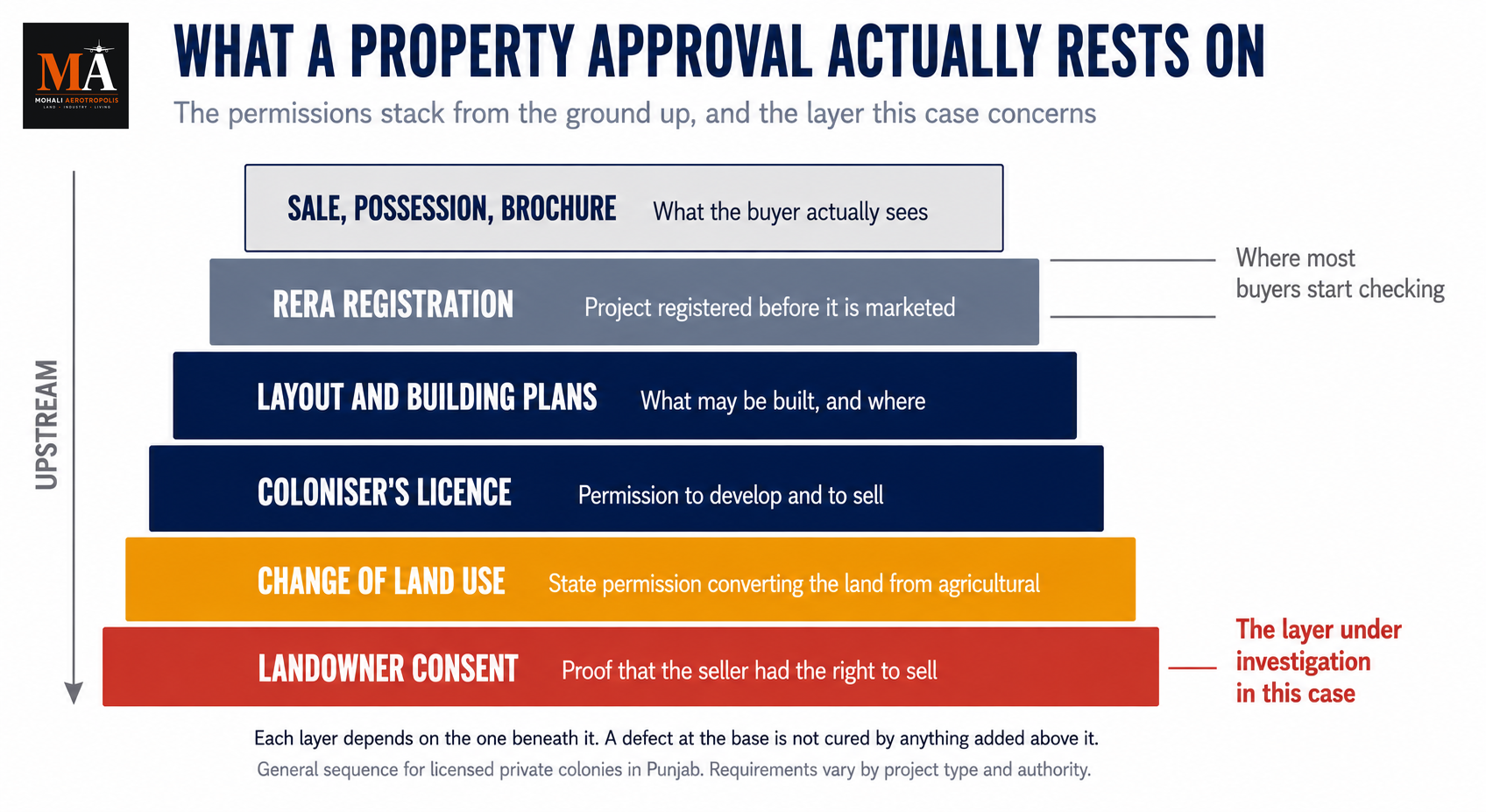
Without it, nothing can lawfully be built. It sits upstream of the licence, upstream of the layout approval, upstream of RERA registration, and a very long way upstream of the brochure. Every legitimate colony in this region rests on one.
The part that matters here is what an application has to establish. A promoter seeking CLU over land it does not already own must demonstrate that the landowners consented to the sale. That consent is the hinge. It is the mechanism by which the state satisfies itself that the person asking to convert the land has a right to it.
Forge the consent, and everything built on top of the permission stands on a foundation that was never valid.
The trail, as it stands on the record
The allegations, as reported by The Tribune and other named press, run as follows.
Suntec City is a 108.58 acre project in New Chandigarh, promoted by the Indian Cooperative House Building Society. It was granted CLU approval in 2016. On 19 November 2022 an FIR was registered at Mullanpur police station following complaints from landowners, invoking criminal conspiracy, cheating, forgery and the use of forged documents.
The ED alleges that fake consent letters were prepared covering 30.5 acres belonging to 15 landowners, bearing forged signatures and thumb impressions, and that these were used to obtain the CLU. In the High Court proceedings the landowners' title over the disputed parcels, 27.78 acres in one village and 2.71 acres in another, was established. GMADA subsequently cancelled the society's licence.
In 2024 the CLU was re-issued in modified form. This is the stage the current summons concerns, and it is the part worth pausing on.
The modification did not re-grant the disputed land. It revoked permission over the contested parcels. What the ED is examining, according to Tribune reporting in May, is why the department stopped there: why, having recorded in those same orders that the promoter had failed to prove the validity of its title or consent, it did not proceed to punitive action.
The agency has put that in statutory terms. It says only a partial revocation covering 30 acres was carried out, using Section 85 of the Punjab Regional and Town Planning and Development Act rather than the stricter Section 90, and that this was contrary to what had been discussed before the High Court. The ED's position is that the effect was to leave the promoter able to sell down the remaining stock.
In May 2026 the ED searched eight premises linked to the society and to a second developer group, seizing roughly Rs 1 crore in cash, part of it recovered from the road after Rs 21 lakh was thrown from a balcony during the search. Ajay Sehgal, Secretary of the society and promoter of Suntec City, was arrested later that month. In July the agency filed a prosecution complaint before the Special PMLA Court in Mohali alleging laundering of close to Rs 348 crore, and said the accused continued to generate proceeds of crime even after the partial revocation.
None of these allegations has been proven. A prosecution complaint is a charge, not a finding.
What the buyers in these projects are facing
Three details from the ED's account describe consequences rather than accusations, and they are the ones a purchaser should sit with.
The same CLU underpins more than the plots. The agency says Sehgal also developed La Canela, a residential multi-storey complex, and District 7, a commercial complex, on the strength of it. Buyers in those two projects are inside the same document chain as buyers of Suntec City plots, whether or not they were ever told so.
Units across these projects were sold before registration with and approval from the Real Estate Regulatory Authority, with sales reported at over Rs 200 crore. The ED has separately alleged that physical possession was handed to buyers without mandatory completion or occupancy certificates, which it says breaches the Punjab Building Rules, 2021 and the RERA Act. It has also said that plots reserved for economically weaker sections were never transferred to the Estate Officer, GMADA, an obligation attached to the licence rather than an optional contribution.
Then the procedural point, which has the sharpest practical edge. Because the revocation was partial, buyers holding units outside the revoked 30 acres are in a materially different position from those inside it. Most will not know which side of that line they sit on, and the parcel description in the CLU order is the only thing that answers it.
This is not a single case
The ED has said its examination extends to the functioning of GMADA and the Department of Town and Country Planning, and to CLU records for other projects. Officials told The Tribune the agency is looking at more than a dozen real estate projects where authorities allegedly revoked only partial CLUs under Section 85 rather than proceeding under Section 90.
The pattern is already visible elsewhere in the record. In June we reported that nearly 30 promoters owed over Rs 1,000 crore in external development charges, licence fees and social infrastructure dues, with the GMADA dues default register putting numbers to it. Our earlier coverage of the Rs 348 crore complaint sets out the money-laundering case in full.
The common thread is not any one developer. It is that the approvals layer, the part of the process a buyer assumes has already been checked by somebody official, is the layer under investigation.
The documents that answer the question
A CLU is a public permission, not a private paper. It has a number, a date, a defined land parcel described by khasra, and a named grantee. It can be asked for by name.
Establish four things before relying on one. Whether a CLU exists for the specific parcel rather than for the project as a whole, since a project can hold approval over part of its land and not the rest. Whether it has been modified or revoked since issue, because an original permission and a later revision are different documents. Whether the land it covers is the land being sold, which is where the parcel description does its work. And, if a revocation has occurred, whether the parcel sits inside or outside the revoked portion.
RERA registration sits downstream of all of this and does not substitute for it. Nor does a licence, nor a layout approval, nor the fact that construction is visibly under way. Our glossary sets out how these documents stack, and the buyer's guide covers the title work that sits alongside them.
The uncomfortable implication of this case is that a buyer cannot fully outsource the question. An approval existed, was recorded, and was relied on. Whether the response to the objections against it was adequate is now a matter for a court, and the people who bought on the strength of it are waiting on that answer along with everyone else.
---
Sources
- Punjab-cadre IAS officer called by ED over Suntec City project, The Tribune, 17 August 2026, on the summons, the officer's 2024 posting and her response
- Town and Planning Dept under ED lens over CLU permissions to Mohali realtors, The Tribune, 9 May 2026, on the modified CLU orders, the FIR particulars and the May searches
- ED arrests Punjab Cooperative Society Secretary Ajay Sehgal in fake change of land use case, The Tribune, 23 May 2026, on the Section 85 partial revocation, the EWS plots and the search recoveries
- ED arrests Punjab real estate businessman in land fraud case, ETV Bharat, 23 May 2026, on La Canela, District 7 and the pre-RERA sales
- After Sehgal's arrest, ED eyes 'big fish', tightens noose around GMADA, The Tribune, 23 May 2026, on the wider set of projects under examination
- Private builders in Punjab bypassing rules to alter layout plans: ED, The Tribune, 30 June 2026, on possession without completion or occupancy certificates
- ED files PMLA complaint against Mohali society secretary in Rs 348 crore land scam, The Tribune, July 2026, on the prosecution complaint and the 108.58 acre project
- Licence for Suntec City cancelled, High Court told, The Tribune, August 2024, on the licence cancellation and the disputed parcels
एक सेवारत पंजाब कैडर के IAS अधिकारी को 18 अगस्त 2026 के लिए प्रवर्तन निदेशालय (ED) के समक्ष बुलाया गया था, ताकि एक ऐसी अनुमति के बारे में सवालों के जवाब दिए जा सकें जिसे इस क्षेत्र के अधिकांश संपत्ति खरीदारों ने कभी जांचा नहीं है और न ही उसका वर्णन कर सकते हैं। ना कोई टाइटल डीड (title deed), ना RERA पंजीकरण, बल्कि एक भू-उपयोग परिवर्तन (change of land use) की मंजूरी।
अधिकारी कंवलप्रीत बराड़ हैं, जिन्होंने 2024 में निदेशक, टाउन एंड कंट्री प्लानिंग के रूप में कार्य किया था। द ट्रिब्यून के अनुसार, उनसे मोहाली में सनटेक सिटी (Suntec City) परियोजना के लिए CLU अनुमतियों के प्रसंस्करण और अनुमोदन के बारे में पूछताछ की जानी है, ऐसी अनुमतियाँ जिनके बारे में ED का आरोप है कि वे जाली सहमति दस्तावेजों के आधार पर प्राप्त की गई थीं। ED सूत्रों ने अखबार को बताया कि एजेंसी जानना चाहती है कि यह सत्यापित करने के लिए क्या उचित परिश्रम (due diligence) किया गया था कि भूमि मालिकों ने बिक्री के लिए सहमति दी थी।
संपर्क करने पर, बराड़ ने कहा कि उन्हें समन के बारे में जानकारी नहीं है। उनके खिलाफ किसी गलत काम का निष्कर्ष स्थापित नहीं हुआ है। 2024 के दौरान आवास विभाग में पदस्थ अन्य अधिकारियों की भूमिकाओं की भी जांच के दायरे में होने की सूचना है।
व्यक्ति को एक तरफ रख दें। यह मामला जो उजागर करता है, वह एक दस्तावेज है जो मोहाली की काफी संपत्ति की नींव में है, और यह कि अधिकांश खरीदारों को इस बारे में कितनी कम जानकारी है कि इसे क्या साबित करना supposed है।
CLU वास्तव में क्या है
पंजाब में भूमि का एक निर्धारित उपयोग होता है। कृषि भूमि तब तक कृषि है जब तक राज्य अन्यथा अनुमति न दे, और भू-उपयोग परिवर्तन की अनुमति वह सहमति है, जो विभाग टाउन एंड कंट्री प्लानिंग द्वारा दी जाती है, जो एक भूखंड को कृषि से आवासीय, वाणिज्यिक या संस्थागत उपयोग में परिवर्तित करती है।
इसके बिना, कानूनी रूप से कुछ भी नहीं बनाया जा सकता। यह लाइसेंस से ऊपर, लेआउट अनुमोदन से ऊपर, RERA पंजीकरण से ऊपर, और ब्रोशर से बहुत ऊपर स्थित है। इस क्षेत्र की हर वैध कॉलोनी इसी पर आधारित है।
यहाँ जो मायने रखता है वह है कि एक आवेदन को क्या स्थापित करना होता है। एक प्रमोटर जो उस भूमि पर CLU चाहता है जो उसके पास पहले से नहीं है, उसे यह प्रदर्शित करना होगा कि भूमि मालिकों ने बिक्री के लिए सहमति दी थी। वह सहमति ही केंद्र बिंदु है। यह वह तंत्र है जिसके द्वारा राज्य खुद को संतुष्ट करता है कि भूमि को परिवर्तित करने के लिए कहने वाले व्यक्ति का उस पर अधिकार है।
सहमति जाली बनाएं, और अनुमति के ऊपर बनी हर चीज़ एक ऐसी नींव पर खड़ी होती है जो कभी वैध नहीं थी।
रिकॉर्ड पर अब तक का निशान
जैसा कि द ट्रिब्यून और अन्य नामित प्रेस ने रिपोर्ट किया है, आरोप इस प्रकार हैं।
सनटेक सिटी न्यू चंडीगढ़ में एक 108.58 एकड़ की परियोजना है, जिसे इंडियन कोऑपरेटिव हाउस बिल्डिंग सोसाइटी द्वारा बढ़ावा दिया जा रहा है। इसे 2016 में CLU अनुमोदन दिया गया था। 19 नवंबर 2022 को भूमि मालिकों की शिकायतों के बाद मुल्लांपुर पुलिस स्टेशन में एक FIR दर्ज की गई थी, जिसमें आपराधिक साजिश, धोखाधड़ी, जालसाजी और जाली दस्तावेजों के उपयोग का आरोप लगाया गया था।
ED का आरोप है कि 15 भूमि मालिकों की 30.5 एकड़ जमीन को कवर करने वाले नकली सहमति पत्र तैयार किए गए थे, जिन पर जाली हस्ताक्षर और अंगूठे के निशान थे, और इनका उपयोग CLU प्राप्त करने के लिए किया गया था। उच्च न्यायालय की कार्यवाही में विवादित भूखंडों पर भूमि मालिकों का स्वामित्व स्थापित किया गया था, जो एक गांव में 27.78 एकड़ और दूसरे में 2.71 एकड़ था। GMADA ने बाद में सोसाइटी का लाइसेंस रद्द कर दिया।
2024 में CLU को संशोधित रूप में फिर से जारी किया गया। यह वह चरण है जिससे वर्तमान समन संबंधित है, और यहीं पर थोड़ा रुकना उचित है।
संशोधन ने विवादित भूमि को दोबारा नहीं दिया। इसने विवादित भूखंडों पर अनुमति रद्द कर दी। ED जांच कर रहा है, मई में ट्रिब्यून रिपोर्टिंग के अनुसार, यह कि विभाग वहीं क्यों रुका: क्यों, उन्हीं आदेशों में यह दर्ज करने के बाद कि प्रमोटर अपने स्वामित्व या सहमति की वैधता साबित करने में विफल रहा, उसने दंडात्मक कार्रवाई की ओर कदम नहीं बढ़ाया।
एजेंसी ने इसे वैधानिक शर्तों में रखा है। उसने कहा है कि केवल 30 एकड़ को कवर करने वाला आंशिक विलोपन किया गया था, जो पंजाब क्षेत्रीय और टाउन प्लानिंग एंड डेवलपमेंट अधिनियम की धारा 85 के तहत किया गया था, न कि सख्त धारा 90 के तहत, और यह उच्च न्यायालय के समक्ष चर्चा की गई बातों के विपरीत था। ED का कहना है कि इसका प्रभाव यह था कि प्रमोटर को शेष स्टॉक बेचने में सक्षम छोड़ दिया गया।
मई 2026 में ED ने सोसाइटी और एक दूसरे डेवलपर समूह से जुड़े आठ परिसरों की तलाशी ली, जिसमें लगभग 1 करोड़ रुपये नकद जब्त किए गए, जिसमें से कुछ राशि तलाशी के दौरान बालकनी से फेंके गए 21 लाख रुपये के बाद सड़क से बरामद की गई। सोसाइटी के सचिव और सनटेक सिटी के प्रमोटर अजय सहगल को उसी महीने के अंत में गिरफ्तार किया गया था। जुलाई में एजेंसी ने मोहाली की विशेष PMLA अदालत के समक्ष लगभग 348 करोड़ रुपये की धनशोधन का आरोप लगाते हुए अभियोजन शिकायत दर्ज की, और कहा कि आरोपी आंशिक विलोपन के बाद भी अपराध की आय उत्पन्न करते रहे।
इनमें से कोई भी आरोप साबित नहीं हुआ है। अभियोजन शिकायत एक आरोप है, निष्कर्ष नहीं।
इन परियोजनाओं के खरीदारों को क्या सामना करना पड़ रहा है
ED के विवरण से तीन बातें परिणामों का वर्णन करती हैं, आरोपों का नहीं, और यही वे हैं जिन पर एक क्रेता को ध्यान देना चाहिए।
वही CLU केवल प्लॉटों से अधिक को रेखांकित करता है। एजेंसी का कहना है कि सहगल ने इसी के आधार पर ला कैनेला (La Canela), एक आवासीय बहुमंजिला परिसर, और डिस्ट्रिक्ट 7 (District 7), एक वाणिज्यिक परिसर भी विकसित किया। इन दोनों परियोजनाओं के खरीदार सनटेक सिटी प्लॉट खरीदारों के समान दस्तावेज़ श्रृंखला में हैं, चाहे उन्हें यह कभी बताया गया हो या नहीं।
इन परियोजनाओं में यूनिट्स रियल एस्टेट नियामक प्राधिकरण (RERA) के साथ पंजीकरण और अनुमोदन से पहले बेची गईं, जिनकी बिक्री 200 करोड़ रुपये से अधिक बताई गई है। ED ने अलग से आरोप लगाया है कि अनिवार्य पूर्णता या अधिभोग प्रमाण पत्र के बिना खरीदारों को भौतिक कब्जा सौंपा गया था, जिसे वह पंजाब बिल्डिंग नियम, 2021 और RERA अधिनियम का उल्लंघन बताता है। उसने यह भी कहा है कि आर्थिक रूप से कमजोर वर्गों के लिए आरक्षित प्लॉट कभी भी एस्टेट ऑफिसर, GMADA को हस्तांतरित नहीं किए गए, जो लाइसेंस से जुड़ा एक दायित्व है, न कि कोई वैकल्पिक योगदान।
फिर प्रक्रियात्मक बिंदु, जिसका सबसे तीव्र व्यावहारिक पहलू है। क्योंकि विलोपन आंशिक था, रद्द किए गए 30 एकड़ के बाहर यूनिट्स रखने वाले खरीदार उन लोगों की तुलना में मूल रूप से भिन्न स्थिति में हैं जो उसके अंदर हैं। अधिकांश को यह नहीं पता होगा कि वे उस रेखा के किस ओर हैं, और CLU आदेश में भूखंड का विवरण ही एकमात्र चीज़ है जो इसका उत्तर देता है।
यह एक अकेला मामला नहीं है
ED ने कहा है कि उसकी जांच GMADA और विभाग टाउन एंड कंट्री प्लानिंग के कामकाज और अन्य परियोजनाओं के CLU रिकॉर्ड तक फैली हुई है। अधिकारियों ने द ट्रिब्यून को बताया कि एजेंसी एक दर्जन से अधिक रियल एस्टेट परियोजनाओं को देख रही है, जहां अधिकारियों ने कथित तौर पर धारा 90 के तहत आगे बढ़ने के बजाय धारा 85 के तहत केवल आंशिक CLU रद्द किए।
यह पैटर्न पहले से ही रिकॉर्ड में कहीं और दिखाई दे रहा है। जून में हमने रिपोर्ट किया था कि लगभग 30 प्रमोटरों पर बाहरी विकास शुल्क, लाइसेंस शुल्क और सामाजिक बुनियादी ढांचे के बकाया में 1,000 करोड़ रुपये से अधिक बकाया थे, और GMADA डिफ़ॉल्ट रजिस्टर ने इसके आंकड़े दिए हैं। 348 करोड़ रुपये की शिकायत की हमारी पिछली कवरेज में धनशोधन मामले का पूरा विवरण दिया गया है।
सामान्य सूत्र कोई एक डेवलपर नहीं है। यह है कि अनुमोदन परत, प्रक्रिया का वह हिस्सा जिसे खरीदार मान लेता है कि पहले से किसी अधिकारी द्वारा जांच लिया गया है, वही परत जांच के दायरे में है।
उन दस्तावेजों के बारे में जो सवाल का जवाब देते हैं
CLU एक सार्वजनिक अनुमति है, कोई निजी कागज नहीं। इसका एक नंबर, एक तारीख, खसरा द्वारा वर्णित एक निर्धारित भूमि पार्सल और एक नामित प्राप्तकर्ता होता है। इसे नाम से मांगा जा सकता है।
उस पर भरोसा करने से पहले चार चीजें स्थापित करें। क्या किसी विशिष्ट पार्सल के लिए CLU मौजूद है, न कि केवल पूरी परियोजना के लिए, क्योंकि एक परियोजना के पास अपनी भूमि के एक हिस्से के लिए अनुमोदन हो सकता है, और बाकी के लिए नहीं। क्या इसे जारी होने के बाद संशोधित या रद्द किया गया है, क्योंकि मूल अनुमति और बाद में संशोधन अलग-अलग दस्तावेज हैं। क्या यह जो भूमि कवर करता है वही भूमि बेची जा रही है, जहां पार्सल विवरण अपना काम करता है। और, यदि विलोपन हुआ है, तो क्या पार्सल रद्द किए गए हिस्से के अंदर है या बाहर।
RERA पंजीकरण इन सबके नीचे है और इनका विकल्प नहीं है। न ही लाइसेंस, न लेआउट अनुमोदन, और न ही यह तथ्य कि निर्माण दृश्यमान रूप से चल रहा है। हमारा शब्दावली बताता है कि ये दस्तावेज कैसे व्यवस्थित होते हैं, और हमारी खरीदार मार्गदर्शिका उस टाइटल कार्य को शामिल करती है जो इनके साथ चलता है।
इस मामले का असुविधाजनक निहितार्थ यह है कि एक खरीदार इस सवाल को पूरी तरह से आउटसोर्स नहीं कर सकता। एक अनुमति मौजूद थी, दर्ज की गई थी और उस पर भरोसा किया गया था। उसके खिलाफ आपत्तियों का जवाब पर्याप्त था या नहीं, यह अब अदालत का मामला है, और जिन लोगों ने उसके आधार पर खरीदारी की है, वे बाकी सभी के साथ उस उत्तर की प्रतीक्षा कर रहे हैं।
---
स्रोत
- पंजाब कैडर के IAS अधिकारी को सनटेक सिटी परियोजना पर ED ने बुलाया, द ट्रिब्यून, 17 अगस्त 2026, समन, अधिकारी की 2024 पोस्टिंग और उनकी प्रतिक्रिया पर
- टाउन एंड प्लानिंग विभाग ED की नजर में, मोहाली रियल्टर्स को CLU अनुमतियों पर, द ट्रिब्यून, 9 मई 2026, संशोधित CLU आदेशों, FIR के विवरण और मई तलाशी पर
- ED ने जाली भू-उपयोग परिवर्तन मामले में पंजाब कोऑपरेटिव सोसाइटी सचिव अजय सहगल को गिरफ्तार किया, द ट्रिब्यून, 23 मई 2026, धारा 85 आंशिक विलोपन, EWS प्लॉट और तलाशी बरामदगी पर
- ED ने भूमि धोखाधड़ी मामले में पंजाब के रियल एस्टेट व्यवसायी को गिरफ्तार किया, ETV भारत, 23 मई 2026, ला कैनेला, डिस्ट्रिक्ट 7 और प्री-RERA बिक्री पर
- सहगल की गिरफ्तारी के बाद, ED की नजर 'बड़ी मछली' पर, GMADA के चारों ओर शिकंजा कसा, द ट्रिब्यून, 23 मई 2026, जांच के दायरे में अन्य परियोजनाओं के व्यापक सेट पर
- पंजाब में निजी बिल्डर लेआउट योजनाएं बदलने के लिए नियमों को दरकिनार कर रहे हैं: ED, द ट्रिब्यून, 30 जून 2026, पूर्णता या अधिभोग प्रमाण पत्र के बिना कब्जे पर
- ED ने 348 करोड़ रुपये की भूमि घोटाले में मोहाली सोसाइटी सचिव के खिलाफ PMLA शिकायत दर्ज की, द ट्रिब्यून, जुलाई 2026, अभियोजन शिकायत और 108.58 एकड़ परियोजना पर
- सनटेक सिटी का लाइसेंस रद्द, उच्च न्यायालय को बताया गया, द ट्रिब्यून, अगस्त 2024, लाइसेंस रद्दीकरण और विवादित भूखंडों पर
A serving Punjab cadre IAS officer was summoned before the Enforcement Directorate for 18 August 2026 to answer questions about a permission most property buyers in this region have never examined and could not describe. Not a title deed. Not a RERA registration. A change of land use approval.
The officer is Kanwal Preet Brar, who served as Director, Town and Country Planning in 2024. According to The Tribune, she is to be questioned about the processing and approval of CLU permissions for the Suntec City project in Mohali, permissions the ED alleges were obtained on the basis of forged consent documents. ED sources told the paper the agency wants to know what due diligence was carried out to verify that landowners had consented to the sale.
When contacted, Brar said she was not aware of the summons. No findings of wrongdoing have been established against her. The roles of other officials posted in the Housing Department during 2024 are reported to be under scrutiny as well.
Set the individual aside. What the case exposes is a document sitting at the base of a great deal of Mohali property, and how little most buyers know about what it is supposed to prove.
What a CLU actually is
Land in Punjab has a designated use. Agricultural land is agricultural until the state permits otherwise, and a change of land use permission is that consent, granted by the Department of Town and Country Planning, converting a parcel from agricultural to residential, commercial or institutional use.
Without it, nothing can lawfully be built. It sits upstream of the licence, upstream of the layout approval, upstream of RERA registration, and a very long way upstream of the brochure. Every legitimate colony in this region rests on one.
The part that matters here is what an application has to establish. A promoter seeking CLU over land it does not already own must demonstrate that the landowners consented to the sale. That consent is the hinge. It is the mechanism by which the state satisfies itself that the person asking to convert the land has a right to it.
Forge the consent, and everything built on top of the permission stands on a foundation that was never valid.
The trail, as it stands on the record
The allegations, as reported by The Tribune and other named press, run as follows.
Suntec City is a 108.58 acre project in New Chandigarh, promoted by the Indian Cooperative House Building Society. It was granted CLU approval in 2016. On 19 November 2022 an FIR was registered at Mullanpur police station following complaints from landowners, invoking criminal conspiracy, cheating, forgery and the use of forged documents.
The ED alleges that fake consent letters were prepared covering 30.5 acres belonging to 15 landowners, bearing forged signatures and thumb impressions, and that these were used to obtain the CLU. In the High Court proceedings the landowners' title over the disputed parcels, 27.78 acres in one village and 2.71 acres in another, was established. GMADA subsequently cancelled the society's licence.
In 2024 the CLU was re-issued in modified form. This is the stage the current summons concerns, and it is the part worth pausing on.
The modification did not re-grant the disputed land. It revoked permission over the contested parcels. What the ED is examining, according to Tribune reporting in May, is why the department stopped there: why, having recorded in those same orders that the promoter had failed to prove the validity of its title or consent, it did not proceed to punitive action.
The agency has put that in statutory terms. It says only a partial revocation covering 30 acres was carried out, using Section 85 of the Punjab Regional and Town Planning and Development Act rather than the stricter Section 90, and that this was contrary to what had been discussed before the High Court. The ED's position is that the effect was to leave the promoter able to sell down the remaining stock.
In May 2026 the ED searched eight premises linked to the society and to a second developer group, seizing roughly Rs 1 crore in cash, part of it recovered from the road after Rs 21 lakh was thrown from a balcony during the search. Ajay Sehgal, Secretary of the society and promoter of Suntec City, was arrested later that month. In July the agency filed a prosecution complaint before the Special PMLA Court in Mohali alleging laundering of close to Rs 348 crore, and said the accused continued to generate proceeds of crime even after the partial revocation.
None of these allegations has been proven. A prosecution complaint is a charge, not a finding.
What the buyers in these projects are facing
Three details from the ED's account describe consequences rather than accusations, and they are the ones a purchaser should sit with.
The same CLU underpins more than the plots. The agency says Sehgal also developed La Canela, a residential multi-storey complex, and District 7, a commercial complex, on the strength of it. Buyers in those two projects are inside the same document chain as buyers of Suntec City plots, whether or not they were ever told so.
Units across these projects were sold before registration with and approval from the Real Estate Regulatory Authority, with sales reported at over Rs 200 crore. The ED has separately alleged that physical possession was handed to buyers without mandatory completion or occupancy certificates, which it says breaches the Punjab Building Rules, 2021 and the RERA Act. It has also said that plots reserved for economically weaker sections were never transferred to the Estate Officer, GMADA, an obligation attached to the licence rather than an optional contribution.
Then the procedural point, which has the sharpest practical edge. Because the revocation was partial, buyers holding units outside the revoked 30 acres are in a materially different position from those inside it. Most will not know which side of that line they sit on, and the parcel description in the CLU order is the only thing that answers it.
This is not a single case
The ED has said its examination extends to the functioning of GMADA and the Department of Town and Country Planning, and to CLU records for other projects. Officials told The Tribune the agency is looking at more than a dozen real estate projects where authorities allegedly revoked only partial CLUs under Section 85 rather than proceeding under Section 90.
The pattern is already visible elsewhere in the record. In June we reported that nearly 30 promoters owed over Rs 1,000 crore in external development charges, licence fees and social infrastructure dues, with the GMADA dues default register putting numbers to it. Our earlier coverage of the Rs 348 crore complaint sets out the money-laundering case in full.
The common thread is not any one developer. It is that the approvals layer, the part of the process a buyer assumes has already been checked by somebody official, is the layer under investigation.
The documents that answer the question
A CLU is a public permission, not a private paper. It has a number, a date, a defined land parcel described by khasra, and a named grantee. It can be asked for by name.
Establish four things before relying on one. Whether a CLU exists for the specific parcel rather than for the project as a whole, since a project can hold approval over part of its land and not the rest. Whether it has been modified or revoked since issue, because an original permission and a later revision are different documents. Whether the land it covers is the land being sold, which is where the parcel description does its work. And, if a revocation has occurred, whether the parcel sits inside or outside the revoked portion.
RERA registration sits downstream of all of this and does not substitute for it. Nor does a licence, nor a layout approval, nor the fact that construction is visibly under way. Our glossary sets out how these documents stack, and the buyer's guide covers the title work that sits alongside them.
The uncomfortable implication of this case is that a buyer cannot fully outsource the question. An approval existed, was recorded, and was relied on. Whether the response to the objections against it was adequate is now a matter for a court, and the people who bought on the strength of it are waiting on that answer along with everyone else.
---
Sources
- Punjab-cadre IAS officer called by ED over Suntec City project, The Tribune, 17 August 2026, on the summons, the officer's 2024 posting and her response
- Town and Planning Dept under ED lens over CLU permissions to Mohali realtors, The Tribune, 9 May 2026, on the modified CLU orders, the FIR particulars and the May searches
- ED arrests Punjab Cooperative Society Secretary Ajay Sehgal in fake change of land use case, The Tribune, 23 May 2026, on the Section 85 partial revocation, the EWS plots and the search recoveries
- ED arrests Punjab real estate businessman in land fraud case, ETV Bharat, 23 May 2026, on La Canela, District 7 and the pre-RERA sales
- After Sehgal's arrest, ED eyes 'big fish', tightens noose around GMADA, The Tribune, 23 May 2026, on the wider set of projects under examination
- Private builders in Punjab bypassing rules to alter layout plans: ED, The Tribune, 30 June 2026, on possession without completion or occupancy certificates
- ED files PMLA complaint against Mohali society secretary in Rs 348 crore land scam, The Tribune, July 2026, on the prosecution complaint and the 108.58 acre project
- Licence for Suntec City cancelled, High Court told, The Tribune, August 2024, on the licence cancellation and the disputed parcels