
In October 2025, the Punjab Cabinet approved stilt plus four floors on residential plots in new urban areas. In April 2026, the government withdrew the rules that allowed it. In July, it amended the older rules it had gone back to.
Anyone who bought a plot in Mohali during that period on the strength of the October announcement bought it under rules that no longer apply.
Change one: the 2025 rules, and what they promised
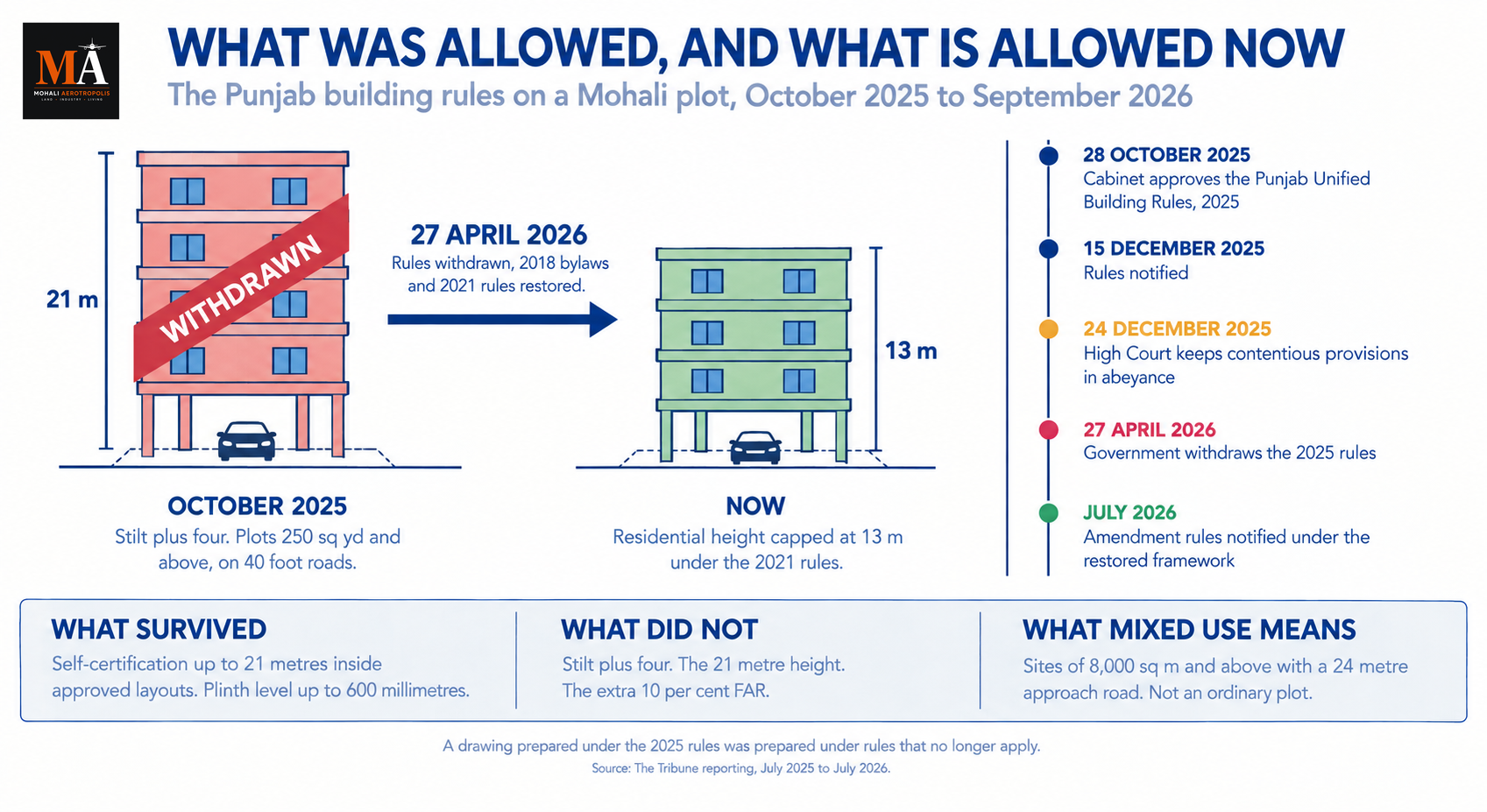
The Punjab Cabinet approved the Punjab Unified Building Rules, 2025 on 28 October 2025, and the government notified them on 15 December.
They were a substantial loosening. Stilt plus four floors were allowed on residential plots of 250 square yards and above along roads at least 40 feet wide, in newly built licensed colonies and urban estate sectors, with permissible height in new settlements raised from 15 metres to 21 metres. In old and existing urban areas, owners could build stilt plus three, with maximum height going from 11 metres to 13 metres. Plots up to 200 square yards needed a road at least 30 feet wide; above 200 square yards, 40 feet.
Floor area ratio went up too. An additional 10 per cent was allowed across all plot sizes, so that the owner of a 500 square yard plot could cover up to 65 per cent of the ground rather than 55. That increase was chargeable: 5 per cent of the collector rate for every 0.25 per cent of extra FAR, capped at 25 per cent of the collector rate.
Approvals were to be deemed. Empanelled architects would stamp and submit plans, which would then be treated as approved. Chief Minister Bhagwant Mann said this would help curb corruption in plan approvals.
The reception was not warm. Town planners and architects said the rules would lead to chaos and densification in urban areas. Former Chief Town Planner Gurpreet Singh said that while relaxing the norms, it would be more practical to conduct an infrastructure capacity audit, specific to each area and distinguishing old sectors from new ones. The government had already narrowed the scheme once, restricting stilt plus four to newly built licensed colonies and urban estate sectors after stakeholder feedback, to avoid overburdening existing civic infrastructure.
Change two: the reversal
On 24 December 2025, a Division Bench of the Punjab and Haryana High Court kept in abeyance those provisions of the 2025 rules that were inconsistent with the earlier rules and regulations, and directed that violations under the earlier norms not be regularised.
Days after the stay, the Housing Department clarified that the PUDA Building Rules, 2021 would apply while the litigation was pending, with only those provisions of the 2025 rules consistent with the 2021 norms in force. Stilt plus four in new sectors and stilt plus three in old sectors remained stayed.
The petitioners, Harbinder Singh Sekhon and Jasinder Sekhon, argued that the rules would lead to haphazard construction and unchecked densification of residential areas, that residents had not been adequately consulted, and that the advisory committee which drafted the rules was dominated by private developers. They maintained that such changes could be contemplated for areas yet to be developed, but not for localities where residents had already built under the existing rules. It was also pointed out that the rules allowed stilt plus four on residential plots along 40 foot roads, and up to 100 per cent ground coverage for certain commercial buildings in core areas.
After the stay, according to a senior government official, work on building plan approvals, compounding of violations and allied matters virtually came to a standstill.
On 27 April 2026, the government withdrew the Punjab Unified Building Rules, 2025 and restored the earlier framework. Construction in Punjab reverted to the Punjab Municipal Building Bylaws, 2018 and the Punjab Urban Planning and Development Building Rules, 2021.
The Tribune described it as the Housing Department's second major rollback after the withdrawal of the land pooling policy, both of which had been designed to generate quick revenue for the state.
So stilt plus four, as a general entitlement on a 250 square yard plot, is not the position. The Cabinet approved it in October 2025, and it was withdrawn six months later.
Change three: the 2026 amendment rules
With the 2021 rules restored, the government amended them instead.
The Punjab Urban Planning and Development Building (Amendment) Rules, 2026 were notified in July. For a plot owner, four provisions matter.
Residential height stays at 13 metres. The maximum permissible height for residential buildings remains 13 metres, with adjustments for how it is measured on elevated ground.
The plinth level rose. It may now be up to 600 millimetres above the crown of the adjoining road, with relaxations where a basement is provided.
Self-certification returned. Empanelled architects can self-certify building plans for all buildings up to 21 metres in height within approved layouts, irrespective of plot size or occupancy. SCOs and SCFs in approved layouts are covered where architectural controls are in place. The authority issues an auto-generated receipt, and the plan is deemed approved if no objection is raised within seven days. Random checks continue, and violations invite action against both the owner and the architect.
Mixed use is now defined, but not at plot scale. A mixed-use project is a single integrated development on one parcel, permitted on sites of at least 8,000 square metres with an approach road of at least 24 metres, at 45 per cent maximum ground coverage. It is a provision for township-scale developments, not for adding shops or offices to an ordinary residential plot.
Where that leaves a plot owner in Mohali
The governing rules are the 2021 rules as amended, and the 2018 bylaws. Not the 2025 unified rules. Anything written between October 2025 and April 2026 describing what you may build is describing a framework that no longer exists.
Stilt plus four is not a general entitlement. It was withdrawn. Any seller or agent still using it as a selling point for a plot is working from old information.
Residential height is capped at 13 metres, with the plinth allowed up to 600 millimetres.
Self-certification is available up to 21 metres inside approved layouts, which makes the approval route faster than it was, even though the building envelope is not larger.
A drawing prepared under the 2025 rules was prepared under rules that no longer apply. With three changes in under a year, one of them a reversal after a court stay, the date on any drawing or advice matters.
Punjab has now withdrawn two major real estate policies inside a year, the land pooling policy and the unified building rules. Both ran into opposition, and both were reversed after a court intervened.
---
Sources
- Punjab okays stilt-plus-4 floors in new urban areas, Ruchika Khanna, The Tribune, 29 October 2025, for the 250 square yard threshold, the 40 foot road condition, the restriction to newly constructed licensed colonies and urban estate sectors, the height increases, the additional 10 per cent FAR, the 65 per cent ground coverage example on a 500 square yard plot, the chargeable basis at 5 per cent of collector rate per 0.25 per cent of FAR capped at 25 per cent, and the Chief Minister's statement on deemed approval
- Punjab notifies unified building bylaws: Stilt-plus-four floors allowed in all new residential areas, Rajmeet Singh, The Tribune, 18 December 2025, for the Cabinet approval on 28 October, the notification, the road width thresholds for plots up to and above 200 square yards, stilt plus three in existing areas with height revised from 11 to 13 metres, and the criticism from town planners and architects
- Like Haryana, Punjab mulls stilt-plus-four floors, Rajmeet Singh, The Tribune, 31 July 2025, for the draft stage, the purchasable ground coverage at collector rates, and former Chief Town Planner Gurpreet Singh's call for an infrastructure capacity audit
- HC stays operation of contentious provisions of Punjab Unified Building Rules, 2025, The Tribune, December 2025, for the 15 December notification, the Division Bench's interim order keeping inconsistent provisions in abeyance, the direction on regularisation, and the petitioners' grounds
- Old building laws applicable till pendency of case, The Tribune, for the Housing Department's order that the PUDA Building Rules, 2021 would apply during the litigation and that stilt plus four and stilt plus three remained stayed
- Punjab withdraws 2025 building rules, reverts to old system, Rajmeet Singh, The Tribune, 28 April 2026, for the withdrawal of the 2025 rules, the restoration of the Punjab Municipal Building Bylaws 2018 and the Punjab Urban Planning and Development Building Rules 2021, the standstill in approvals after the stay, the 100 per cent ground coverage provision, and the earlier withdrawal of the land pooling policy
- Punjab notifies major amendments to building rules, promotes mixed-use projects, Rajmeet Singh, The Tribune, 16 July 2026, for the Punjab Urban Planning and Development Building (Amendment) Rules, 2026, the mixed-use site criteria, the 600 millimetre plinth level, the 13 metre residential height limit, self-certification up to 21 metres within approved layouts including SCOs and SCFs, the seven day deemed approval, and random checks
In October 2025, the Punjab Cabinet approved stilt plus four floors on residential plots in new urban areas. In April 2026, the government withdrew the rules that allowed it. In July, it amended the older rules it had gone back to.
Anyone who bought a plot in Mohali during that period on the strength of the October announcement bought it under rules that no longer apply.
Change one: the 2025 rules, and what they promised
The Punjab Cabinet approved the Punjab Unified Building Rules, 2025 on 28 October 2025, and the government notified them on 15 December.
They were a substantial loosening. Stilt plus four floors were allowed on residential plots of 250 square yards and above along roads at least 40 feet wide, in newly built licensed colonies and urban estate sectors, with permissible height in new settlements raised from 15 metres to 21 metres. In old and existing urban areas, owners could build stilt plus three, with maximum height going from 11 metres to 13 metres. Plots up to 200 square yards needed a road at least 30 feet wide; above 200 square yards, 40 feet.
Floor area ratio went up too. An additional 10 per cent was allowed across all plot sizes, so that the owner of a 500 square yard plot could cover up to 65 per cent of the ground rather than 55. That increase was chargeable: 5 per cent of the collector rate for every 0.25 per cent of extra FAR, capped at 25 per cent of the collector rate.
Approvals were to be deemed. Empanelled architects would stamp and submit plans, which would then be treated as approved. Chief Minister Bhagwant Mann said this would help curb corruption in plan approvals.
The reception was not warm. Town planners and architects said the rules would lead to chaos and densification in urban areas. Former Chief Town Planner Gurpreet Singh said that while relaxing the norms, it would be more practical to conduct an infrastructure capacity audit, specific to each area and distinguishing old sectors from new ones. The government had already narrowed the scheme once, restricting stilt plus four to newly built licensed colonies and urban estate sectors after stakeholder feedback, to avoid overburdening existing civic infrastructure.
Change two: the reversal
On 24 December 2025, a Division Bench of the Punjab and Haryana High Court kept in abeyance those provisions of the 2025 rules that were inconsistent with the earlier rules and regulations, and directed that violations under the earlier norms not be regularised.
Days after the stay, the Housing Department clarified that the PUDA Building Rules, 2021 would apply while the litigation was pending, with only those provisions of the 2025 rules consistent with the 2021 norms in force. Stilt plus four in new sectors and stilt plus three in old sectors remained stayed.
The petitioners, Harbinder Singh Sekhon and Jasinder Sekhon, argued that the rules would lead to haphazard construction and unchecked densification of residential areas, that residents had not been adequately consulted, and that the advisory committee which drafted the rules was dominated by private developers. They maintained that such changes could be contemplated for areas yet to be developed, but not for localities where residents had already built under the existing rules. It was also pointed out that the rules allowed stilt plus four on residential plots along 40 foot roads, and up to 100 per cent ground coverage for certain commercial buildings in core areas.
After the stay, according to a senior government official, work on building plan approvals, compounding of violations and allied matters virtually came to a standstill.
On 27 April 2026, the government withdrew the Punjab Unified Building Rules, 2025 and restored the earlier framework. Construction in Punjab reverted to the Punjab Municipal Building Bylaws, 2018 and the Punjab Urban Planning and Development Building Rules, 2021.
The Tribune described it as the Housing Department's second major rollback after the withdrawal of the land pooling policy, both of which had been designed to generate quick revenue for the state.
So stilt plus four, as a general entitlement on a 250 square yard plot, is not the position. The Cabinet approved it in October 2025, and it was withdrawn six months later.
Change three: the 2026 amendment rules
With the 2021 rules restored, the government amended them instead.
The Punjab Urban Planning and Development Building (Amendment) Rules, 2026 were notified in July. For a plot owner, four provisions matter.
Residential height stays at 13 metres. The maximum permissible height for residential buildings remains 13 metres, with adjustments for how it is measured on elevated ground.
The plinth level rose. It may now be up to 600 millimetres above the crown of the adjoining road, with relaxations where a basement is provided.
Self-certification returned. Empanelled architects can self-certify building plans for all buildings up to 21 metres in height within approved layouts, irrespective of plot size or occupancy. SCOs and SCFs in approved layouts are covered where architectural controls are in place. The authority issues an auto-generated receipt, and the plan is deemed approved if no objection is raised within seven days. Random checks continue, and violations invite action against both the owner and the architect.
Mixed use is now defined, but not at plot scale. A mixed-use project is a single integrated development on one parcel, permitted on sites of at least 8,000 square metres with an approach road of at least 24 metres, at 45 per cent maximum ground coverage. It is a provision for township-scale developments, not for adding shops or offices to an ordinary residential plot.
Where that leaves a plot owner in Mohali
The governing rules are the 2021 rules as amended, and the 2018 bylaws. Not the 2025 unified rules. Anything written between October 2025 and April 2026 describing what you may build is describing a framework that no longer exists.
Stilt plus four is not a general entitlement. It was withdrawn. Any seller or agent still using it as a selling point for a plot is working from old information.
Residential height is capped at 13 metres, with the plinth allowed up to 600 millimetres.
Self-certification is available up to 21 metres inside approved layouts, which makes the approval route faster than it was, even though the building envelope is not larger.
A drawing prepared under the 2025 rules was prepared under rules that no longer apply. With three changes in under a year, one of them a reversal after a court stay, the date on any drawing or advice matters.
Punjab has now withdrawn two major real estate policies inside a year, the land pooling policy and the unified building rules. Both ran into opposition, and both were reversed after a court intervened.
---
Sources
- Punjab okays stilt-plus-4 floors in new urban areas, Ruchika Khanna, The Tribune, 29 October 2025, for the 250 square yard threshold, the 40 foot road condition, the restriction to newly constructed licensed colonies and urban estate sectors, the height increases, the additional 10 per cent FAR, the 65 per cent ground coverage example on a 500 square yard plot, the chargeable basis at 5 per cent of collector rate per 0.25 per cent of FAR capped at 25 per cent, and the Chief Minister's statement on deemed approval
- Punjab notifies unified building bylaws: Stilt-plus-four floors allowed in all new residential areas, Rajmeet Singh, The Tribune, 18 December 2025, for the Cabinet approval on 28 October, the notification, the road width thresholds for plots up to and above 200 square yards, stilt plus three in existing areas with height revised from 11 to 13 metres, and the criticism from town planners and architects
- Like Haryana, Punjab mulls stilt-plus-four floors, Rajmeet Singh, The Tribune, 31 July 2025, for the draft stage, the purchasable ground coverage at collector rates, and former Chief Town Planner Gurpreet Singh's call for an infrastructure capacity audit
- HC stays operation of contentious provisions of Punjab Unified Building Rules, 2025, The Tribune, December 2025, for the 15 December notification, the Division Bench's interim order keeping inconsistent provisions in abeyance, the direction on regularisation, and the petitioners' grounds
- Old building laws applicable till pendency of case, The Tribune, for the Housing Department's order that the PUDA Building Rules, 2021 would apply during the litigation and that stilt plus four and stilt plus three remained stayed
- Punjab withdraws 2025 building rules, reverts to old system, Rajmeet Singh, The Tribune, 28 April 2026, for the withdrawal of the 2025 rules, the restoration of the Punjab Municipal Building Bylaws 2018 and the Punjab Urban Planning and Development Building Rules 2021, the standstill in approvals after the stay, the 100 per cent ground coverage provision, and the earlier withdrawal of the land pooling policy
- Punjab notifies major amendments to building rules, promotes mixed-use projects, Rajmeet Singh, The Tribune, 16 July 2026, for the Punjab Urban Planning and Development Building (Amendment) Rules, 2026, the mixed-use site criteria, the 600 millimetre plinth level, the 13 metre residential height limit, self-certification up to 21 metres within approved layouts including SCOs and SCFs, the seven day deemed approval, and random checks
In October 2025, the Punjab Cabinet approved stilt plus four floors on residential plots in new urban areas. In April 2026, the government withdrew the rules that allowed it. In July, it amended the older rules it had gone back to.
Anyone who bought a plot in Mohali during that period on the strength of the October announcement bought it under rules that no longer apply.
Change one: the 2025 rules, and what they promised
The Punjab Cabinet approved the Punjab Unified Building Rules, 2025 on 28 October 2025, and the government notified them on 15 December.
They were a substantial loosening. Stilt plus four floors were allowed on residential plots of 250 square yards and above along roads at least 40 feet wide, in newly built licensed colonies and urban estate sectors, with permissible height in new settlements raised from 15 metres to 21 metres. In old and existing urban areas, owners could build stilt plus three, with maximum height going from 11 metres to 13 metres. Plots up to 200 square yards needed a road at least 30 feet wide; above 200 square yards, 40 feet.
Floor area ratio went up too. An additional 10 per cent was allowed across all plot sizes, so that the owner of a 500 square yard plot could cover up to 65 per cent of the ground rather than 55. That increase was chargeable: 5 per cent of the collector rate for every 0.25 per cent of extra FAR, capped at 25 per cent of the collector rate.
Approvals were to be deemed. Empanelled architects would stamp and submit plans, which would then be treated as approved. Chief Minister Bhagwant Mann said this would help curb corruption in plan approvals.
The reception was not warm. Town planners and architects said the rules would lead to chaos and densification in urban areas. Former Chief Town Planner Gurpreet Singh said that while relaxing the norms, it would be more practical to conduct an infrastructure capacity audit, specific to each area and distinguishing old sectors from new ones. The government had already narrowed the scheme once, restricting stilt plus four to newly built licensed colonies and urban estate sectors after stakeholder feedback, to avoid overburdening existing civic infrastructure.
Change two: the reversal
On 24 December 2025, a Division Bench of the Punjab and Haryana High Court kept in abeyance those provisions of the 2025 rules that were inconsistent with the earlier rules and regulations, and directed that violations under the earlier norms not be regularised.
Days after the stay, the Housing Department clarified that the PUDA Building Rules, 2021 would apply while the litigation was pending, with only those provisions of the 2025 rules consistent with the 2021 norms in force. Stilt plus four in new sectors and stilt plus three in old sectors remained stayed.
The petitioners, Harbinder Singh Sekhon and Jasinder Sekhon, argued that the rules would lead to haphazard construction and unchecked densification of residential areas, that residents had not been adequately consulted, and that the advisory committee which drafted the rules was dominated by private developers. They maintained that such changes could be contemplated for areas yet to be developed, but not for localities where residents had already built under the existing rules. It was also pointed out that the rules allowed stilt plus four on residential plots along 40 foot roads, and up to 100 per cent ground coverage for certain commercial buildings in core areas.
After the stay, according to a senior government official, work on building plan approvals, compounding of violations and allied matters virtually came to a standstill.
On 27 April 2026, the government withdrew the Punjab Unified Building Rules, 2025 and restored the earlier framework. Construction in Punjab reverted to the Punjab Municipal Building Bylaws, 2018 and the Punjab Urban Planning and Development Building Rules, 2021.
The Tribune described it as the Housing Department's second major rollback after the withdrawal of the land pooling policy, both of which had been designed to generate quick revenue for the state.
So stilt plus four, as a general entitlement on a 250 square yard plot, is not the position. The Cabinet approved it in October 2025, and it was withdrawn six months later.
Change three: the 2026 amendment rules
With the 2021 rules restored, the government amended them instead.
The Punjab Urban Planning and Development Building (Amendment) Rules, 2026 were notified in July. For a plot owner, four provisions matter.
Residential height stays at 13 metres. The maximum permissible height for residential buildings remains 13 metres, with adjustments for how it is measured on elevated ground.
The plinth level rose. It may now be up to 600 millimetres above the crown of the adjoining road, with relaxations where a basement is provided.
Self-certification returned. Empanelled architects can self-certify building plans for all buildings up to 21 metres in height within approved layouts, irrespective of plot size or occupancy. SCOs and SCFs in approved layouts are covered where architectural controls are in place. The authority issues an auto-generated receipt, and the plan is deemed approved if no objection is raised within seven days. Random checks continue, and violations invite action against both the owner and the architect.
Mixed use is now defined, but not at plot scale. A mixed-use project is a single integrated development on one parcel, permitted on sites of at least 8,000 square metres with an approach road of at least 24 metres, at 45 per cent maximum ground coverage. It is a provision for township-scale developments, not for adding shops or offices to an ordinary residential plot.
Where that leaves a plot owner in Mohali
The governing rules are the 2021 rules as amended, and the 2018 bylaws. Not the 2025 unified rules. Anything written between October 2025 and April 2026 describing what you may build is describing a framework that no longer exists.
Stilt plus four is not a general entitlement. It was withdrawn. Any seller or agent still using it as a selling point for a plot is working from old information.
Residential height is capped at 13 metres, with the plinth allowed up to 600 millimetres.
Self-certification is available up to 21 metres inside approved layouts, which makes the approval route faster than it was, even though the building envelope is not larger.
A drawing prepared under the 2025 rules was prepared under rules that no longer apply. With three changes in under a year, one of them a reversal after a court stay, the date on any drawing or advice matters.
Punjab has now withdrawn two major real estate policies inside a year, the land pooling policy and the unified building rules. Both ran into opposition, and both were reversed after a court intervened.
---
Sources
- Punjab okays stilt-plus-4 floors in new urban areas, Ruchika Khanna, The Tribune, 29 October 2025, for the 250 square yard threshold, the 40 foot road condition, the restriction to newly constructed licensed colonies and urban estate sectors, the height increases, the additional 10 per cent FAR, the 65 per cent ground coverage example on a 500 square yard plot, the chargeable basis at 5 per cent of collector rate per 0.25 per cent of FAR capped at 25 per cent, and the Chief Minister's statement on deemed approval
- Punjab notifies unified building bylaws: Stilt-plus-four floors allowed in all new residential areas, Rajmeet Singh, The Tribune, 18 December 2025, for the Cabinet approval on 28 October, the notification, the road width thresholds for plots up to and above 200 square yards, stilt plus three in existing areas with height revised from 11 to 13 metres, and the criticism from town planners and architects
- Like Haryana, Punjab mulls stilt-plus-four floors, Rajmeet Singh, The Tribune, 31 July 2025, for the draft stage, the purchasable ground coverage at collector rates, and former Chief Town Planner Gurpreet Singh's call for an infrastructure capacity audit
- HC stays operation of contentious provisions of Punjab Unified Building Rules, 2025, The Tribune, December 2025, for the 15 December notification, the Division Bench's interim order keeping inconsistent provisions in abeyance, the direction on regularisation, and the petitioners' grounds
- Old building laws applicable till pendency of case, The Tribune, for the Housing Department's order that the PUDA Building Rules, 2021 would apply during the litigation and that stilt plus four and stilt plus three remained stayed
- Punjab withdraws 2025 building rules, reverts to old system, Rajmeet Singh, The Tribune, 28 April 2026, for the withdrawal of the 2025 rules, the restoration of the Punjab Municipal Building Bylaws 2018 and the Punjab Urban Planning and Development Building Rules 2021, the standstill in approvals after the stay, the 100 per cent ground coverage provision, and the earlier withdrawal of the land pooling policy
- Punjab notifies major amendments to building rules, promotes mixed-use projects, Rajmeet Singh, The Tribune, 16 July 2026, for the Punjab Urban Planning and Development Building (Amendment) Rules, 2026, the mixed-use site criteria, the 600 millimetre plinth level, the 13 metre residential height limit, self-certification up to 21 metres within approved layouts including SCOs and SCFs, the seven day deemed approval, and random checks