

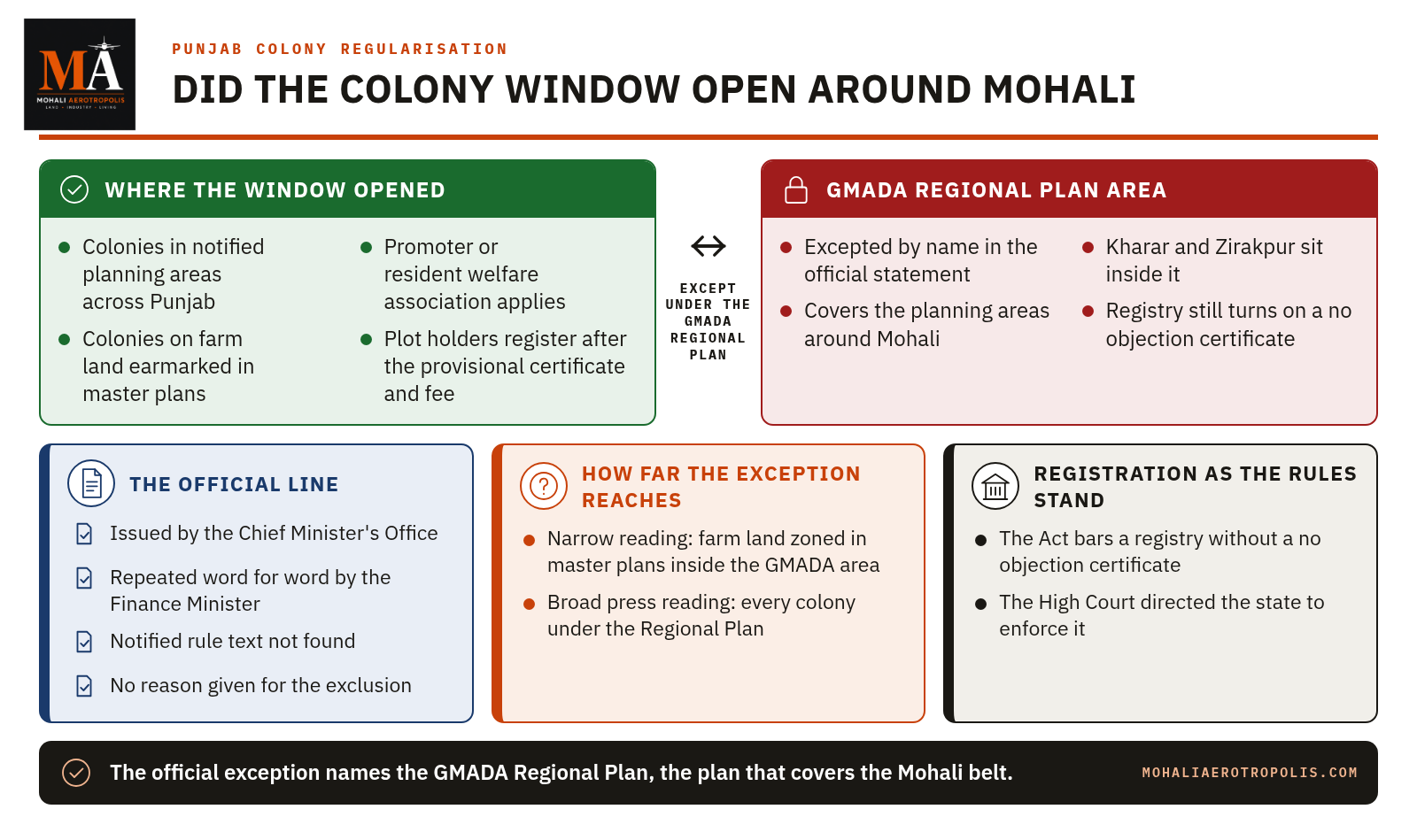
In July, headlines across Punjab said the state would regularise unauthorised colonies, with applications open until the end of September. Many owners of colony plots in the belt from Kharar to Zirakpur read that as their turn. On the official wording, it was not. The government's own statement on the change carved out colonies falling under the Regional Plan of GMADA, and that plan is the one that covers the Mohali belt. The window opened elsewhere in the state. Around Mohali it did not open in the same way, and for plots the exception covers, registration was left where it stood before July.
What the cabinet changed in July
The Punjab cabinet approved an amendment to the rule on compounding unauthorised colonies in the Punjab Apartment and Property Regulation Rules. The aim, in the government's words, was to simplify regularisation for eligible colonies across the state.
Under the change, a colony qualified once a set share of its plots had already been built on. Either the promoter or the resident welfare association could apply. Colonies turned down under earlier regularisation policies were allowed to apply again. Applications had to be in by the end of September.
The payoff for individual owners came after the colony stage. Once a colony received a provisional regularisation certificate and the prescribed fee was paid, plot holders became eligible for regularisation certificates for their own plots and for building approvals under the prevailing rules. They could also register their plots after paying the fee.
The exact line that leaves out the GMADA area
The statement issued by the Chief Minister's Office on the day of the cabinet meeting contains this sentence:
"The amended provisions will also apply to eligible colonies situated within notified Local Planning Areas and on agricultural land earmarked under Master Plans, except those falling under the Regional Plan of GMADA."
The Indian Express reported Finance Minister Harpal Singh Cheema saying the same thing in identical words, and Babushahi carried the statement in full. The Tribune reported it in near identical words the next morning, and the Hindustan Times summarised it more broadly.
We could not open the Punjab government's own press release page or find the notified text of the amended rule. The line above is the official wording as the state's statement put it and as reputable outlets quoted it within hours.
Why the Mohali belt sits under that plan
The GMADA Regional Plan is the Greater Mohali Region Master Plan, the document that sits above the individual town master plans around Chandigarh. It covers the Local Planning Areas of SAS Nagar, Zirakpur, Kharar, Mullanpur, Banur and Derabassi. The town master plans for Mohali, New Chandigarh, Zirakpur, Derabassi, Banur and Kharar came in under it.
That matters because of where the exclusion falls. The statement extended the amended provisions to colonies inside notified Local Planning Areas and on farm land earmarked in master plans, and then made its exception. The towns around Mohali are themselves Local Planning Areas inside the Regional Plan. So the extension that reached planning areas elsewhere in Punjab came with an exception naming the plan that covers this belt.
What the line says and what it leaves open
Read closely, the exception is tied to the extension. It says the amended provisions will also reach colonies in planning areas and on master plan farm land, except those under the GMADA Regional Plan. It does not say in so many words that every colony anywhere in the GMADA area was kept out of every part of the amended rule.
There is a narrower reading still. The exception comes straight after the words about farm land earmarked under master plans, so it can be read as qualifying only that land. On that reading, colonies on farm land zoned in a master plan inside the GMADA area were left out. The sentence says nothing either way about other colonies there.
The Hindustan Times read it broadly, reporting that colonies falling under the GMADA Regional Plan would remain outside the ambit of the amended rules. That is the paper's summary. The official sentence itself is narrower in form.
Without the notified text we cannot say which reading the rule adopts. What holds on every reading is that the GMADA Regional Plan was the one area the official statement singled out for exclusion. The government gave no reason for it, and we have not found one since.
The rule already kept colonies near Chandigarh out
The GMADA area was already treated differently in the rule itself. When the housing department rewrote the same rule in an earlier amendment, it listed places where "compounding of offence and regularization of unauthorized colony shall not be considered by the competent authority". The first of them was any colony within a set distance of the outer boundary of the Union Territory of Chandigarh. Mohali adjoins Chandigarh.
The July reports do not say whether that clause survived the change. Either way, colonies near Chandigarh were already carved out before July. The official statement on the July change then carved out the GMADA Regional Plan area by name.
Registration still turns on a no objection certificate
The question most owners care about is whether they can register the plot. The Punjab Apartment and Property Regulation Act bars the registration of a sale deed for a plot in an unauthorised colony unless a no objection certificate from the competent authority is produced.
An amendment to the Act had allowed some smaller plots in unauthorised colonies to be registered without that certificate, where the parties held an agreement or power of attorney signed before a cut off date. The High Court then directed the state, in a public interest case, to enforce the certificate requirement in the Act. The government stopped registering such plots without the certificate soon after, as The Tribune reported.
The July change offered owners elsewhere a way past that bar: once the colony was provisionally regularised and the fee paid, plot holders could register. Where the GMADA exception applies, that route was closed. Registration of a plot in an unauthorised colony there rests on the certificate requirement as it stood before July.
Where that leaves a plot around Mohali now
Applications under the amended rule closed at the end of September. We found no official statement since July setting out a separate route for colonies under the GMADA Regional Plan.
Our earlier coverage of the June announcement reported the Chief Minister's promise that relief would apply uniformly across Punjab and would reach the colony belts on the Mohali periphery. The July detail narrowed that promise for the GMADA area.
Whether a given colony falls inside the Regional Plan depends on its exact location on the plan, and the GMADA planning office is the place that can confirm it for a particular plot.
What the record establishes
The official statement extended Punjab's regularisation relief to colonies in planning areas and on master plan farm land, and it excepted those falling under the Regional Plan of GMADA. The towns of the Mohali belt, Kharar and Zirakpur among them, lie under that plan. So the window that closed at the end of September did not reach colonies there in the way it reached the rest of the state. How far the exception runs inside the GMADA area turns on the notified text, which we have not seen.
Outside a completed regularisation, registering a plot in an unauthorised colony still depends on a no objection certificate from the competent authority.
Related reading
- Punjab promises a new relief policy for unauthorised colony buyers
- What the GMADA Regional Plan assigned each town
- Housing societies around Mohali and who approves them
- Two ED actions against tricity builders and what they mean for unlicensed colonies
Sources
- Babushahi Bureau, Bhagwant Singh Mann-led Cabinet Approves Amendment to Regularise Unauthorised Colonies across Punjab, 2 July 2026, carrying the Chief Minister's Office statement including the exclusion sentence quoted above. Report
- The Indian Express, Punjab clears proposal to regularise illegal colonies, tweaks land pooling policy, 3 July 2026, attributing the same sentence word for word to Finance Minister Harpal Singh Cheema. Report
- The Tribune, Punjab Cabinet simplifies norms for regularising illegal colonies, 3 July 2026. Report
- Hindustan Times, Punjab cabinet approves amendment to regularise unauthorised colonies, 3 July 2026. Report
- Hindustan Times, Punjab's new policy targets 5,000 unauthorised colonies, 7 July 2026, reporting that the amended rules were expected to be notified that week. Report
- Government of Punjab, Department of Housing and Urban Development, notification G.S.R. 71 of 2022 dated 18 October 2022, Punjab Apartment and Property Regulation Amendment Rules 2022, substituting rule 31, clause j on colonies within sixteen kilometres of the outer boundary of Chandigarh. Text
- Amar Ujala, report on the draft Kurali master plan, 3 July 2026, on the town master plans brought in under the 2009 GMADA Regional Plan. Report
- Hindustan Times, Ensure no property registration sans NoC, high court tells Punjab, 21 March 2025, on section 20 of the Punjab Apartment and Property Regulation Act, 1995 and the 2024 amendment. Report
- The Tribune, Govt stalls registration of plots without NOC, 13 May 2025. Report
This explains what the official statements and published rules say about colonies around Mohali and is not legal advice. The position of any single plot turns on its own location and papers.
In July, headlines across Punjab said the state would regularise unauthorised colonies, with applications open until the end of September. Many owners of colony plots in the belt from Kharar to Zirakpur read that as their turn. On the official wording, it was not. The government's own statement on the change carved out colonies falling under the Regional Plan of GMADA, and that plan is the one that covers the Mohali belt. The window opened elsewhere in the state. Around Mohali it did not open in the same way, and for plots the exception covers, registration was left where it stood before July.
What the cabinet changed in July
The Punjab cabinet approved an amendment to the rule on compounding unauthorised colonies in the Punjab Apartment and Property Regulation Rules. The aim, in the government's words, was to simplify regularisation for eligible colonies across the state.
Under the change, a colony qualified once a set share of its plots had already been built on. Either the promoter or the resident welfare association could apply. Colonies turned down under earlier regularisation policies were allowed to apply again. Applications had to be in by the end of September.
The payoff for individual owners came after the colony stage. Once a colony received a provisional regularisation certificate and the prescribed fee was paid, plot holders became eligible for regularisation certificates for their own plots and for building approvals under the prevailing rules. They could also register their plots after paying the fee.
The exact line that leaves out the GMADA area
The statement issued by the Chief Minister's Office on the day of the cabinet meeting contains this sentence:
"The amended provisions will also apply to eligible colonies situated within notified Local Planning Areas and on agricultural land earmarked under Master Plans, except those falling under the Regional Plan of GMADA."
The Indian Express reported Finance Minister Harpal Singh Cheema saying the same thing in identical words, and Babushahi carried the statement in full. The Tribune reported it in near identical words the next morning, and the Hindustan Times summarised it more broadly.
We could not open the Punjab government's own press release page or find the notified text of the amended rule. The line above is the official wording as the state's statement put it and as reputable outlets quoted it within hours.
Why the Mohali belt sits under that plan
The GMADA Regional Plan is the Greater Mohali Region Master Plan, the document that sits above the individual town master plans around Chandigarh. It covers the Local Planning Areas of SAS Nagar, Zirakpur, Kharar, Mullanpur, Banur and Derabassi. The town master plans for Mohali, New Chandigarh, Zirakpur, Derabassi, Banur and Kharar came in under it.
That matters because of where the exclusion falls. The statement extended the amended provisions to colonies inside notified Local Planning Areas and on farm land earmarked in master plans, and then made its exception. The towns around Mohali are themselves Local Planning Areas inside the Regional Plan. So the extension that reached planning areas elsewhere in Punjab came with an exception naming the plan that covers this belt.
What the line says and what it leaves open
Read closely, the exception is tied to the extension. It says the amended provisions will also reach colonies in planning areas and on master plan farm land, except those under the GMADA Regional Plan. It does not say in so many words that every colony anywhere in the GMADA area was kept out of every part of the amended rule.
There is a narrower reading still. The exception comes straight after the words about farm land earmarked under master plans, so it can be read as qualifying only that land. On that reading, colonies on farm land zoned in a master plan inside the GMADA area were left out. The sentence says nothing either way about other colonies there.
The Hindustan Times read it broadly, reporting that colonies falling under the GMADA Regional Plan would remain outside the ambit of the amended rules. That is the paper's summary. The official sentence itself is narrower in form.
Without the notified text we cannot say which reading the rule adopts. What holds on every reading is that the GMADA Regional Plan was the one area the official statement singled out for exclusion. The government gave no reason for it, and we have not found one since.
The rule already kept colonies near Chandigarh out
The GMADA area was already treated differently in the rule itself. When the housing department rewrote the same rule in an earlier amendment, it listed places where "compounding of offence and regularization of unauthorized colony shall not be considered by the competent authority". The first of them was any colony within a set distance of the outer boundary of the Union Territory of Chandigarh. Mohali adjoins Chandigarh.
The July reports do not say whether that clause survived the change. Either way, colonies near Chandigarh were already carved out before July. The official statement on the July change then carved out the GMADA Regional Plan area by name.
Registration still turns on a no objection certificate
The question most owners care about is whether they can register the plot. The Punjab Apartment and Property Regulation Act bars the registration of a sale deed for a plot in an unauthorised colony unless a no objection certificate from the competent authority is produced.
An amendment to the Act had allowed some smaller plots in unauthorised colonies to be registered without that certificate, where the parties held an agreement or power of attorney signed before a cut off date. The High Court then directed the state, in a public interest case, to enforce the certificate requirement in the Act. The government stopped registering such plots without the certificate soon after, as The Tribune reported.
The July change offered owners elsewhere a way past that bar: once the colony was provisionally regularised and the fee paid, plot holders could register. Where the GMADA exception applies, that route was closed. Registration of a plot in an unauthorised colony there rests on the certificate requirement as it stood before July.
Where that leaves a plot around Mohali now
Applications under the amended rule closed at the end of September. We found no official statement since July setting out a separate route for colonies under the GMADA Regional Plan.
Our earlier coverage of the June announcement reported the Chief Minister's promise that relief would apply uniformly across Punjab and would reach the colony belts on the Mohali periphery. The July detail narrowed that promise for the GMADA area.
Whether a given colony falls inside the Regional Plan depends on its exact location on the plan, and the GMADA planning office is the place that can confirm it for a particular plot.
What the record establishes
The official statement extended Punjab's regularisation relief to colonies in planning areas and on master plan farm land, and it excepted those falling under the Regional Plan of GMADA. The towns of the Mohali belt, Kharar and Zirakpur among them, lie under that plan. So the window that closed at the end of September did not reach colonies there in the way it reached the rest of the state. How far the exception runs inside the GMADA area turns on the notified text, which we have not seen.
Outside a completed regularisation, registering a plot in an unauthorised colony still depends on a no objection certificate from the competent authority.
Related reading
- Punjab promises a new relief policy for unauthorised colony buyers
- What the GMADA Regional Plan assigned each town
- Housing societies around Mohali and who approves them
- Two ED actions against tricity builders and what they mean for unlicensed colonies
Sources
- Babushahi Bureau, Bhagwant Singh Mann-led Cabinet Approves Amendment to Regularise Unauthorised Colonies across Punjab, 2 July 2026, carrying the Chief Minister's Office statement including the exclusion sentence quoted above. Report
- The Indian Express, Punjab clears proposal to regularise illegal colonies, tweaks land pooling policy, 3 July 2026, attributing the same sentence word for word to Finance Minister Harpal Singh Cheema. Report
- The Tribune, Punjab Cabinet simplifies norms for regularising illegal colonies, 3 July 2026. Report
- Hindustan Times, Punjab cabinet approves amendment to regularise unauthorised colonies, 3 July 2026. Report
- Hindustan Times, Punjab's new policy targets 5,000 unauthorised colonies, 7 July 2026, reporting that the amended rules were expected to be notified that week. Report
- Government of Punjab, Department of Housing and Urban Development, notification G.S.R. 71 of 2022 dated 18 October 2022, Punjab Apartment and Property Regulation Amendment Rules 2022, substituting rule 31, clause j on colonies within sixteen kilometres of the outer boundary of Chandigarh. Text
- Amar Ujala, report on the draft Kurali master plan, 3 July 2026, on the town master plans brought in under the 2009 GMADA Regional Plan. Report
- Hindustan Times, Ensure no property registration sans NoC, high court tells Punjab, 21 March 2025, on section 20 of the Punjab Apartment and Property Regulation Act, 1995 and the 2024 amendment. Report
- The Tribune, Govt stalls registration of plots without NOC, 13 May 2025. Report
This explains what the official statements and published rules say about colonies around Mohali and is not legal advice. The position of any single plot turns on its own location and papers.
In July, headlines across Punjab said the state would regularise unauthorised colonies, with applications open until the end of September. Many owners of colony plots in the belt from Kharar to Zirakpur read that as their turn. On the official wording, it was not. The government's own statement on the change carved out colonies falling under the Regional Plan of GMADA, and that plan is the one that covers the Mohali belt. The window opened elsewhere in the state. Around Mohali it did not open in the same way, and for plots the exception covers, registration was left where it stood before July.
What the cabinet changed in July
The Punjab cabinet approved an amendment to the rule on compounding unauthorised colonies in the Punjab Apartment and Property Regulation Rules. The aim, in the government's words, was to simplify regularisation for eligible colonies across the state.
Under the change, a colony qualified once a set share of its plots had already been built on. Either the promoter or the resident welfare association could apply. Colonies turned down under earlier regularisation policies were allowed to apply again. Applications had to be in by the end of September.
The payoff for individual owners came after the colony stage. Once a colony received a provisional regularisation certificate and the prescribed fee was paid, plot holders became eligible for regularisation certificates for their own plots and for building approvals under the prevailing rules. They could also register their plots after paying the fee.
The exact line that leaves out the GMADA area
The statement issued by the Chief Minister's Office on the day of the cabinet meeting contains this sentence:
"The amended provisions will also apply to eligible colonies situated within notified Local Planning Areas and on agricultural land earmarked under Master Plans, except those falling under the Regional Plan of GMADA."
The Indian Express reported Finance Minister Harpal Singh Cheema saying the same thing in identical words, and Babushahi carried the statement in full. The Tribune reported it in near identical words the next morning, and the Hindustan Times summarised it more broadly.
We could not open the Punjab government's own press release page or find the notified text of the amended rule. The line above is the official wording as the state's statement put it and as reputable outlets quoted it within hours.
Why the Mohali belt sits under that plan
The GMADA Regional Plan is the Greater Mohali Region Master Plan, the document that sits above the individual town master plans around Chandigarh. It covers the Local Planning Areas of SAS Nagar, Zirakpur, Kharar, Mullanpur, Banur and Derabassi. The town master plans for Mohali, New Chandigarh, Zirakpur, Derabassi, Banur and Kharar came in under it.
That matters because of where the exclusion falls. The statement extended the amended provisions to colonies inside notified Local Planning Areas and on farm land earmarked in master plans, and then made its exception. The towns around Mohali are themselves Local Planning Areas inside the Regional Plan. So the extension that reached planning areas elsewhere in Punjab came with an exception naming the plan that covers this belt.
What the line says and what it leaves open
Read closely, the exception is tied to the extension. It says the amended provisions will also reach colonies in planning areas and on master plan farm land, except those under the GMADA Regional Plan. It does not say in so many words that every colony anywhere in the GMADA area was kept out of every part of the amended rule.
There is a narrower reading still. The exception comes straight after the words about farm land earmarked under master plans, so it can be read as qualifying only that land. On that reading, colonies on farm land zoned in a master plan inside the GMADA area were left out. The sentence says nothing either way about other colonies there.
The Hindustan Times read it broadly, reporting that colonies falling under the GMADA Regional Plan would remain outside the ambit of the amended rules. That is the paper's summary. The official sentence itself is narrower in form.
Without the notified text we cannot say which reading the rule adopts. What holds on every reading is that the GMADA Regional Plan was the one area the official statement singled out for exclusion. The government gave no reason for it, and we have not found one since.
The rule already kept colonies near Chandigarh out
The GMADA area was already treated differently in the rule itself. When the housing department rewrote the same rule in an earlier amendment, it listed places where "compounding of offence and regularization of unauthorized colony shall not be considered by the competent authority". The first of them was any colony within a set distance of the outer boundary of the Union Territory of Chandigarh. Mohali adjoins Chandigarh.
The July reports do not say whether that clause survived the change. Either way, colonies near Chandigarh were already carved out before July. The official statement on the July change then carved out the GMADA Regional Plan area by name.
Registration still turns on a no objection certificate
The question most owners care about is whether they can register the plot. The Punjab Apartment and Property Regulation Act bars the registration of a sale deed for a plot in an unauthorised colony unless a no objection certificate from the competent authority is produced.
An amendment to the Act had allowed some smaller plots in unauthorised colonies to be registered without that certificate, where the parties held an agreement or power of attorney signed before a cut off date. The High Court then directed the state, in a public interest case, to enforce the certificate requirement in the Act. The government stopped registering such plots without the certificate soon after, as The Tribune reported.
The July change offered owners elsewhere a way past that bar: once the colony was provisionally regularised and the fee paid, plot holders could register. Where the GMADA exception applies, that route was closed. Registration of a plot in an unauthorised colony there rests on the certificate requirement as it stood before July.
Where that leaves a plot around Mohali now
Applications under the amended rule closed at the end of September. We found no official statement since July setting out a separate route for colonies under the GMADA Regional Plan.
Our earlier coverage of the June announcement reported the Chief Minister's promise that relief would apply uniformly across Punjab and would reach the colony belts on the Mohali periphery. The July detail narrowed that promise for the GMADA area.
Whether a given colony falls inside the Regional Plan depends on its exact location on the plan, and the GMADA planning office is the place that can confirm it for a particular plot.
What the record establishes
The official statement extended Punjab's regularisation relief to colonies in planning areas and on master plan farm land, and it excepted those falling under the Regional Plan of GMADA. The towns of the Mohali belt, Kharar and Zirakpur among them, lie under that plan. So the window that closed at the end of September did not reach colonies there in the way it reached the rest of the state. How far the exception runs inside the GMADA area turns on the notified text, which we have not seen.
Outside a completed regularisation, registering a plot in an unauthorised colony still depends on a no objection certificate from the competent authority.
Related reading
- Punjab promises a new relief policy for unauthorised colony buyers
- What the GMADA Regional Plan assigned each town
- Housing societies around Mohali and who approves them
- Two ED actions against tricity builders and what they mean for unlicensed colonies
Sources
- Babushahi Bureau, Bhagwant Singh Mann-led Cabinet Approves Amendment to Regularise Unauthorised Colonies across Punjab, 2 July 2026, carrying the Chief Minister's Office statement including the exclusion sentence quoted above. Report
- The Indian Express, Punjab clears proposal to regularise illegal colonies, tweaks land pooling policy, 3 July 2026, attributing the same sentence word for word to Finance Minister Harpal Singh Cheema. Report
- The Tribune, Punjab Cabinet simplifies norms for regularising illegal colonies, 3 July 2026. Report
- Hindustan Times, Punjab cabinet approves amendment to regularise unauthorised colonies, 3 July 2026. Report
- Hindustan Times, Punjab's new policy targets 5,000 unauthorised colonies, 7 July 2026, reporting that the amended rules were expected to be notified that week. Report
- Government of Punjab, Department of Housing and Urban Development, notification G.S.R. 71 of 2022 dated 18 October 2022, Punjab Apartment and Property Regulation Amendment Rules 2022, substituting rule 31, clause j on colonies within sixteen kilometres of the outer boundary of Chandigarh. Text
- Amar Ujala, report on the draft Kurali master plan, 3 July 2026, on the town master plans brought in under the 2009 GMADA Regional Plan. Report
- Hindustan Times, Ensure no property registration sans NoC, high court tells Punjab, 21 March 2025, on section 20 of the Punjab Apartment and Property Regulation Act, 1995 and the 2024 amendment. Report
- The Tribune, Govt stalls registration of plots without NOC, 13 May 2025. Report
This explains what the official statements and published rules say about colonies around Mohali and is not legal advice. The position of any single plot turns on its own location and papers.