
Punjab Has Been on the Verge of a Semiconductor Future for Fifty Years
In April 2026, Punjab Chief Minister Bhagwant Singh Mann sat across from NXP Semiconductors leadership in Eindhoven and made his pitch. Come to Mohali, set up an R&D centre, join India's chip story. NXP is a Dutch giant whose automotive chips sit inside a large share of the world's cars, and its executives listened. They were invited to visit Punjab and assess the ground. No commitment followed.
It was a good meeting. It may yet turn into something. But it was also a familiar kind of moment for this region, because Punjab has been one meeting or one announcement away from a semiconductor future for half a century.
The gap between ambition and outcome has a long history here. Long enough that it is worth reading clearly before the next chapter gets written.
1976: The Dream Is Born in Mohali
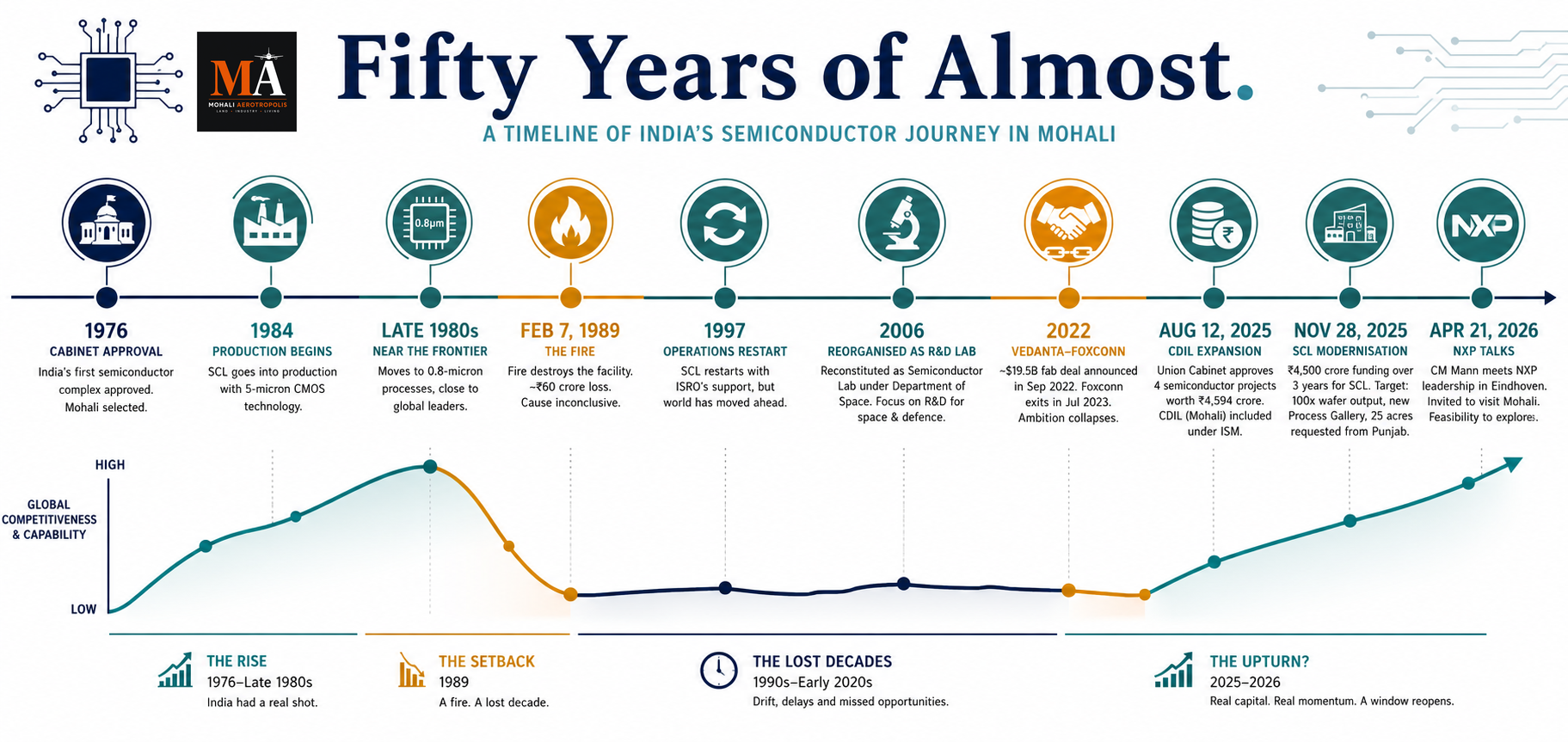
It began under Indira Gandhi. In 1976 the Union Cabinet approved India's first semiconductor complex, and a technical committee narrowed twenty-two candidate sites down to four: Navi Mumbai, Tambaram near Chennai, Bhubaneswar, and Mohali.
Then Punjab Chief Minister Giani Zail Singh offered 51 acres of Mohali land to the project for a token one rupee. Mohali won. Semiconductor Complex Limited, or SCL, was incorporated and went into production in 1984 using 5-micron CMOS technology under a collaboration with American Microsystems.
By the late 1980s SCL had moved to 0.8-micron processes, barely a year or two behind global leaders like Intel. At that point Taiwan and China had not yet become serious chip manufacturers. India's only fab was in Mohali, and it was genuinely competitive.
February 1989: The Fire
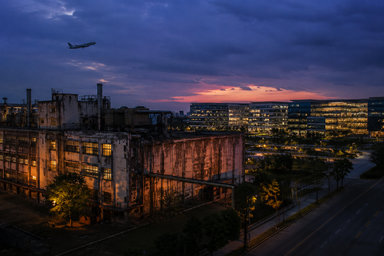
On the night of 7 February 1989, a fire broke out at SCL's Mohali facility and burned through the production lines. Imported equipment and infrastructure, estimated in most accounts at around ₹60 crore, was destroyed.
The Intelligence Bureau was called in and its probe came back inconclusive. The fire had started at several points at once, which fuelled suspicion of sabotage, but no one was ever charged. One official panel later attributed it to mismanagement and possible accident rather than external sabotage. The cause was never settled.
The consequence was settled. India lost its only chip fab at the moment it had reached near-parity with the frontier. TSMC, founded just two years earlier, was finding its feet, and Samsung was ramping hard. India, briefly at the table, was now out of the room.
1989 to 2006: Seventeen Years of Drift
SCL's recovery took the better part of a decade. Operations resumed in 1997 with ISRO's support, but by then the world had moved into deep submicron territory and SCL was several generations behind.
In 2000 the government tried to bring in commercial momentum by selling part of SCL's equity to private investors. Talks broke down over terms and no deal was signed. By the mid-2000s accumulated losses had eroded a large share of the company's net worth.
In 2006 the facility was reorganised as a society under the Department of Space, formally renamed Semiconductor Lab, and repositioned as an R&D unit for space and defence. A plant that had once aimed at the global chip market was now producing a modest run of wafers for satellites and strategic uses. It was, in effect, a retreat from commercial ambition.
2007 to 2022: Schemes That Drew Nobody
The central government made several more attempts to pull in semiconductor investment through policy. The Special Incentive Package Scheme in 2007 offered incentives. Few applied, none built. The Modified version in 2012 extended the framework to little visible effect.
The reasons were structural. Infrastructure gaps, approval complexity, doubts about power reliability, and the absence of a local ecosystem made India a hard sell against Malaysia, Vietnam and Thailand for back-end work, let alone against Taiwan and South Korea for front-end fabrication.
Punjab watched from the sidelines. SCL sat in Mohali, underfunded and progressively obsolete, serving a niche that honoured its existence without demanding its growth.
2022: The Vedanta-Foxconn Moment, and Its Collapse
India's most headline-grabbing chip ambition in decades arrived in September 2022, a roughly $19.5 billion Vedanta-Foxconn joint venture for a fab and display plant in Gujarat. It was read as a signal that India was finally serious about front-end manufacturing.
By July 2023 Foxconn had walked away, with both sides saying they had mutually agreed to part. Other proposals stalled too, including a consortium project disrupted when its technology partner was acquired by Intel. None of this was Punjab's story directly, but all of it was India's context, and Punjab remained a spectator to an industry that kept announcing itself and failing to land.
2025: Real Money Finally Arrives
Something shifted in 2025, and it was capital rather than rhetoric. In August 2025 the Union Cabinet approved four semiconductor projects worth a combined ₹4,594 crore. One was CDIL in Mohali, a brownfield expansion of India's oldest discrete semiconductor maker, adding capacity for roughly 158 million high-power devices a year under India Semiconductor Mission approval.
In late November 2025, Union Minister Ashwini Vaishnaw came to SCL and announced ₹4,500 crore in modernisation funding over three years, the largest upgrade in the facility's history. The plan targets a hundredfold jump in wafer output, a new Semiconductor Process Gallery, and a formal request to Punjab for 25 adjacent acres. Privatisation was ruled out, and the facility now sits under MeitY rather than the Department of Space.
For the first time in a long while, the announcements came with specific numbers, real timelines, and ministers on site rather than press notes from Delhi. Punjab's own statements describe the SCL capacity work as proceeding with Tata Group involvement under the national mission.
April 2026: NXP, and the Pattern That Repeats
Which returns us to Eindhoven. Mann pitching NXP, an invitation to visit, a feasibility to explore. NXP is not a stranger to India. It runs design centres here, employs thousands, and has signalled a major commitment to Indian R&D. The Mohali pitch is being made to a company already scaling in the country and choosing where its next centre lands.
The meeting was real and the interest is plausible. Whether it converts in Mohali is unknown. What is striking is that the shape of the moment, a promising meeting, a senior delegation, an invitation, a policy incentive cited, is structurally identical to every earlier chapter in this story.
The difference this time, if there is one, is that the underlying base is more credible than it has been in decades. ₹4,500 crore committed to SCL, CDIL's approved expansion under way, IBDP 2026 offering electronics and semiconductors incentives of up to 125 percent of fixed capital investment, and an engineering pipeline from IIT Ropar, Plaksha, PEC and Chandigarh University that a company like NXP could draw on.
Where the Physical Infrastructure Sits
For anyone tracking the Aerotropolis corridor, this history is context rather than discouragement. The spatial case for Mohali as a technology and manufacturing corridor is genuinely strong, and it is being built out regardless of which single company commits.
GMADA's planned township footprint around the airport runs into thousands of acres, with active infrastructure work contracted across the early blocks. An industrial park has been announced to sit alongside the residential and commercial zones, which is logically where the precision manufacturing, logistics and clean-room support that serve chip, pharma and electronics firms would cluster. It is a short hop from SCL, next to a growing talent pipeline, and connected to an airport adding routes.
The market has already moved ahead of the industries. Land in the GMADA area has firmed up substantially through the acquisition and notification cycle, which is the market pricing in infrastructure before the factories arrive. The broader sectors shaping the Mohali corridor are the demand layer underneath the township.
Semiconductor is the most visible and most historically fraught of those sectors. The corridor's case does not rest on it alone. It rests on whether Punjab finally decides to convert policy and proximity into execution, and stops being almost there.
Sources:
Business Today, "How Maharashtra lost out in its bid to become a semiconductor hub", Sep 2022
The Tribune, "When India's dream of becoming semiconductor powerhouse was shattered", Oct 2022
techovedas / India.com, SCL 1989 fire accounts
The Tribune, "Dutch semiconductor major NXP plans R&D centre in Mohali", 21 Apr 2026
PMO / PIB, four semiconductor projects approval, 12 Aug 2025
The Tribune, SCL ₹4,500 crore modernisation, 28 Nov 2025
पंजाब पचास सालों से सेमीकंडक्टर भविष्य की दहलीज़ पर खड़ा है। वह कभी पूरी तरह पहुंचा ही नहीं।
अप्रैल 2026 में, पंजाब के मुख्यमंत्री भगवंत सिंह मान, आइंडहोवन में NXP सेमीकंडक्टर्स के नेतृत्व के सामने बैठे और अपना प्रस्ताव रखा। मोहाली आएं, एक R&D सेंटर स्थापित करें, और भारत की चिप कहानी का हिस्सा बनें। NXP एक डच दिग्गज कंपनी है, जिसकी ऑटोमोटिव चिप्स दुनिया की अधिकांश कारों में लगी होती हैं, और इसके अधिकारियों ने बात सुनी। उन्हें पंजाब आने और ज़मीनी स्थिति का जायज़ा लेने का निमंत्रण दिया गया। कोई प्रतिबद्धता नहीं बनी।
यह एक अच्छी बैठक थी। यह अभी भी किसी चीज़ में बदल सकती है। लेकिन यह इस क्षेत्र के लिए एक परिचित तरह का पल भी था, क्योंकि पंजाब आधी सदी से सेमीकंडक्टर भविष्य से एक बैठक या एक घोषणा की दूरी पर रहा है।
महत्वाकांक्षा और परिणाम के बीच का अंतर यहाँ एक लंबा इतिहास रखता है। इतना लंबा कि अगला अध्याय लिखे जाने से पहले इसे स्पष्ट रूप से पढ़ना उचित है।
1976: मोहाली में सपने का जन्म
यह इंदिरा गांधी के समय में शुरू हुआ। 1976 में, केंद्रीय मंत्रिमंडल ने भारत के पहले सेमीकंडक्टर कॉम्प्लेक्स को मंजूरी दी, और एक तकनीकी समिति ने बाईस संभावित स्थलों को चार तक सीमित कर दिया: नवी मुंबई, चेन्नई के पास ताम्बरम, भुवनेश्वर और मोहाली।
तत्कालीन पंजाब के मुख्यमंत्री गियानी जैल सिंह ने मोहाली में परियोजना के लिए प्रतीकात्मक एक रुपये पर 51 एकड़ ज़मीन देने की पेशकश की। मोहाली ने जीत हासिल की। सेमीकंडक्टर कॉम्प्लेक्स लिमिटेड, या SCL, का गठन हुआ और यह अमेरिकन माइक्रोसिस्टम्स के सहयोग से 5-माइक्रोन CMOS तकनीक का उपयोग करके 1984 में उत्पादन में आया।
1980 के दशक के अंत तक, SCL 0.8-माइक्रोन प्रक्रियाओं पर आ गया था, जो इंटेल जैसे वैश्विक नेताओं से मुश्किल से एक या दो साल पीछे था। उस समय ताइवान और चीन अभी तक गंभीर चिप निर्माता नहीं बने थे। भारत का एकमात्र फैब मोहाली में था, और वह वास्तव में प्रतिस्पर्धी था।
फरवरी 1989: आग
7 फरवरी 1989 की रात को, SCL की मोहाली सुविधा में आग लग गई और उत्पादन लाइनें जलकर खाक हो गईं। अधिकांश विवरणों के अनुसार, आयातित उपकरण और बुनियादी ढांचा, जिसका अनुमान लगभग ₹60 करोड़ था, नष्ट हो गया।
खुफिया ब्यूरो को बुलाया गया और उसकी जांच अनिर्णायक रही। आग एक साथ कई जगहों पर लगी थी, जिससे तोड़फोड़ का संदेह हुआ, लेकिन कभी किसी पर आरोप नहीं लगा। एक सरकारी पैनल ने बाद में इसे बाहरी तोड़फोड़ के बजाय कुप्रबंधन और संभावित दुर्घटना के लिए जिम्मेदार ठहराया। कारण कभी तय नहीं हो पाया।
परिणाम तय हो गया। भारत ने अपना एकमात्र चिप फैब उस समय खो दिया जब वह अत्याधुनिक तकनीक के लगभग बराबर पहुंच गया था। TSMC, जिसकी स्थापना सिर्फ दो साल पहले हुई थी, अपने पैर जमा रहा था, और Samsung जोरों से आगे बढ़ रहा था। भारत, जो कुछ समय के लिए मेज पर था, अब कमरे से बाहर था।
1989 से 2006: बहाव के सत्रह साल
SCL को उबरने में लगभग एक दशक लग गया। ISRO के समर्थन से 1997 में संचालन फिर से शुरू हुआ, लेकिन तब तक दुनिया गहरी सबमाइक्रोन तकनीक में आगे बढ़ चुकी थी और SCL कई पीढ़ियों पीछे था।
2000 में, सरकार ने SCL की इक्विटी का एक हिस्सा निजी निवेशकों को बेचकर व्यावसायिक गति लाने की कोशिश की। शर्तों पर बातचीत टूट गई और कोई सौदा नहीं हुआ। 2000 के दशक के मध्य तक, संचित घाटे ने कंपनी की नेट वर्थ का एक बड़ा हिस्सा खत्म कर दिया था।
2006 में, सुविधा को अंतरिक्ष विभाग के तहत एक सोसायटी के रूप में पुनर्गठित किया गया, औपचारिक रूप से इसका नाम सेमीकंडक्टर लैब रखा गया, और इसे अंतरिक्ष और रक्षा के लिए एक R&D इकाई के रूप में पुनर्स्थापित किया गया। एक संयंत्र जिसने कभी वैश्विक चिप बाजार को लक्षित किया था, अब उपग्रहों और रणनीतिक उपयोगों के लिए वेफर्स का एक मामूली उत्पादन कर रहा था। यह प्रभावी रूप से, व्यावसायिक महत्वाकांक्षा से एक कदम पीछे हटना था।
2007 से 2022: ऐसी योजनाएं जिन्होंने किसी को आकर्षित नहीं किया
केंद्र सरकार ने नीति के माध्यम से सेमीकंडक्टर निवेश आकर्षित करने के लिए कई और प्रयास किए। 2007 में विशेष प्रोत्साहन पैकेज योजना (Special Incentive Package Scheme) ने प्रोत्साहन की पेशकश की। कुछ ने आवेदन किया, किसी ने निर्माण नहीं किया। 2012 में संशोधित संस्करण ने बहुत कम दृश्य प्रभाव के साथ ढांचे का विस्तार किया।
कारण संरचनात्मक थे। बुनियादी ढांचे की कमी, अनुमोदन की जटिलता, बिजली की विश्वसनीयता के बारे में संदेह, और स्थानीय पारिस्थितिकी तंत्र की अनुपस्थिति ने बैक-एंड काम के लिए भी मलेशिया, वियतनाम और थाईलैंड के मुकाबले भारत को एक कठिन विकल्प बना दिया, फ्रंट-एंड फैब्रिकेशन के लिए ताइवान और दक्षिण कोरिया के मुकाबले तो छोड़ ही दें।
पंजाब किनारे से देखता रहा। SCL मोहाली में बैठा रहा, कम वित्त पोषित और धीरे-धीरे अप्रचलित होता गया, एक विशिष्ट भूमिका निभाता रहा जिसने इसके अस्तित्व का सम्मान किया लेकिन इसके विकास की मांग नहीं की।
2022: वेदांता-फॉक्सकॉन पल, और उसका पतन
दशकों में भारत की सबसे सुर्खियाँ बटोरने वाली चिप महत्वाकांक्षा सितंबर 2022 में आई, जो गुजरात में एक फैब और डिस्प्ले प्लांट के लिए लगभग $19.5 बिलियन का वेदांता-फॉक्सकॉन संयुक्त उद्यम था। इसे एक संकेत के रूप में पढ़ा गया कि भारत आखिरकार फ्रंट-एंड विनिर्माण के बारे में गंभीर है।
जुलाई 2023 तक, फॉक्सकॉन ने कदम वापस ले लिया था, दोनों पक्षों ने कहा कि उन्होंने आपसी सहमति से अलग होने का फैसला किया है। अन्य प्रस्ताव भी ठप हो गए, जिसमें एक कंसोर्टियम परियोजना भी शामिल थी जो तब बाधित हुई जब इसके प्रौद्योगिकी भागीदार को Intel द्वारा अधिग्रहित कर लिया गया। इसका सीधे तौर पर पंजाब की कहानी से कोई लेना-देना नहीं था, लेकिन यह सब भारत का संदर्भ था, और पंजाब एक ऐसे उद्योग का दर्शक बना रहा जो खुद को घोषित करता रहा और उतरने में विफल रहा।
2025: असली पैसा आखिरकार आता है
2025 में कुछ बदलाव हुआ, और वह बयानबाजी के बजाय पूंजी था। अगस्त 2025 में, केंद्रीय मंत्रिमंडल ने कुल मिलाकर ₹4,594 करोड़ की चार सेमीकंडक्टर परियोजनाओं को मंजूरी दी। उनमें से एक मोहाली में CDIL था, जो भारत के सबसे पुराने डिस्क्रीट सेमीकंडक्टर निर्माता का ब्राउनफील्ड विस्तार था, जो भारत सेमीकंडक्टर मिशन की मंजूरी के तहत प्रति वर्ष लगभग 158 मिलियन हाई-पावर डिवाइसों के लिए क्षमता बढ़ा रहा था।
नवंबर 2025 के अंत में, केंद्रीय मंत्री अश्विनी वैष्णव SCL आए और तीन वर्षों में ₹4,500 करोड़ के आधुनिकीकरण फंडिंग की घोषणा की, जो सुविधा के इतिहास में सबसे बड़ा उन्नयन था। योजना में वेफर उत्पादन में सौ गुना उछाल, एक नई सेमीकंडक्टर प्रोसेस गैलरी, और पंजाब से 25 एकड़ की आसन्न ज़मीन का औपचारिक अनुरोध शामिल है। निजीकरण को खारिज कर दिया गया, और सुविधा अब अंतरिक्ष विभाग के बजाय MeitY के अंतर्गत आती है।
लंबे समय बाद पहली बार, घोषणाएं विशिष्ट संख्याओं, वास्तविक समय-सीमाओं और दिल्ली से प्रेस नोटों के बजाय साइट पर मौजूद मंत्रियों के साथ आईं। पंजाब के अपने बयान SCL क्षमता कार्य को राष्ट्रीय मिशन के तहत टाटा समूह की भागीदारी के साथ आगे बढ़ने के रूप में वर्णित करते हैं।
अप्रैल 2026: NXP, और दोहराया जाने वाला पैटर्न
जो हमें वापस आइंडहोवन ले आता है। मान NXP को प्रस्ताव दे रहे हैं, यात्रा का निमंत्रण, संभावनाओं की खोज। NXP भारत के लिए अजनबी नहीं है। यह यहाँ डिज़ाइन सेंटर चलाता है, हज़ारों को रोज़गार देता है, और भारतीय R&D के लिए एक बड़ी प्रतिबद्धता का संकेत दिया है। मोहाली का प्रस्ताव एक ऐसी कंपनी को दिया जा रहा है जो पहले से ही देश में विस्तार कर रही है और चुन रही है कि उसका अगला केंद्र कहाँ उतरेगा।
बैठक वास्तविक थी और रुचि प्रशंसनीय है। यह मोहाली में परिवर्तित होती है या नहीं, अज्ञात है। जो हड़ताली है वह यह है कि इस पल का आकार, एक आशाजनक बैठक, एक वरिष्ठ प्रतिनिधिमंडल, एक निमंत्रण, एक उद्धृत नीतिगत प्रोत्साहन, संरचनात्मक रूप से इस कहानी के हर पिछले अध्याय के समान है।
इस बार अंतर, यदि कोई है, तो यह है कि अंतर्निहित आधार दशकों में कभी भी अधिक विश्वसनीय है। SCL के लिए ₹4,500 करोड़ प्रतिबद्ध, CDIL का स्वीकृत विस्तार चल रहा है, IBDP 2026 इलेक्ट्रॉनिक्स और सेमीकंडक्टर के लिए निश्चित पूंजी निवेश का 125 प्रतिशत तक प्रोत्साहन प्रदान कर रहा है, और IIT रोपड़, प्लक्ष, पीईसी और चंडीगढ़ विश्वविद्यालय से एक इंजीनियरिंग पाइपलाइन है जिस पर NXP जैसी कंपनी भरोसा कर सकती है।
भौतिक बुनियादी ढांचा कहाँ स्थित है
Aerotropolis कॉरिडोर पर नज़र रखने वाले किसी भी व्यक्ति के लिए, यह इतिहास निराशा के बजाय संदर्भ है। मोहाली के लिए एक प्रौद्योगिकी और विनिर्माण गलियारे के रूप में स्थानिक मामला वास्तव में मजबूत है, और इसका निर्माण इस बात की परवाह किए बिना किया जा रहा है कि कोई एक कंपनी प्रतिबद्ध होती है या नहीं।
हवाई अड्डे के आसपास GMADA का नियोजित टाउनशिप पदचिह्न हज़ारों एकड़ में फैला है, जिसमें शुरुआती ब्लॉकों में सक्रिय बुनियादी ढांचा कार्य अनुबंधित है। एक औद्योगिक पार्क की घोषणा की गई है जो आवासीय और वाणिज्यिक क्षेत्रों के साथ स्थित होगा, जो तार्किक रूप से वह स्थान है जहाँ सटीक विनिर्माण, रसद और क्लीन-रूम सहायता जो चिप, फार्मा और इलेक्ट्रॉनिक्स फर्मों की सेवा करती है, क्लस्टर होगी। यह SCL से थोड़ी दूरी पर है, एक बढ़ती प्रतिभा पाइपलाइन के बगल में है, और एक हवाई अड्डे से जुड़ा है जो रूट जोड़ रहा है।
बाजार पहले ही उद्योगों से आगे बढ़ चुका है। GMADA क्षेत्र में ज़मीन अधिग्रहण और अधिसूचना चक्र के माध्यम से काफी मजबूत हुई है, जो कारखानों के आने से पहले बुनियादी ढांचे की कीमत तय करने वाला बाजार है। मोहाली कॉरिडोर को आकार देने वाले व्यापक क्षेत्र टाउनशिप के अंतर्निहित मांग स्तर हैं।
सेमीकंडक्टर उन क्षेत्रों में सबसे अधिक दिखाई देने वाला और ऐतिहासिक रूप से सबसे अधिक समस्याग्रस्त है। कॉरिडोर का मामला अकेले इस पर निर्भर नहीं करता है। यह इस पर निर्भर करता है कि क्या पंजाब आखिरकार नीति और निकटता को क्रियान्वयन में बदलने का फैसला करता है, और लगभग वहाँ होने की स्थिति को समाप्त करता है।
स्रोत:
Business Today, "How Maharashtra lost out in its bid to become a semiconductor hub", Sep 2022
The Tribune, "When India's dream of becoming semiconductor powerhouse was shattered", Oct 2022
techovedas / India.com, SCL 1989 fire accounts
The Tribune, "Dutch semiconductor major NXP plans R&D centre in Mohali", 21 Apr 2026
PMO / PIB, four semiconductor projects approval, 12 Aug 2025
The Tribune, SCL ₹4,500 crore modernisation, 28 Nov 2025
Punjab Has Been on the Verge of a Semiconductor Future for Fifty Years
In April 2026, Punjab Chief Minister Bhagwant Singh Mann sat across from NXP Semiconductors leadership in Eindhoven and made his pitch. Come to Mohali, set up an R&D centre, join India's chip story. NXP is a Dutch giant whose automotive chips sit inside a large share of the world's cars, and its executives listened. They were invited to visit Punjab and assess the ground. No commitment followed.
It was a good meeting. It may yet turn into something. But it was also a familiar kind of moment for this region, because Punjab has been one meeting or one announcement away from a semiconductor future for half a century.
The gap between ambition and outcome has a long history here. Long enough that it is worth reading clearly before the next chapter gets written.
1976: The Dream Is Born in Mohali
It began under Indira Gandhi. In 1976 the Union Cabinet approved India's first semiconductor complex, and a technical committee narrowed twenty-two candidate sites down to four: Navi Mumbai, Tambaram near Chennai, Bhubaneswar, and Mohali.
Then Punjab Chief Minister Giani Zail Singh offered 51 acres of Mohali land to the project for a token one rupee. Mohali won. Semiconductor Complex Limited, or SCL, was incorporated and went into production in 1984 using 5-micron CMOS technology under a collaboration with American Microsystems.
By the late 1980s SCL had moved to 0.8-micron processes, barely a year or two behind global leaders like Intel. At that point Taiwan and China had not yet become serious chip manufacturers. India's only fab was in Mohali, and it was genuinely competitive.
February 1989: The Fire
On the night of 7 February 1989, a fire broke out at SCL's Mohali facility and burned through the production lines. Imported equipment and infrastructure, estimated in most accounts at around ₹60 crore, was destroyed.
The Intelligence Bureau was called in and its probe came back inconclusive. The fire had started at several points at once, which fuelled suspicion of sabotage, but no one was ever charged. One official panel later attributed it to mismanagement and possible accident rather than external sabotage. The cause was never settled.
The consequence was settled. India lost its only chip fab at the moment it had reached near-parity with the frontier. TSMC, founded just two years earlier, was finding its feet, and Samsung was ramping hard. India, briefly at the table, was now out of the room.
1989 to 2006: Seventeen Years of Drift
SCL's recovery took the better part of a decade. Operations resumed in 1997 with ISRO's support, but by then the world had moved into deep submicron territory and SCL was several generations behind.
In 2000 the government tried to bring in commercial momentum by selling part of SCL's equity to private investors. Talks broke down over terms and no deal was signed. By the mid-2000s accumulated losses had eroded a large share of the company's net worth.
In 2006 the facility was reorganised as a society under the Department of Space, formally renamed Semiconductor Lab, and repositioned as an R&D unit for space and defence. A plant that had once aimed at the global chip market was now producing a modest run of wafers for satellites and strategic uses. It was, in effect, a retreat from commercial ambition.
2007 to 2022: Schemes That Drew Nobody
The central government made several more attempts to pull in semiconductor investment through policy. The Special Incentive Package Scheme in 2007 offered incentives. Few applied, none built. The Modified version in 2012 extended the framework to little visible effect.
The reasons were structural. Infrastructure gaps, approval complexity, doubts about power reliability, and the absence of a local ecosystem made India a hard sell against Malaysia, Vietnam and Thailand for back-end work, let alone against Taiwan and South Korea for front-end fabrication.
Punjab watched from the sidelines. SCL sat in Mohali, underfunded and progressively obsolete, serving a niche that honoured its existence without demanding its growth.
2022: The Vedanta-Foxconn Moment, and Its Collapse
India's most headline-grabbing chip ambition in decades arrived in September 2022, a roughly $19.5 billion Vedanta-Foxconn joint venture for a fab and display plant in Gujarat. It was read as a signal that India was finally serious about front-end manufacturing.
By July 2023 Foxconn had walked away, with both sides saying they had mutually agreed to part. Other proposals stalled too, including a consortium project disrupted when its technology partner was acquired by Intel. None of this was Punjab's story directly, but all of it was India's context, and Punjab remained a spectator to an industry that kept announcing itself and failing to land.
2025: Real Money Finally Arrives
Something shifted in 2025, and it was capital rather than rhetoric. In August 2025 the Union Cabinet approved four semiconductor projects worth a combined ₹4,594 crore. One was CDIL in Mohali, a brownfield expansion of India's oldest discrete semiconductor maker, adding capacity for roughly 158 million high-power devices a year under India Semiconductor Mission approval.
In late November 2025, Union Minister Ashwini Vaishnaw came to SCL and announced ₹4,500 crore in modernisation funding over three years, the largest upgrade in the facility's history. The plan targets a hundredfold jump in wafer output, a new Semiconductor Process Gallery, and a formal request to Punjab for 25 adjacent acres. Privatisation was ruled out, and the facility now sits under MeitY rather than the Department of Space.
For the first time in a long while, the announcements came with specific numbers, real timelines, and ministers on site rather than press notes from Delhi. Punjab's own statements describe the SCL capacity work as proceeding with Tata Group involvement under the national mission.
April 2026: NXP, and the Pattern That Repeats
Which returns us to Eindhoven. Mann pitching NXP, an invitation to visit, a feasibility to explore. NXP is not a stranger to India. It runs design centres here, employs thousands, and has signalled a major commitment to Indian R&D. The Mohali pitch is being made to a company already scaling in the country and choosing where its next centre lands.
The meeting was real and the interest is plausible. Whether it converts in Mohali is unknown. What is striking is that the shape of the moment, a promising meeting, a senior delegation, an invitation, a policy incentive cited, is structurally identical to every earlier chapter in this story.
The difference this time, if there is one, is that the underlying base is more credible than it has been in decades. ₹4,500 crore committed to SCL, CDIL's approved expansion under way, IBDP 2026 offering electronics and semiconductors incentives of up to 125 percent of fixed capital investment, and an engineering pipeline from IIT Ropar, Plaksha, PEC and Chandigarh University that a company like NXP could draw on.
Where the Physical Infrastructure Sits
For anyone tracking the Aerotropolis corridor, this history is context rather than discouragement. The spatial case for Mohali as a technology and manufacturing corridor is genuinely strong, and it is being built out regardless of which single company commits.
GMADA's planned township footprint around the airport runs into thousands of acres, with active infrastructure work contracted across the early blocks. An industrial park has been announced to sit alongside the residential and commercial zones, which is logically where the precision manufacturing, logistics and clean-room support that serve chip, pharma and electronics firms would cluster. It is a short hop from SCL, next to a growing talent pipeline, and connected to an airport adding routes.
The market has already moved ahead of the industries. Land in the GMADA area has firmed up substantially through the acquisition and notification cycle, which is the market pricing in infrastructure before the factories arrive. The broader sectors shaping the Mohali corridor are the demand layer underneath the township.
Semiconductor is the most visible and most historically fraught of those sectors. The corridor's case does not rest on it alone. It rests on whether Punjab finally decides to convert policy and proximity into execution, and stops being almost there.
Sources:
Business Today, "How Maharashtra lost out in its bid to become a semiconductor hub", Sep 2022
The Tribune, "When India's dream of becoming semiconductor powerhouse was shattered", Oct 2022
techovedas / India.com, SCL 1989 fire accounts
The Tribune, "Dutch semiconductor major NXP plans R&D centre in Mohali", 21 Apr 2026
PMO / PIB, four semiconductor projects approval, 12 Aug 2025
The Tribune, SCL ₹4,500 crore modernisation, 28 Nov 2025