
Every acquisition notice this site has covered in the past year has an unstated question behind it. GMADA has an award of ₹23,457.74 crore against 3,522.98 acres for the Aerotropolis expansion. It declared its Eco City 3 award, covering 716 acres, in December 2025. It is acquiring in Sectors 87, 101 and 103. Where does that money come from?
As of 19 August, there is an answer on the record. GMADA is raising ₹15,000 crore against 5,000 to 6,000 acres, and it is paying a Gujarat merchant banker ₹191.16 crore to arrange it.
What was decided
The proposal was approved at GMADA's executive committee, chaired by Punjab Chief Secretary and GMADA Chairperson KAP Sinha. The successful bidder is Tipsons Consultancy Services Private Limited, whose arranger fee The Tribune describes as the largest of its kind in the state's history.
The authority's power to do this comes from the Punjab Regional and Town Planning and Development Act, 1995, which allows it to raise money through debentures or bonds. That was the route flagged at the meeting.
The process behind it ran through the Finance Department first. The file on the bond option went there, and the department recommended that GMADA take the cheapest borrowing route after exploring all available sources. The approach was cleared at an earlier GMADA meeting, an expression of interest was invited, and a request for proposal followed on 25 June.
Six firms sent pre-bid queries. Only two submitted bids. Technical presentations were held on 12 August and financial bids opened the next day. Trust Investment Advisors quoted ₹259.50 crore. Tipsons quoted ₹191.16 crore and won on price.
Sinha told The Tribune the consultant was finalised through open tendering, that the fee is payable "only after Rs 15,000 crore has been raised", and that safeguards have been put in place.
The mobilisation schedule is aggressive. The funds must be raised within nine months of the contract being signed, with ₹5,000 crore in the first three months after an investment-grade rating is obtained, another ₹5,000 crore in the three months after that, and the balance within the stipulated period. The merchant banker's job covers devising the fundraising strategy, liaising with investors, obtaining credit ratings, securing approvals and listing the bonds.
Not a loan, says the government
Asked about it, the government pushed back on the framing directly. Its statement to The Tribune describes this as an infrastructure development bond rather than a loan, a long-term financing mechanism that lets capital requirements be met without depending entirely on annual budgetary allocations.
The distinction is worth holding onto, though it is partly a distinction about instrument rather than obligation. The Tribune reports the money will be raised through bonds or bank loans, whichever proves cheaper, and Finance Department sources say the state is unlikely to guarantee the bond. Without a state guarantee, the people who buy the paper have recourse to GMADA and to GMADA's own revenues.
Which brings the question to the part that matters for anyone holding property in these sectors.
How it gets repaid, in the government's own words
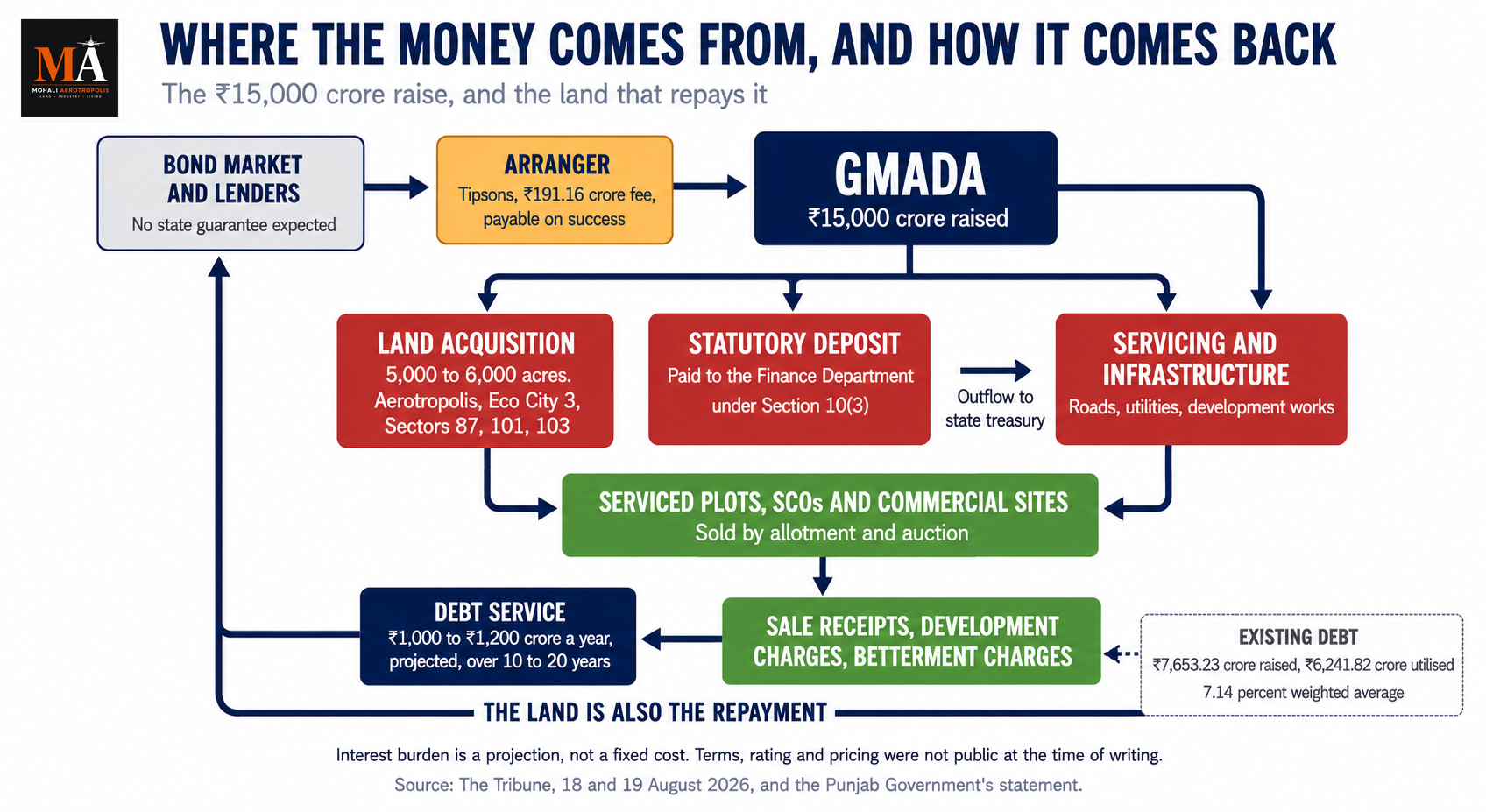
The government's statement does not leave this to inference. It says the bond programme will create value and generate future revenue through development charges, land monetisation, betterment charges and other receipts linked to the projects. It describes bonds as a way to build infrastructure ahead of development, which in turn allows planned urbanisation and unlocks the economic value of the land.
Read plainly: the land being acquired is also the repayment mechanism. GMADA buys agricultural land, services it, and sells plots, SCOs and commercial sites through allotment and auction. Those receipts, along with development and betterment charges, service the debt.
This is not a criticism of the model. It is how development authorities have always worked, and the alternative is either waiting for budget allocations that may never come or not building at all. But it does mean that the financing cost attached to this land is not an abstraction sitting in a balance sheet somewhere in Chandigarh. It is a cost carried by the same land, to be recovered from what that land eventually sells for.
GMADA reserve prices are set off acquisition and development cost rather than off whatever the resale market happens to be doing. Financing is now a visible and substantial line in that cost.
The debt already on the books
The new raise does not start from zero. Documents seen by The Tribune show GMADA has already raised term loan and overdraft facilities totalling ₹7,653.23 crore, of which ₹6,241.82 crore has been utilised, at a weighted average interest rate of 7.14 percent.
Layering ₹15,000 crore on top of that could carry an annual interest burden of roughly ₹1,000 crore to ₹1,200 crore over the next ten to twenty years.
An authority that once funded its acquisitions from its own receipts is now arranging them from the bond market. That is the shift underneath this whole story.
Why the money is needed now
Part of the answer is a statutory obligation that gets very little attention. Citing Section 10(3) of the RFCTLARR Act, the state maintains that development authorities acquiring land must either develop an equivalent area of land for agricultural purposes or deposit an amount equivalent to the value of the land acquired.
The provision as drafted is narrower than that reading suggests. It is triggered when irrigated multi-cropped land is acquired, the land to be developed in exchange is culturable wasteland, and the deposit is earmarked for investment in agriculture to support food security rather than for general use. How far the state's broader application of it holds is a question for the courts, not for a property site. What is not in dispute is the money already moved: the Finance Department has recovered over ₹10,000 crore from GMADA and other authorities on this basis.
So the ₹15,000 crore is not only for buying land. Part of it goes to the Finance Department as a deposit against land already taken. Acquisition at this scale generates its own bill before a single plot is serviced.
That sits alongside the recovery problem running the other way. We reported in June that nearly 30 promoters owed over ₹1,000 crore in external development charges, licence fees and social infrastructure dues, tracked in the GMADA dues default register. An authority chasing a thousand crore from developers while arranging fifteen thousand crore from the bond market is a picture of a balance sheet under real pressure.
The political row
Leader of the Opposition Partap Singh Bajwa put the taxpayer exposure at ₹24,000 crore over two decades on an annual interest burden of ₹1,200 crore, excluding principal, and asked why a private company should be paid ₹191 crore to facilitate a loan the government could arrange itself. He questioned the transparency of the tendering process and demanded public disclosure of the terms, the interest rate, the repayment schedule, any security or guarantees, the selection process for the intermediary and the utilisation plan for the money.
SAD leader Bikram Singh Majithia also attacked the decision, calling its financial credibility questionable.
The government's position is that appointing an investment banker on a purely success-fee basis aligns payment with successful fund mobilisation, minimises GMADA's upfront burden and promotes competitive pricing and wider investor outreach. On the process point specifically, the record shows the route was cleared by the Finance Department and put out to open tender before the bids came in.
What this actually tells a buyer
None of the following requires anyone to take a view on the politics.
The acquisitions are funded and moving. A financing plan of this size for Aerotropolis, Eco City 3 and Sectors 87, 101 and 103 indicates the state is committed to seeing them through rather than letting them stall, which has happened before in this region.
The pace is now tied to a market process. The bonds need an investment-grade rating and investors willing to buy them at a workable price. That introduces a dependency that did not exist when authorities were funded from their own reserves.
The disposal side has a number behind it. Whatever GMADA eventually charges for plots in these sectors carries the cost of acquiring them, developing them, depositing against them under the state's reading of Section 10(3), and now financing all of that.
And the schedule is checkable. Nine months from contract signature, with ₹5,000 crore due in the first three months after the rating comes through. If those tranches slip, that is the earliest visible signal that the acquisition programme is under strain.
Current live rates in the pockets that already trade sit on our LOI price tracker, and each new notification is recorded in the notices archive as it is published.
None of that predicts a price. It does explain what the price will be built from.
---
Sources
- GMADA to pay Gujarat firm Rs 191 cr for raising Rs 15,000 cr, Ruchika Khanna and Rajmeet Singh, The Tribune, 18 August 2026, on the appointment, the bid process, the existing debt and the government's statement
- GMADA's Rs 15K-crore loan plan kicks up political row, The Tribune, 19 August 2026, on the opposition response
- Section 10, Right to Fair Compensation and Transparency in Land Acquisition, Rehabilitation and Resettlement Act, 2013, India Code, for the text of the food security provision
- GMADA announces awards for 8 villages in Mohali for next phase of Aerotropolis, The Tribune, July 2026, on the 3,522.98 acre award
- Punjab to acquire 11,103 acres in Mohali, New Chandigarh for infra push, The Tribune, 31 March 2026, on the wider acquisition programme
Every acquisition notice this site has covered in the past year has an unstated question behind it. GMADA has an award of ₹23,457.74 crore against 3,522.98 acres for the Aerotropolis expansion. It declared its Eco City 3 award, covering 716 acres, in December 2025. It is acquiring in Sectors 87, 101 and 103. Where does that money come from?
As of 19 August, there is an answer on the record. GMADA is raising ₹15,000 crore against 5,000 to 6,000 acres, and it is paying a Gujarat merchant banker ₹191.16 crore to arrange it.
What was decided
The proposal was approved at GMADA's executive committee, chaired by Punjab Chief Secretary and GMADA Chairperson KAP Sinha. The successful bidder is Tipsons Consultancy Services Private Limited, whose arranger fee The Tribune describes as the largest of its kind in the state's history.
The authority's power to do this comes from the Punjab Regional and Town Planning and Development Act, 1995, which allows it to raise money through debentures or bonds. That was the route flagged at the meeting.
The process behind it ran through the Finance Department first. The file on the bond option went there, and the department recommended that GMADA take the cheapest borrowing route after exploring all available sources. The approach was cleared at an earlier GMADA meeting, an expression of interest was invited, and a request for proposal followed on 25 June.
Six firms sent pre-bid queries. Only two submitted bids. Technical presentations were held on 12 August and financial bids opened the next day. Trust Investment Advisors quoted ₹259.50 crore. Tipsons quoted ₹191.16 crore and won on price.
Sinha told The Tribune the consultant was finalised through open tendering, that the fee is payable "only after Rs 15,000 crore has been raised", and that safeguards have been put in place.
The mobilisation schedule is aggressive. The funds must be raised within nine months of the contract being signed, with ₹5,000 crore in the first three months after an investment-grade rating is obtained, another ₹5,000 crore in the three months after that, and the balance within the stipulated period. The merchant banker's job covers devising the fundraising strategy, liaising with investors, obtaining credit ratings, securing approvals and listing the bonds.
Not a loan, says the government
Asked about it, the government pushed back on the framing directly. Its statement to The Tribune describes this as an infrastructure development bond rather than a loan, a long-term financing mechanism that lets capital requirements be met without depending entirely on annual budgetary allocations.
The distinction is worth holding onto, though it is partly a distinction about instrument rather than obligation. The Tribune reports the money will be raised through bonds or bank loans, whichever proves cheaper, and Finance Department sources say the state is unlikely to guarantee the bond. Without a state guarantee, the people who buy the paper have recourse to GMADA and to GMADA's own revenues.
Which brings the question to the part that matters for anyone holding property in these sectors.
How it gets repaid, in the government's own words
The government's statement does not leave this to inference. It says the bond programme will create value and generate future revenue through development charges, land monetisation, betterment charges and other receipts linked to the projects. It describes bonds as a way to build infrastructure ahead of development, which in turn allows planned urbanisation and unlocks the economic value of the land.
Read plainly: the land being acquired is also the repayment mechanism. GMADA buys agricultural land, services it, and sells plots, SCOs and commercial sites through allotment and auction. Those receipts, along with development and betterment charges, service the debt.
This is not a criticism of the model. It is how development authorities have always worked, and the alternative is either waiting for budget allocations that may never come or not building at all. But it does mean that the financing cost attached to this land is not an abstraction sitting in a balance sheet somewhere in Chandigarh. It is a cost carried by the same land, to be recovered from what that land eventually sells for.
GMADA reserve prices are set off acquisition and development cost rather than off whatever the resale market happens to be doing. Financing is now a visible and substantial line in that cost.
The debt already on the books
The new raise does not start from zero. Documents seen by The Tribune show GMADA has already raised term loan and overdraft facilities totalling ₹7,653.23 crore, of which ₹6,241.82 crore has been utilised, at a weighted average interest rate of 7.14 percent.
Layering ₹15,000 crore on top of that could carry an annual interest burden of roughly ₹1,000 crore to ₹1,200 crore over the next ten to twenty years.
An authority that once funded its acquisitions from its own receipts is now arranging them from the bond market. That is the shift underneath this whole story.
Why the money is needed now
Part of the answer is a statutory obligation that gets very little attention. Citing Section 10(3) of the RFCTLARR Act, the state maintains that development authorities acquiring land must either develop an equivalent area of land for agricultural purposes or deposit an amount equivalent to the value of the land acquired.
The provision as drafted is narrower than that reading suggests. It is triggered when irrigated multi-cropped land is acquired, the land to be developed in exchange is culturable wasteland, and the deposit is earmarked for investment in agriculture to support food security rather than for general use. How far the state's broader application of it holds is a question for the courts, not for a property site. What is not in dispute is the money already moved: the Finance Department has recovered over ₹10,000 crore from GMADA and other authorities on this basis.
So the ₹15,000 crore is not only for buying land. Part of it goes to the Finance Department as a deposit against land already taken. Acquisition at this scale generates its own bill before a single plot is serviced.
That sits alongside the recovery problem running the other way. We reported in June that nearly 30 promoters owed over ₹1,000 crore in external development charges, licence fees and social infrastructure dues, tracked in the GMADA dues default register. An authority chasing a thousand crore from developers while arranging fifteen thousand crore from the bond market is a picture of a balance sheet under real pressure.
The political row
Leader of the Opposition Partap Singh Bajwa put the taxpayer exposure at ₹24,000 crore over two decades on an annual interest burden of ₹1,200 crore, excluding principal, and asked why a private company should be paid ₹191 crore to facilitate a loan the government could arrange itself. He questioned the transparency of the tendering process and demanded public disclosure of the terms, the interest rate, the repayment schedule, any security or guarantees, the selection process for the intermediary and the utilisation plan for the money.
SAD leader Bikram Singh Majithia also attacked the decision, calling its financial credibility questionable.
The government's position is that appointing an investment banker on a purely success-fee basis aligns payment with successful fund mobilisation, minimises GMADA's upfront burden and promotes competitive pricing and wider investor outreach. On the process point specifically, the record shows the route was cleared by the Finance Department and put out to open tender before the bids came in.
What this actually tells a buyer
None of the following requires anyone to take a view on the politics.
The acquisitions are funded and moving. A financing plan of this size for Aerotropolis, Eco City 3 and Sectors 87, 101 and 103 indicates the state is committed to seeing them through rather than letting them stall, which has happened before in this region.
The pace is now tied to a market process. The bonds need an investment-grade rating and investors willing to buy them at a workable price. That introduces a dependency that did not exist when authorities were funded from their own reserves.
The disposal side has a number behind it. Whatever GMADA eventually charges for plots in these sectors carries the cost of acquiring them, developing them, depositing against them under the state's reading of Section 10(3), and now financing all of that.
And the schedule is checkable. Nine months from contract signature, with ₹5,000 crore due in the first three months after the rating comes through. If those tranches slip, that is the earliest visible signal that the acquisition programme is under strain.
Current live rates in the pockets that already trade sit on our LOI price tracker, and each new notification is recorded in the notices archive as it is published.
None of that predicts a price. It does explain what the price will be built from.
---
Sources
- GMADA to pay Gujarat firm Rs 191 cr for raising Rs 15,000 cr, Ruchika Khanna and Rajmeet Singh, The Tribune, 18 August 2026, on the appointment, the bid process, the existing debt and the government's statement
- GMADA's Rs 15K-crore loan plan kicks up political row, The Tribune, 19 August 2026, on the opposition response
- Section 10, Right to Fair Compensation and Transparency in Land Acquisition, Rehabilitation and Resettlement Act, 2013, India Code, for the text of the food security provision
- GMADA announces awards for 8 villages in Mohali for next phase of Aerotropolis, The Tribune, July 2026, on the 3,522.98 acre award
- Punjab to acquire 11,103 acres in Mohali, New Chandigarh for infra push, The Tribune, 31 March 2026, on the wider acquisition programme
Every acquisition notice this site has covered in the past year has an unstated question behind it. GMADA has an award of ₹23,457.74 crore against 3,522.98 acres for the Aerotropolis expansion. It declared its Eco City 3 award, covering 716 acres, in December 2025. It is acquiring in Sectors 87, 101 and 103. Where does that money come from?
As of 19 August, there is an answer on the record. GMADA is raising ₹15,000 crore against 5,000 to 6,000 acres, and it is paying a Gujarat merchant banker ₹191.16 crore to arrange it.
What was decided
The proposal was approved at GMADA's executive committee, chaired by Punjab Chief Secretary and GMADA Chairperson KAP Sinha. The successful bidder is Tipsons Consultancy Services Private Limited, whose arranger fee The Tribune describes as the largest of its kind in the state's history.
The authority's power to do this comes from the Punjab Regional and Town Planning and Development Act, 1995, which allows it to raise money through debentures or bonds. That was the route flagged at the meeting.
The process behind it ran through the Finance Department first. The file on the bond option went there, and the department recommended that GMADA take the cheapest borrowing route after exploring all available sources. The approach was cleared at an earlier GMADA meeting, an expression of interest was invited, and a request for proposal followed on 25 June.
Six firms sent pre-bid queries. Only two submitted bids. Technical presentations were held on 12 August and financial bids opened the next day. Trust Investment Advisors quoted ₹259.50 crore. Tipsons quoted ₹191.16 crore and won on price.
Sinha told The Tribune the consultant was finalised through open tendering, that the fee is payable "only after Rs 15,000 crore has been raised", and that safeguards have been put in place.
The mobilisation schedule is aggressive. The funds must be raised within nine months of the contract being signed, with ₹5,000 crore in the first three months after an investment-grade rating is obtained, another ₹5,000 crore in the three months after that, and the balance within the stipulated period. The merchant banker's job covers devising the fundraising strategy, liaising with investors, obtaining credit ratings, securing approvals and listing the bonds.
Not a loan, says the government
Asked about it, the government pushed back on the framing directly. Its statement to The Tribune describes this as an infrastructure development bond rather than a loan, a long-term financing mechanism that lets capital requirements be met without depending entirely on annual budgetary allocations.
The distinction is worth holding onto, though it is partly a distinction about instrument rather than obligation. The Tribune reports the money will be raised through bonds or bank loans, whichever proves cheaper, and Finance Department sources say the state is unlikely to guarantee the bond. Without a state guarantee, the people who buy the paper have recourse to GMADA and to GMADA's own revenues.
Which brings the question to the part that matters for anyone holding property in these sectors.
How it gets repaid, in the government's own words
The government's statement does not leave this to inference. It says the bond programme will create value and generate future revenue through development charges, land monetisation, betterment charges and other receipts linked to the projects. It describes bonds as a way to build infrastructure ahead of development, which in turn allows planned urbanisation and unlocks the economic value of the land.
Read plainly: the land being acquired is also the repayment mechanism. GMADA buys agricultural land, services it, and sells plots, SCOs and commercial sites through allotment and auction. Those receipts, along with development and betterment charges, service the debt.
This is not a criticism of the model. It is how development authorities have always worked, and the alternative is either waiting for budget allocations that may never come or not building at all. But it does mean that the financing cost attached to this land is not an abstraction sitting in a balance sheet somewhere in Chandigarh. It is a cost carried by the same land, to be recovered from what that land eventually sells for.
GMADA reserve prices are set off acquisition and development cost rather than off whatever the resale market happens to be doing. Financing is now a visible and substantial line in that cost.
The debt already on the books
The new raise does not start from zero. Documents seen by The Tribune show GMADA has already raised term loan and overdraft facilities totalling ₹7,653.23 crore, of which ₹6,241.82 crore has been utilised, at a weighted average interest rate of 7.14 percent.
Layering ₹15,000 crore on top of that could carry an annual interest burden of roughly ₹1,000 crore to ₹1,200 crore over the next ten to twenty years.
An authority that once funded its acquisitions from its own receipts is now arranging them from the bond market. That is the shift underneath this whole story.
Why the money is needed now
Part of the answer is a statutory obligation that gets very little attention. Citing Section 10(3) of the RFCTLARR Act, the state maintains that development authorities acquiring land must either develop an equivalent area of land for agricultural purposes or deposit an amount equivalent to the value of the land acquired.
The provision as drafted is narrower than that reading suggests. It is triggered when irrigated multi-cropped land is acquired, the land to be developed in exchange is culturable wasteland, and the deposit is earmarked for investment in agriculture to support food security rather than for general use. How far the state's broader application of it holds is a question for the courts, not for a property site. What is not in dispute is the money already moved: the Finance Department has recovered over ₹10,000 crore from GMADA and other authorities on this basis.
So the ₹15,000 crore is not only for buying land. Part of it goes to the Finance Department as a deposit against land already taken. Acquisition at this scale generates its own bill before a single plot is serviced.
That sits alongside the recovery problem running the other way. We reported in June that nearly 30 promoters owed over ₹1,000 crore in external development charges, licence fees and social infrastructure dues, tracked in the GMADA dues default register. An authority chasing a thousand crore from developers while arranging fifteen thousand crore from the bond market is a picture of a balance sheet under real pressure.
The political row
Leader of the Opposition Partap Singh Bajwa put the taxpayer exposure at ₹24,000 crore over two decades on an annual interest burden of ₹1,200 crore, excluding principal, and asked why a private company should be paid ₹191 crore to facilitate a loan the government could arrange itself. He questioned the transparency of the tendering process and demanded public disclosure of the terms, the interest rate, the repayment schedule, any security or guarantees, the selection process for the intermediary and the utilisation plan for the money.
SAD leader Bikram Singh Majithia also attacked the decision, calling its financial credibility questionable.
The government's position is that appointing an investment banker on a purely success-fee basis aligns payment with successful fund mobilisation, minimises GMADA's upfront burden and promotes competitive pricing and wider investor outreach. On the process point specifically, the record shows the route was cleared by the Finance Department and put out to open tender before the bids came in.
What this actually tells a buyer
None of the following requires anyone to take a view on the politics.
The acquisitions are funded and moving. A financing plan of this size for Aerotropolis, Eco City 3 and Sectors 87, 101 and 103 indicates the state is committed to seeing them through rather than letting them stall, which has happened before in this region.
The pace is now tied to a market process. The bonds need an investment-grade rating and investors willing to buy them at a workable price. That introduces a dependency that did not exist when authorities were funded from their own reserves.
The disposal side has a number behind it. Whatever GMADA eventually charges for plots in these sectors carries the cost of acquiring them, developing them, depositing against them under the state's reading of Section 10(3), and now financing all of that.
And the schedule is checkable. Nine months from contract signature, with ₹5,000 crore due in the first three months after the rating comes through. If those tranches slip, that is the earliest visible signal that the acquisition programme is under strain.
Current live rates in the pockets that already trade sit on our LOI price tracker, and each new notification is recorded in the notices archive as it is published.
None of that predicts a price. It does explain what the price will be built from.
---
Sources
- GMADA to pay Gujarat firm Rs 191 cr for raising Rs 15,000 cr, Ruchika Khanna and Rajmeet Singh, The Tribune, 18 August 2026, on the appointment, the bid process, the existing debt and the government's statement
- GMADA's Rs 15K-crore loan plan kicks up political row, The Tribune, 19 August 2026, on the opposition response
- Section 10, Right to Fair Compensation and Transparency in Land Acquisition, Rehabilitation and Resettlement Act, 2013, India Code, for the text of the food security provision
- GMADA announces awards for 8 villages in Mohali for next phase of Aerotropolis, The Tribune, July 2026, on the 3,522.98 acre award
- Punjab to acquire 11,103 acres in Mohali, New Chandigarh for infra push, The Tribune, 31 March 2026, on the wider acquisition programme