

It is one of the first questions buyers ask in this market, right after the price, and it gets the vaguest answers. Can you finance it?
The answer depends entirely on which of three quite different things you are buying, and the market talks about all three as though they were one. A built house, a demarcated plot with an allotment letter, and a Letter of Intent for a plot that does not physically exist yet are three separate propositions to a lender, and only the first is a home loan at all.
The rule underneath all of it
Most explanations of plot financing describe what banks do. The more useful starting point is what they are permitted to do.
The Reserve Bank of India's Master Circular on Housing Finance, issued under Sections 21 and 35A of the Banking Regulation Act, 1949 and applying to all scheduled commercial banks other than regional rural banks, sets the frame. Its governing instruction is that bank credit in this sector must go to construction activity and not to speculation in real estate.
From that follows the provision that decides most Mohali cases. Bank finance can be granted for the purchase of a plot only where the borrower declares an intention to construct a house on it, whether with bank finance or otherwise, within a period each bank sets for itself.
Read that carefully, because two things follow. Financing bare land is conditional on a commitment to build, as a matter of regulation rather than lender preference. And the deadline attached to that commitment is set by the bank, not by the RBI, which is why the answer differs between lenders and why it is a question worth asking before signing anything.
A plot loan is not a home loan
This distinction costs people money because they budget for one and get offered the other.
A home loan finances a built or under-construction property. A plot loan finances bare land. The circular sets loan-to-value ceilings and risk weights for housing loans that step down as the loan grows, and plot lending sits under the separate declaration condition above. Lenders price and structure the two accordingly.
On how much you can borrow, home loans commonly reach the upper end of the regulatory ceiling. Plot loans are typically capped lower, with lenders restricting funding further where the plot sits outside municipal limits. A plot purchase needs a materially larger contribution from your own funds.
On how long you have, home loan tenures run up to 30 years. Standalone plot loan tenures are shorter. A shorter tenure on a similar principal means a substantially higher monthly outgo, and that, rather than the interest rate, is usually what breaks a buyer's budget.
On tax, this is the one people discover late. Repayment of principal and interest on a plot loan does not attract the deductions available on a housing loan. Those arrive once construction happens and the borrowing becomes housing finance. Buying land and holding it produces no tax relief at all, which compounds the shorter tenure rather than offsetting it.
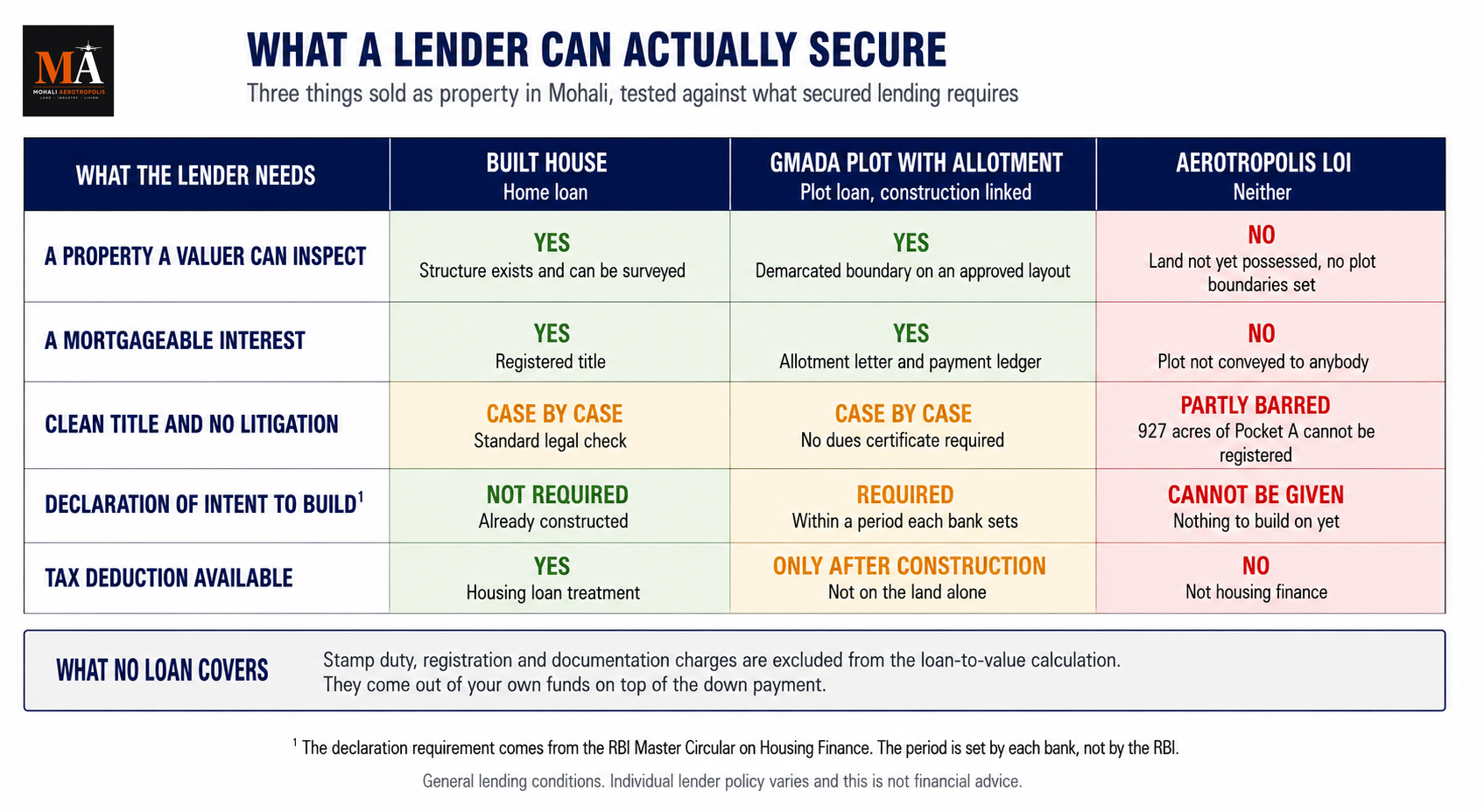
What a lender actually needs
Strip away the product names and a secured lender needs four things.
Something it can value, meaning a specific identifiable property a valuer can inspect and attest a market price for. Something it can take security over, meaning a mortgageable interest the borrower legally holds. A clean title position, meaning approvals in order, no encumbrance and no litigation attached to the land. And a borrower who can make the declaration the circular requires.
Lenders generally finance plots within municipal limits or within the jurisdiction of a development authority, in approved layouts, with non-agricultural status. That works in Mohali's favour, because a GMADA sector is exactly the kind of jurisdiction lenders are comfortable with.
The difficulty here is not the authority. It is the stage.
A GMADA allotment is financeable in principle
Lenders offer plot loans on direct allotment cases and on resale plots. HDFC, for one, lists construction on a plot allotted by a development authority as a covered category on its own product page.
So an allotted GMADA plot with an allotment letter, a demarcated boundary and a payment ledger sits inside normal lending territory. The lender will want the allotment letter, the payment receipts, a no dues certificate, the approved layout, and confirmation that nothing is pending against the plot. Our buyer's guide covers the same document set from the purchase side, because the checks a lender runs and the checks a buyer should run are largely identical.
Where financing works cleanly here is the composite structure. The lender releases the plot portion first, then funds construction in tranches tied to milestones like foundation, slab and finishing, each released after inspection. That staged release is itself an RBI expectation: the circular tells banks to link disbursals to construction stages rather than paying out upfront. And the construction condition is what eventually converts the borrowing into something with housing loan tax treatment.
An LOI is a different animal
This is the part the market glosses over.
A Letter of Intent is a GMADA document confirming a preferential right to a plot, issued ahead of conveyance, and it is transferable in the secondary market. It is the instrument that defines Aerotropolis trading, and our LOI price tracker exists because of it.
Measure it against what a lender needs and the problems are structural rather than procedural.
There is no demarcated plot to value. When the Punjab Government decided in June 2026 to route pending compensation through the Reference Court, The Tribune reported that this paved the way for GMADA to finally take possession of land in Pockets A to D after a freeze of more than three years caused by the guava orchard compensation scam. Possession precedes layout, and layout precedes plot boundaries. A valuer cannot inspect a boundary that has not been set.
There is no conveyance of the plot, so there is no title deed over which a charge can be created. An assignment of an LOI is a transaction in its own right and is documented as such, but the underlying plot has not been conveyed to anybody, which is a different thing and is the thing a lender needs.
And in the disputed portion of Pocket A, 927 acres are subject to a court case arising from the same scam. LOIs in that area cannot be registered until it resolves.
There is also the declaration. A buyer acquiring an entitlement to a plot that has not been laid out cannot honestly undertake to build on it within a period a bank would set, because there is nothing to build on yet. That is not a documentation gap that a good file can close.
None of this is a claim about any particular bank's internal policy. No lender publishes a position on Aerotropolis LOIs, and if any Punjab lender or NBFC finances them, it is not documented publicly. What can be said is that an LOI does not currently meet the conditions a secured lender applies, and that anyone told financing is straightforward should ask for that in writing from the lender rather than from the seller.
The practical implication is unglamorous and important. LOI purchases in this market are largely self-funded, which is part of why the buyer profile skews to investors and to the diaspora rather than to households buying somewhere to live. Around 40 percent of Aerotropolis enquiries reaching this platform come from NRI buyers.
The costs no loan will cover
One provision of the circular deserves its own note, because it changes the arithmetic on every purchase here.
Banks must exclude stamp duty, registration and other documentation charges from the cost of the property when computing the loan-to-value ratio. The only exception is where the house costs no more than ₹10 lakh, which excludes essentially everything in this market.
So those charges come out of your own pocket on top of the down payment, and they are not small on a Punjab transaction. When someone says a purchase is 80 percent financed, the 20 percent is the floor of what you need in hand, not the total.
The NRI complication
Lending rules do not treat resident and non-resident buyers identically. Some plot loan products are offered to resident Indians only, and age limits at loan maturity apply, so eligibility is the first question rather than the rate.
NRI purchases separately have to run through NRE or NRO accounts under FEMA, and repatriation rules attach to how the purchase was funded in the first place. Our NRI corner sets out the FEMA position on buying. The financing question sits on top of that rather than beside it.
What to establish before assuming a purchase is financeable
Which product you are being offered, plot loan or home loan, because the tenure, the ceiling and the tax treatment all change with the answer.
What the lender will lend against, meaning the specific document, whether a registered sale deed, an allotment letter, or something earlier in the chain.
What construction period the bank will write into the declaration, since that is a regulatory requirement rather than a negotiable clause, and it determines whether you are buying land or committing to build on a clock.
What you need in cash beyond the down payment, including stamp duty and registration, which no lender will fund.
And whether the specific parcel carries anything that would fail a legal check, which for parts of the Aerotropolis means asking about the litigated 927 acres before asking about the interest rate.
None of the above is financial advice, and lending terms vary by lender, by borrower profile and over time. What it is meant to do is narrow the question. The honest version is not whether property here can be financed. It is that a house can, a plot with an allotment usually can, and an entitlement to a plot that has not yet been created generally cannot, however similar the three sound in a listing.
---
Sources
- Master Circular on Housing Finance, Reserve Bank of India, issued 1 April 2025 consolidating instructions to 31 March 2025, on the plot purchase declaration requirement
- RBI Master Circular on Housing Finance, ELP Law, on the construction-not-speculation principle, the exclusion of stamp duty and registration from loan-to-value computation, and the requirement to link disbursals to construction stages
- RBI Master Circular on Housing Finance, King Stubb and Kasiva, on the statutory basis under Sections 21 and 35A of the Banking Regulation Act, 1949 and the loan-to-value and risk weight tables
- Land Loans and Plot Purchase Loans, HDFC Bank, on direct allotment and resale plot loans and on construction on a plot allotted by a development authority
- Punjab clears way for Aerotropolis compensation, land possession, The Tribune, 22 June 2026, on the Reference Court route and the three-year freeze in Pockets A to D
यह इस बाजार में खरीदारों द्वारा पूछे जाने वाले पहले सवालों में से एक है, कीमत के ठीक बाद, और इसका सबसे अस्पष्ट जवाब मिलता है। क्या आप इसे फाइनेंस कर सकते हैं?
जवाब पूरी तरह से इस बात पर निर्भर करता है कि आप तीन बहुत अलग चीजों में से कौन सी खरीद रहे हैं, और बाजार तीनों के बारे में ऐसे बात करता है जैसे वे एक ही हों। एक बना हुआ घर, आवंटन पत्र के साथ एक सीमांकित प्लॉट, और एक प्लॉट के लिए लेटर ऑफ इंटेंट जो अभी भौतिक रूप से मौजूद नहीं है—ये तीनों एक लेंडर के लिए अलग-अलग प्रस्ताव हैं, और इनमें से केवल पहला ही होम लोन है।
इन सबके नीचे का नियम
प्लॉट फाइनेंसिंग के अधिकांश स्पष्टीकरण बताते हैं कि बैंक क्या करते हैं। अधिक उपयोगी शुरुआती बिंदु यह है कि उन्हें क्या करने की अनुमति है।
भारतीय रिजर्व बैंक का हाउसिंग फाइनेंस पर मास्टर सर्कुलर, जो बैंकिंग विनियमन अधिनियम, 1949 की धारा 21 और 35A के तहत जारी किया गया है और क्षेत्रीय ग्रामीण बैंकों को छोड़कर सभी अनुसूचित वाणिज्यिक बैंकों पर लागू होता है, रूपरेखा तय करता है। इसका मुख्य निर्देश यह है कि इस क्षेत्र में बैंक ऋण निर्माण गतिविधि के लिए जाना चाहिए, न कि रियल एस्टेट में सट्टेबाजी के लिए।
इसी से वह प्रावधान निकलता है जो अधिकांश मोहाली मामलों का फैसला करता है। बैंक वित्त केवल उसी स्थिति में प्लॉट की खरीद के लिए दिया जा सकता है जहां उधारकर्ता उस पर घर बनाने का इरादा घोषित करता है, चाहे बैंक वित्त से या अन्यथा, उस अवधि के भीतर जो प्रत्येक बैंक अपने लिए तय करता है।
इसे ध्यान से पढ़ें, क्योंकि इससे दो बातें निकलती हैं। खाली जमीन का फाइनेंसिंग निर्माण की प्रतिबद्धता पर सशर्त है, यह लेंडर की पसंद के बजाय नियमन का मामला है। और उस प्रतिबद्धता से जुड़ी समय सीमा बैंक द्वारा तय की जाती है, न कि RBI द्वारा, यही कारण है कि जवाब लेंडर के बीच अलग-अलग होता है और यही कारण है कि कुछ भी हस्ताक्षर करने से पहले यह प्रश्न पूछने लायक है।
प्लॉट लोन होम लोन नहीं है
यह अंतर लोगों को पैसा खर्च कराता है क्योंकि वे एक के लिए बजट बनाते हैं और उन्हें दूसरा ऑफर किया जाता है।
होम लोन एक बने या निर्माणाधीन संपत्ति को फाइनेंस करता है। प्लॉट लोन खाली जमीन को फाइनेंस करता है। सर्कुलर आवास ऋणों के लिए लोन-टू-वैल्यू सीमा और जोखिम भार निर्धारित करता है जो ऋण बढ़ने के साथ घटते जाते हैं, और प्लॉट ऋण उपरोक्त अलग घोषणा शर्त के तहत आता है। लेंडर दोनों की कीमत और संरचना उसी के अनुसार तय करते हैं।
आप कितना उधार ले सकते हैं, इस पर होम लोन आमतौर पर नियामक सीमा के ऊपरी छोर तक पहुंचते हैं। प्लॉट लोन आमतौर पर कम सीमा पर कैप किए जाते हैं, और जहां प्लॉट नगरपालिका सीमा के बाहर होता है, लेंडर फंडिंग को और प्रतिबंधित करते हैं। प्लॉट खरीद के लिए आपके अपने फंड से काफी बड़ा योगदान चाहिए।
आपके पास कितना समय है, इस पर होम लोन की अवधि 30 साल तक होती है। स्टैंडअलोन प्लॉट लोन की अवधि कम होती है। समान मूल राशि पर कम अवधि का मतलब काफी अधिक मासिक भुगतान होता है, और यह, ब्याज दर के बजाय, आमतौर पर खरीदार का बजट तोड़ देता है।
टैक्स पर, यह वह बात है जो लोगों को देर से पता चलती है। प्लॉट लोन पर मूलधन और ब्याज का भुगतान उन कटौतियों को आकर्षित नहीं करता जो हाउसिंग लोन पर उपलब्ध हैं। वे तब मिलती हैं जब निर्माण शुरू होता है और उधार हाउसिंग फाइनेंस बन जाता है। जमीन खरीदना और उसे रखना कोई कर राहत नहीं देता, जो कम अवधि को ऑफसेट करने के बजाय उसे और बढ़ा देता है।
एक लेंडर को वास्तव में क्या चाहिए
उत्पाद के नाम हटा दें और एक सुरक्षित लेंडर को चार चीजों की आवश्यकता होती है।
कुछ जिसका वह मूल्यांकन कर सके, यानी एक विशिष्ट पहचान योग्य संपत्ति जिसका एक मूल्यांकक निरीक्षण कर सके और बाजार मूल्य प्रमाणित कर सके। कुछ जिस पर वह सुरक्षा ले सके, यानी एक बंधक योग्य हित जो उधारकर्ता के पास कानूनी रूप से हो। एक स्वच्छ शीर्षक स्थिति, यानी अनुमोदन क्रम में हों, कोई भार न हो और भूमि से जुड़ा कोई मुकदमा न हो। और एक उधारकर्ता जो सर्कुलर द्वारा आवश्यक घोषणा कर सके।
लेंडर आमतौर पर नगरपालिका सीमा के भीतर या एक विकास प्राधिकरण के अधिकार क्षेत्र के भीतर, स्वीकृत लेआउट में, गैर-कृषि स्थिति वाले प्लॉटों को फाइनेंस करते हैं। यह मोहाली के पक्ष में काम करता है, क्योंकि GMADA सेक्टर ठीक उसी तरह का अधिकार क्षेत्र है जिसके साथ लेंडर सहज हैं।
यहां कठिनाई प्राधिकरण की नहीं है। यह चरण की है।
GMADA आवंटन सैद्धांतिक रूप से फाइनेंस योग्य है
लेंडर प्रत्यक्ष आवंटन मामलों और रीसेल प्लॉटों पर प्लॉट लोन देते हैं। HDFC, उदाहरण के लिए, अपने उत्पाद पृष्ठ पर एक विकास प्राधिकरण द्वारा आवंटित प्लॉट पर निर्माण को एक कवर की गई श्रेणी के रूप में सूचीबद्ध करता है।
इसलिए एक आवंटित GMADA प्लॉट जिसके पास आवंटन पत्र, एक सीमांकित सीमा और भुगतान लेजर है, सामान्य ऋण देने के दायरे में आता है। लेंडर आवंटन पत्र, भुगतान रसीदें, एक नो ड्यूज सर्टिफिकेट, स्वीकृत लेआउट, और पुष्टि चाहेगा कि प्लॉट के खिलाफ कुछ भी लंबित नहीं है। हमारी buyer's guide खरीद पक्ष से उसी दस्तावेज़ सेट को कवर करती है, क्योंकि लेंडर जो जांच करता है और खरीदार को जो जांच करनी चाहिए वे काफी हद तक समान हैं।
यहां फाइनेंसिंग जहां साफ तौर पर काम करती है वह समग्र संरचना है। लेंडर पहले प्लॉट हिस्सा जारी करता है, फिर नींव, स्लैब और फिनिशिंग जैसे माइलस्टोन से जुड़ी किश्तों में निर्माण को फंड करता है, प्रत्येक को निरीक्षण के बाद जारी किया जाता है। यह चरणबद्ध जारी स्वयं एक RBI अपेक्षा है: सर्कुलर बैंकों को अग्रिम भुगतान के बजाय भुगतान को निर्माण चरणों से जोड़ने का निर्देश देता है। और निर्माण की शर्त वह है जो अंततः उधार को हाउसिंग लोन कर उपचार वाली चीज़ में बदल देती है।
एक LOI एक अलग जानवर है
यह वह हिस्सा है जिसे बाजार नजरअंदाज कर देता है।
लेटर ऑफ इंटेंट एक GMADA दस्तावेज़ है जो एक प्लॉट पर प्राथमिक अधिकार की पुष्टि करता है, कन्वेयंस से पहले जारी किया जाता है, और यह द्वितीयक बाजार में हस्तांतरणीय है। यह वह साधन है जो एयरोट्रोपोलिस ट्रेडिंग को परिभाषित करता है, और हमारा LOI price tracker इसी की वजह से मौजूद है।
इसे उस चीज़ के सामने मापें जो एक लेंडर को चाहिए और समस्याएं प्रक्रियात्मक के बजाय संरचनात्मक हैं।
मूल्यांकन करने के लिए कोई सीमांकित प्लॉट नहीं है। जब पंजाब सरकार ने जून 2026 में लंबित मुआवजे को रेफरेंस कोर्ट के माध्यम से भेजने का फैसला किया, तो The Tribune ने रिपोर्ट किया कि इसने अमरूद बाग मुआवजा घोटाले के कारण तीन साल से अधिक के ठहराव के बाद GMADA के लिए अंततः पॉकेट A से D में भूमि पर कब्जा लेने का रास्ता साफ कर दिया। कब्जा लेआउट से पहले आता है, और लेआउट प्लॉट सीमाओं से पहले आता है। एक मूल्यांकक उस सीमा का निरीक्षण नहीं कर सकता जो निर्धारित नहीं हुई है।
प्लॉट की कोई कन्वेयंस नहीं है, इसलिए कोई शीर्षक दस्तावेज़ नहीं है जिस पर शुल्क लगाया जा सके। एक LOI का असाइनमेंट अपने आप में एक लेनदेन है और उसी रूप में दर्ज किया जाता है, लेकिन अंतर्निहित प्लॉट किसी को हस्तांतरित नहीं किया गया है, जो एक अलग बात है और वही है जो एक लेंडर को चाहिए।
और पॉकेट A के विवादित हिस्से में, 927 एकड़ उसी घोटाले से उत्पन्न एक अदालती मामले के अधीन है। उस क्षेत्र में LOI का पंजीकरण तब तक नहीं हो सकता जब तक यह हल नहीं हो जाता।
घोषणा भी है। एक खरीदार जो एक प्लॉट का अधिकार प्राप्त कर रहा है जो अभी लेआउट नहीं हुआ है, वह ईमानदारी से उस पर एक अवधि के भीतर निर्माण करने का वचन नहीं दे सकता जो बैंक तय करेगा, क्योंकि अभी निर्माण करने के लिए कुछ है ही नहीं। यह एक दस्तावेज़ीकरण अंतर नहीं है जिसे एक अच्छी फाइल बंद कर सके।
इनमें से कोई भी किसी विशेष बैंक की आंतरिक नीति के बारे में दावा नहीं है। कोई भी लेंडर एयरोट्रोपोलिस LOI पर स्थिति प्रकाशित नहीं करता, और यदि कोई पंजाब लेंडर या NBFC उन्हें फाइनेंस करता है, तो यह सार्वजनिक रूप से दर्ज नहीं है। यह कहा जा सकता है कि एक LOI वर्तमान में उन शर्तों को पूरा नहीं करता जो एक सुरक्षित लेंडर लागू करता है, और जिसे भी फाइनेंसिंग सीधा बताया जाए, उसे विक्रेता के बजाय लेंडर से लिखित में मांगना चाहिए।
व्यावहारिक निहितार्थ अनाकर्षक और महत्वपूर्ण है। इस बाजार में LOI खरीद काफी हद तक स्व-वित्तपोषित है, यही एक कारण है कि खरीदार प्रोफ़ाइल रहने के लिए घर खरीदने वाले परिवारों के बजाय निवेशकों और प्रवासी भारतीयों की ओर झुकती है। इस प्लेटफॉर्म तक पहुंचने वाली एयरोट्रोपोलिस पूछताछ का लगभग 40 प्रतिशत NRI खरीदारों से आता है।
वह लागत जो कोई लोन कवर नहीं करेगा
सर्कुलर का एक प्रावधान अपने स्वयं के नोट के योग्य है, क्योंकि यह यहां हर खरीद पर गणित बदल देता है।
बैंकों को लोन-टू-वैल्यू अनुपात की गणना करते समय स्टांप ड्यूटी, पंजीकरण और अन्य दस्तावेज़ीकरण शुल्क को संपत्ति की लागत से बाहर रखना चाहिए। एकमात्र अपवाद तब है जब घर की कीमत ₹10 लाख से अधिक न हो, जो अनिवार्य रूप से इस बाजार में सब कुछ बाहर कर देता है।
इसलिए वे शुल्क डाउन पेमेंट के ऊपर आपकी अपनी जेब से आते हैं, और पंजाब लेनदेन पर वे छोटे नहीं हैं। जब कोई कहता है कि खरीद 80 प्रतिशत वित्तपोषित है, तो 20 प्रतिशत वह न्यूनतम है जो आपके पास नकद में होना चाहिए, कुल नहीं।
NRI जटिलता
ऋण देने के नियम निवासी और अनिवासी खरीदारों के साथ समान व्यवहार नहीं करते। कुछ प्लॉट लोन उत्पाद केवल भारतीय निवासियों को दिए जाते हैं, और ऋण परिपक्वता पर आयु सीमाएं लागू होती हैं, इसलिए पात्रता दर के बजाय पहला प्रश्न है।
NRI खरीद को अलग से FEMA के तहत NRE या NRO खातों से गुजरना पड़ता है, और प्रत्यावर्तन नियम इस बात से जुड़े होते हैं कि खरीद शुरुआत में कैसे वित्तपोषित हुई थी। हमारा NRI corner खरीद पर FEMA स्थिति निर्धारित करता है। फाइनेंसिंग का प्रश्न उसके बगल में नहीं, बल्कि उसके ऊपर बैठता है।
यह मानने से पहले कि खरीद फाइनेंस योग्य है, क्या स्थापित करें
आपको कौन सा उत्पाद दिया जा रहा है, प्लॉट लोन या होम लोन, क्योंकि अवधि, सीमा और कर उपचार सभी उत्तर के साथ बदलते हैं।
लेंडर किसके खिलाफ उधार देगा, यानी विशिष्ट दस्तावेज़, चाहे पंजीकृत बिक्री विलेख, आवंटन पत्र, या श्रृंखला में पहले की कोई चीज़।
बैंक घोषणा में कौन सी निर्माण अवधि लिखेगा, क्योंकि यह एक नियामक आवश्यकता है, बातचीत योग्य खंड नहीं, और यह निर्धारित करता है कि आप जमीन खरीद रहे हैं या घड़ी पर निर्माण करने की प्रतिबद्धता कर रहे हैं।
डाउन पेमेंट के अलावा आपको नकद में क्या चाहिए, जिसमें स्टांप ड्यूटी और पंजीकरण शामिल है, जिसे कोई लेंडर फंड नहीं करेगा।
और क्या विशिष्ट भूखंड के साथ कुछ ऐसा जुड़ा है जो कानूनी जांच में विफल हो सकता है, जो एयरोट्रोपोलिस के कुछ हिस्सों के लिए ब्याज दर पूछने से पहले विवादित 927 एकड़ के बारे में पूछने का मतलब है।
उपरोक्त में से कोई भी वित्तीय सलाह नहीं है, और ऋण शर्तें लेंडर, उधारकर्ता प्रोफ़ाइल और समय के अनुसार भिन्न होती हैं। इसका उद्देश्य प्रश्न को संकीर्ण करना है। ईमानदार संस्करण यह नहीं है कि क्या यहां की संपत्ति फाइनेंस की जा सकती है। यह है कि एक घर को फाइनेंस किया जा सकता है, एक आवंटन वाला प्लॉट आमतौर पर किया जा सकता है, और एक प्लॉट का अधिकार जो अभी तक बनाया नहीं गया है, आम तौर पर नहीं किया जा सकता, चाहे तीनों सूची में कितने भी समान क्यों न लगें।
---
स्रोत
- Master Circular on Housing Finance, भारतीय रिजर्व बैंक, 1 अप्रैल 2025 को जारी, 31 मार्च 2025 तक के निर्देशों का समेकन, प्लॉट खरीद घोषणा आवश्यकता पर
- RBI Master Circular on Housing Finance, ELP Law, निर्माण-नहीं-सट्टेबाजी सिद्धांत, लोन-टू-वैल्यू गणना से स्टांप ड्यूटी और पंजीकरण का बहिष्करण, और भुगतान को निर्माण चरणों से जोड़ने की आवश्यकता पर
- RBI Master Circular on Housing Finance, King Stubb and Kasiva, बैंकिंग विनियमन अधिनियम, 1949 की धारा 21 और 35A के तहत वैधानिक आधार और लोन-टू-वैल्यू और जोखिम भार तालिकाओं पर
- Land Loans and Plot Purchase Loans, HDFC Bank, प्रत्यक्ष आवंटन और रीसेल प्लॉट ऋणों पर और एक विकास प्राधिकरण द्वारा आवंटित प्लॉट पर निर्माण पर
- Punjab clears way for Aerotropolis compensation, land possession, The Tribune, 22 जून 2026, रेफरेंस कोर्ट
It is one of the first questions buyers ask in this market, right after the price, and it gets the vaguest answers. Can you finance it?
The answer depends entirely on which of three quite different things you are buying, and the market talks about all three as though they were one. A built house, a demarcated plot with an allotment letter, and a Letter of Intent for a plot that does not physically exist yet are three separate propositions to a lender, and only the first is a home loan at all.
The rule underneath all of it
Most explanations of plot financing describe what banks do. The more useful starting point is what they are permitted to do.
The Reserve Bank of India's Master Circular on Housing Finance, issued under Sections 21 and 35A of the Banking Regulation Act, 1949 and applying to all scheduled commercial banks other than regional rural banks, sets the frame. Its governing instruction is that bank credit in this sector must go to construction activity and not to speculation in real estate.
From that follows the provision that decides most Mohali cases. Bank finance can be granted for the purchase of a plot only where the borrower declares an intention to construct a house on it, whether with bank finance or otherwise, within a period each bank sets for itself.
Read that carefully, because two things follow. Financing bare land is conditional on a commitment to build, as a matter of regulation rather than lender preference. And the deadline attached to that commitment is set by the bank, not by the RBI, which is why the answer differs between lenders and why it is a question worth asking before signing anything.
A plot loan is not a home loan
This distinction costs people money because they budget for one and get offered the other.
A home loan finances a built or under-construction property. A plot loan finances bare land. The circular sets loan-to-value ceilings and risk weights for housing loans that step down as the loan grows, and plot lending sits under the separate declaration condition above. Lenders price and structure the two accordingly.
On how much you can borrow, home loans commonly reach the upper end of the regulatory ceiling. Plot loans are typically capped lower, with lenders restricting funding further where the plot sits outside municipal limits. A plot purchase needs a materially larger contribution from your own funds.
On how long you have, home loan tenures run up to 30 years. Standalone plot loan tenures are shorter. A shorter tenure on a similar principal means a substantially higher monthly outgo, and that, rather than the interest rate, is usually what breaks a buyer's budget.
On tax, this is the one people discover late. Repayment of principal and interest on a plot loan does not attract the deductions available on a housing loan. Those arrive once construction happens and the borrowing becomes housing finance. Buying land and holding it produces no tax relief at all, which compounds the shorter tenure rather than offsetting it.
What a lender actually needs
Strip away the product names and a secured lender needs four things.
Something it can value, meaning a specific identifiable property a valuer can inspect and attest a market price for. Something it can take security over, meaning a mortgageable interest the borrower legally holds. A clean title position, meaning approvals in order, no encumbrance and no litigation attached to the land. And a borrower who can make the declaration the circular requires.
Lenders generally finance plots within municipal limits or within the jurisdiction of a development authority, in approved layouts, with non-agricultural status. That works in Mohali's favour, because a GMADA sector is exactly the kind of jurisdiction lenders are comfortable with.
The difficulty here is not the authority. It is the stage.
A GMADA allotment is financeable in principle
Lenders offer plot loans on direct allotment cases and on resale plots. HDFC, for one, lists construction on a plot allotted by a development authority as a covered category on its own product page.
So an allotted GMADA plot with an allotment letter, a demarcated boundary and a payment ledger sits inside normal lending territory. The lender will want the allotment letter, the payment receipts, a no dues certificate, the approved layout, and confirmation that nothing is pending against the plot. Our buyer's guide covers the same document set from the purchase side, because the checks a lender runs and the checks a buyer should run are largely identical.
Where financing works cleanly here is the composite structure. The lender releases the plot portion first, then funds construction in tranches tied to milestones like foundation, slab and finishing, each released after inspection. That staged release is itself an RBI expectation: the circular tells banks to link disbursals to construction stages rather than paying out upfront. And the construction condition is what eventually converts the borrowing into something with housing loan tax treatment.
An LOI is a different animal
This is the part the market glosses over.
A Letter of Intent is a GMADA document confirming a preferential right to a plot, issued ahead of conveyance, and it is transferable in the secondary market. It is the instrument that defines Aerotropolis trading, and our LOI price tracker exists because of it.
Measure it against what a lender needs and the problems are structural rather than procedural.
There is no demarcated plot to value. When the Punjab Government decided in June 2026 to route pending compensation through the Reference Court, The Tribune reported that this paved the way for GMADA to finally take possession of land in Pockets A to D after a freeze of more than three years caused by the guava orchard compensation scam. Possession precedes layout, and layout precedes plot boundaries. A valuer cannot inspect a boundary that has not been set.
There is no conveyance of the plot, so there is no title deed over which a charge can be created. An assignment of an LOI is a transaction in its own right and is documented as such, but the underlying plot has not been conveyed to anybody, which is a different thing and is the thing a lender needs.
And in the disputed portion of Pocket A, 927 acres are subject to a court case arising from the same scam. LOIs in that area cannot be registered until it resolves.
There is also the declaration. A buyer acquiring an entitlement to a plot that has not been laid out cannot honestly undertake to build on it within a period a bank would set, because there is nothing to build on yet. That is not a documentation gap that a good file can close.
None of this is a claim about any particular bank's internal policy. No lender publishes a position on Aerotropolis LOIs, and if any Punjab lender or NBFC finances them, it is not documented publicly. What can be said is that an LOI does not currently meet the conditions a secured lender applies, and that anyone told financing is straightforward should ask for that in writing from the lender rather than from the seller.
The practical implication is unglamorous and important. LOI purchases in this market are largely self-funded, which is part of why the buyer profile skews to investors and to the diaspora rather than to households buying somewhere to live. Around 40 percent of Aerotropolis enquiries reaching this platform come from NRI buyers.
The costs no loan will cover
One provision of the circular deserves its own note, because it changes the arithmetic on every purchase here.
Banks must exclude stamp duty, registration and other documentation charges from the cost of the property when computing the loan-to-value ratio. The only exception is where the house costs no more than ₹10 lakh, which excludes essentially everything in this market.
So those charges come out of your own pocket on top of the down payment, and they are not small on a Punjab transaction. When someone says a purchase is 80 percent financed, the 20 percent is the floor of what you need in hand, not the total.
The NRI complication
Lending rules do not treat resident and non-resident buyers identically. Some plot loan products are offered to resident Indians only, and age limits at loan maturity apply, so eligibility is the first question rather than the rate.
NRI purchases separately have to run through NRE or NRO accounts under FEMA, and repatriation rules attach to how the purchase was funded in the first place. Our NRI corner sets out the FEMA position on buying. The financing question sits on top of that rather than beside it.
What to establish before assuming a purchase is financeable
Which product you are being offered, plot loan or home loan, because the tenure, the ceiling and the tax treatment all change with the answer.
What the lender will lend against, meaning the specific document, whether a registered sale deed, an allotment letter, or something earlier in the chain.
What construction period the bank will write into the declaration, since that is a regulatory requirement rather than a negotiable clause, and it determines whether you are buying land or committing to build on a clock.
What you need in cash beyond the down payment, including stamp duty and registration, which no lender will fund.
And whether the specific parcel carries anything that would fail a legal check, which for parts of the Aerotropolis means asking about the litigated 927 acres before asking about the interest rate.
None of the above is financial advice, and lending terms vary by lender, by borrower profile and over time. What it is meant to do is narrow the question. The honest version is not whether property here can be financed. It is that a house can, a plot with an allotment usually can, and an entitlement to a plot that has not yet been created generally cannot, however similar the three sound in a listing.
---
Sources
- Master Circular on Housing Finance, Reserve Bank of India, issued 1 April 2025 consolidating instructions to 31 March 2025, on the plot purchase declaration requirement
- RBI Master Circular on Housing Finance, ELP Law, on the construction-not-speculation principle, the exclusion of stamp duty and registration from loan-to-value computation, and the requirement to link disbursals to construction stages
- RBI Master Circular on Housing Finance, King Stubb and Kasiva, on the statutory basis under Sections 21 and 35A of the Banking Regulation Act, 1949 and the loan-to-value and risk weight tables
- Land Loans and Plot Purchase Loans, HDFC Bank, on direct allotment and resale plot loans and on construction on a plot allotted by a development authority
- Punjab clears way for Aerotropolis compensation, land possession, The Tribune, 22 June 2026, on the Reference Court route and the three-year freeze in Pockets A to D