

When an NRI in Canada or the United States takes citizenship there, India's foreign exchange rules decide which property transactions in Mohali remain permitted. Those rules are the Foreign Exchange Management Act and the Non-debt Instruments Rules made under it, which the Reserve Bank administers. On their text, an OCI cardholder stands where an NRI stands for homes and commercial property. Farmland is the exception, and inheritance is treated separately.
The Rules Turn On Two Definitions
Clause aj of rule 2 of the Non-debt Instruments Rules defines an NRI as an individual resident outside India who is a citizen of India. Clause ak of the same rule defines an OCI as an individual resident outside India who is registered as an Overseas Citizen of India Cardholder under the Citizenship Act.
Whether Indian citizenship continues after naturalisation abroad is a question for citizenship law, and these rules do not answer it. What the rules do settle is the consequence. A person who is no longer an Indian citizen falls outside the NRI definition, and falls within the OCI definition only once registered as a cardholder.
Homes And Commercial Property Carry The Same Permission
Clause a of rule 24 permits an NRI or an OCI to acquire immovable property in India, subject to one exclusion for farm property. Clause b permits acquisition of the same kind of property by gift from a relative, as the Companies Act defines that term.
The rule also governs payment. Consideration is to come from funds received in India through banking channels as an inward remittance, or from a non-resident account. The rule bars payment by traveller's cheque or foreign currency notes.
Reports of a Supreme Court judgement led the Reserve Bank to issue a clarification. It said the judgement concerned the old foreign exchange law, which FEMA repealed. It added that NRIs and OCIs need no prior approval from the Reserve Bank to acquire property outside the farm category under Chapter IX of the Rules.
The rules speak of immovable property. They do not mention a letter of intent for a future plot, so the text does not say how an Aerotropolis LOI is treated.
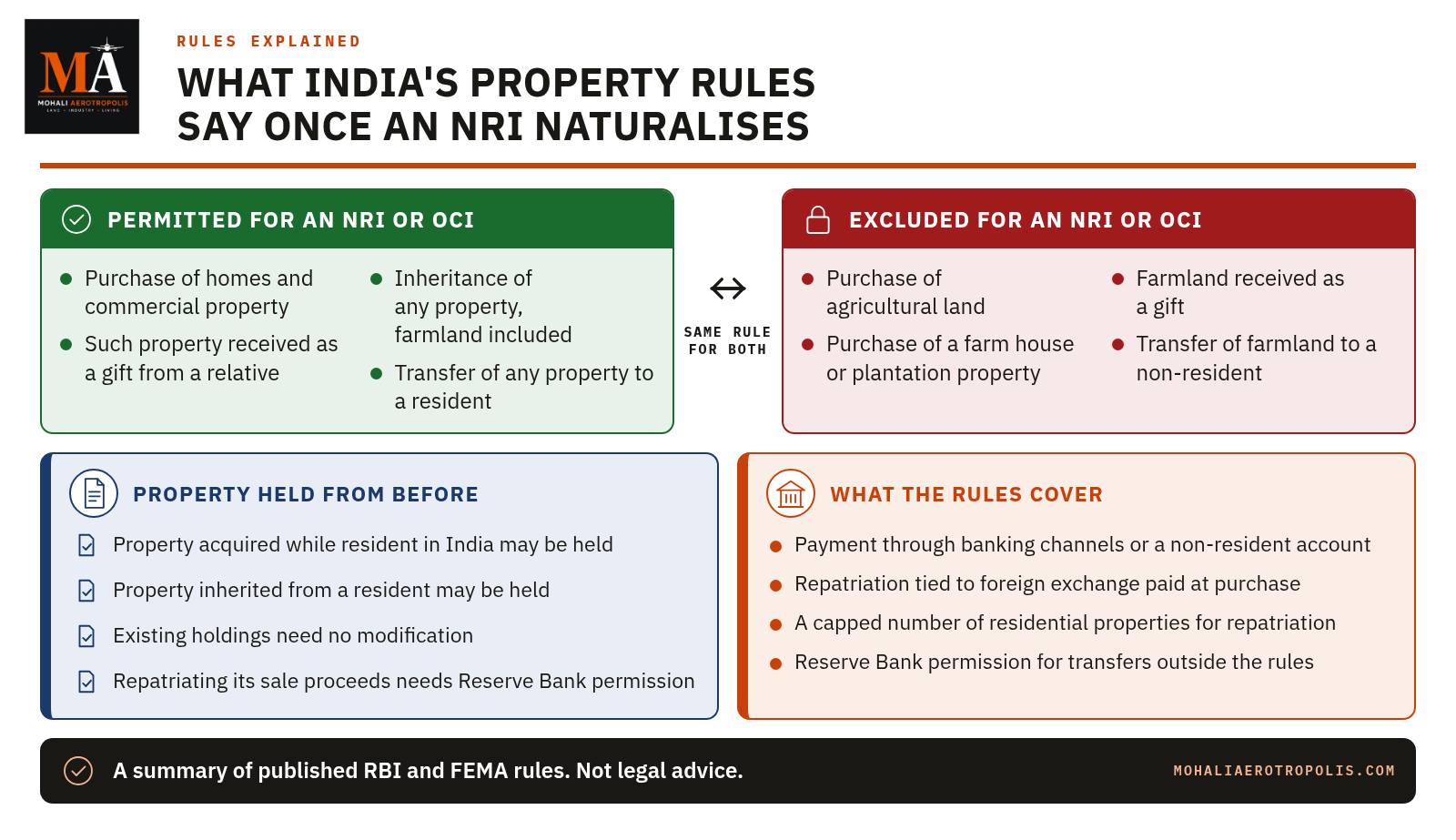
The Farm Exclusion
The exclusion in clause a of rule 24 covers agricultural land and farm houses. Plantation property sits in the same exclusion. The gift permission in clause b carries the same carve out, so an OCI cardholder cannot receive farmland by gift either.
The Reserve Bank's FAQs set this out in a table. In that table the purchase and gift rows for NRIs and OCIs both carry the farm carve out.
Inheritance Is Treated Separately
Clause c of rule 24 permits an NRI or an OCI to acquire any immovable property in India by inheritance. Unlike clauses a and b, it carries no farm exclusion. The Reserve Bank's Master Direction reads it as covering inheritance from a person resident in India, and from a person resident outside India who acquired the property under the foreign exchange law in force at the time.
The exit routes differ by type. Clause d permits transfer of any immovable property to a person resident in India. Clause e permits transfer of property outside the farm category to an NRI or an OCI. Under rule 24, inherited farmland can therefore pass only to a person resident in India.
Property Held From Before
Sub-section five of section six of FEMA lets a person resident outside India hold and transfer immovable property in India that was acquired while that person was resident in India, or inherited from a person resident in India.
Rule 33 of the Non-debt Instruments Rules adds a savings clause. An existing holding acquired under the policy in force at the time of acquisition needs no modification to conform to the current rules.
Repatriation Follows The Original Payment
Sub-rule two of rule 29 lets an authorised dealer allow repatriation of sale proceeds of property outside the farm category sold by an NRI or an OCI. The property has to have been acquired lawfully, and paid for in foreign exchange through banking channels or from an FCNR or NRE account. For residential property, repatriation is capped at a set number of properties.
Sub-rule one of rule 29 treats property held under section six of FEMA differently. Its sale proceeds cannot be repatriated without the general or specific permission of the Reserve Bank. The Master Direction notes that a non-resident may still use the Remittance of Assets Regulations, and the Reserve Bank's FAQs describe an annual cap under them.
Outside Both Definitions
Rule 30 says that, save as otherwise provided, no person resident outside India shall transfer immovable property in India, and that the Reserve Bank may permit a transfer. FEMA defines transfer to include purchase.
For foreign nationals of non-Indian origin resident outside India, the Reserve Bank's FAQs list a lease of limited term and inheritance from a resident. All other acquisitions by foreign nationals need the Reserve Bank's prior permission. The rules name no separate category for a foreign citizen of Indian origin who is not registered as an OCI cardholder.
Rule 25 covers mixed couples. A spouse resident outside India who is neither an NRI nor an OCI may acquire a single property outside the farm category jointly with an NRI or OCI spouse. The marriage has to have been registered and to have subsisted for a set continuous period.
Read together, the rules place an OCI cardholder alongside an NRI for homes and commercial property. Farm purchases are excluded, while inheritance follows its own clause. This article summarises published rules and is not legal advice.
Related Reading
- Can An NRI Buy Property In India? A Mohali Guide
- Buying An Aerotropolis LOI From Abroad As An NRI
Sources
- Foreign Exchange Management Act, 1999, Act No. 42 of 1999, dated 29 December 1999: section 2, clause ze, definition of transfer, and section 6, sub-section 5. Consulted 6 October 2026.
- Foreign Exchange Management Non-debt Instruments Rules, 2019, Ministry of Finance notification S.O. 3732 E dated 17 October 2019, as consolidated on the Reserve Bank website up to 2 September 2026: clauses aj and ak of rule 2; Chapter IX, rule 24, clauses a to e; rule 25; sub-rules 1 and 2 of rule 29; rule 30; rule 33. Consulted 6 October 2026.
- Reserve Bank of India, FED Master Direction No. 12, Acquisition or Transfer of Immovable Property under the Foreign Exchange Management Act, 1999, dated 1 January 2016 and updated to 1 September 2022: Part II, paragraphs 1.2, 3.1, 3.2, 8.1 and 8.2. Consulted 6 October 2026.
- Reserve Bank of India, Frequently Asked Questions on Purchase of Immovable Property, updated 6 April 2023: Part II, questions 1, 4, 6, 7 and 8. Consulted 6 October 2026.
- Reserve Bank of India press release of 29 December 2021, Clarification on Acquisition or Transfer of Immovable Property in India by Overseas Citizens of India, referring to the Supreme Court judgement of 26 February 2021 in Civil Appeal 9546 of 2010. Consulted 6 October 2026.
When an NRI in Canada or the United States takes citizenship there, India's foreign exchange rules decide which property transactions in Mohali remain permitted. Those rules are the Foreign Exchange Management Act and the Non-debt Instruments Rules made under it, which the Reserve Bank administers. On their text, an OCI cardholder stands where an NRI stands for homes and commercial property. Farmland is the exception, and inheritance is treated separately.
The Rules Turn On Two Definitions
Clause aj of rule 2 of the Non-debt Instruments Rules defines an NRI as an individual resident outside India who is a citizen of India. Clause ak of the same rule defines an OCI as an individual resident outside India who is registered as an Overseas Citizen of India Cardholder under the Citizenship Act.
Whether Indian citizenship continues after naturalisation abroad is a question for citizenship law, and these rules do not answer it. What the rules do settle is the consequence. A person who is no longer an Indian citizen falls outside the NRI definition, and falls within the OCI definition only once registered as a cardholder.
Homes And Commercial Property Carry The Same Permission
Clause a of rule 24 permits an NRI or an OCI to acquire immovable property in India, subject to one exclusion for farm property. Clause b permits acquisition of the same kind of property by gift from a relative, as the Companies Act defines that term.
The rule also governs payment. Consideration is to come from funds received in India through banking channels as an inward remittance, or from a non-resident account. The rule bars payment by traveller's cheque or foreign currency notes.
Reports of a Supreme Court judgement led the Reserve Bank to issue a clarification. It said the judgement concerned the old foreign exchange law, which FEMA repealed. It added that NRIs and OCIs need no prior approval from the Reserve Bank to acquire property outside the farm category under Chapter IX of the Rules.
The rules speak of immovable property. They do not mention a letter of intent for a future plot, so the text does not say how an Aerotropolis LOI is treated.
The Farm Exclusion
The exclusion in clause a of rule 24 covers agricultural land and farm houses. Plantation property sits in the same exclusion. The gift permission in clause b carries the same carve out, so an OCI cardholder cannot receive farmland by gift either.
The Reserve Bank's FAQs set this out in a table. In that table the purchase and gift rows for NRIs and OCIs both carry the farm carve out.
Inheritance Is Treated Separately
Clause c of rule 24 permits an NRI or an OCI to acquire any immovable property in India by inheritance. Unlike clauses a and b, it carries no farm exclusion. The Reserve Bank's Master Direction reads it as covering inheritance from a person resident in India, and from a person resident outside India who acquired the property under the foreign exchange law in force at the time.
The exit routes differ by type. Clause d permits transfer of any immovable property to a person resident in India. Clause e permits transfer of property outside the farm category to an NRI or an OCI. Under rule 24, inherited farmland can therefore pass only to a person resident in India.
Property Held From Before
Sub-section five of section six of FEMA lets a person resident outside India hold and transfer immovable property in India that was acquired while that person was resident in India, or inherited from a person resident in India.
Rule 33 of the Non-debt Instruments Rules adds a savings clause. An existing holding acquired under the policy in force at the time of acquisition needs no modification to conform to the current rules.
Repatriation Follows The Original Payment
Sub-rule two of rule 29 lets an authorised dealer allow repatriation of sale proceeds of property outside the farm category sold by an NRI or an OCI. The property has to have been acquired lawfully, and paid for in foreign exchange through banking channels or from an FCNR or NRE account. For residential property, repatriation is capped at a set number of properties.
Sub-rule one of rule 29 treats property held under section six of FEMA differently. Its sale proceeds cannot be repatriated without the general or specific permission of the Reserve Bank. The Master Direction notes that a non-resident may still use the Remittance of Assets Regulations, and the Reserve Bank's FAQs describe an annual cap under them.
Outside Both Definitions
Rule 30 says that, save as otherwise provided, no person resident outside India shall transfer immovable property in India, and that the Reserve Bank may permit a transfer. FEMA defines transfer to include purchase.
For foreign nationals of non-Indian origin resident outside India, the Reserve Bank's FAQs list a lease of limited term and inheritance from a resident. All other acquisitions by foreign nationals need the Reserve Bank's prior permission. The rules name no separate category for a foreign citizen of Indian origin who is not registered as an OCI cardholder.
Rule 25 covers mixed couples. A spouse resident outside India who is neither an NRI nor an OCI may acquire a single property outside the farm category jointly with an NRI or OCI spouse. The marriage has to have been registered and to have subsisted for a set continuous period.
Read together, the rules place an OCI cardholder alongside an NRI for homes and commercial property. Farm purchases are excluded, while inheritance follows its own clause. This article summarises published rules and is not legal advice.
Related Reading
- Can An NRI Buy Property In India? A Mohali Guide
- Buying An Aerotropolis LOI From Abroad As An NRI
Sources
- Foreign Exchange Management Act, 1999, Act No. 42 of 1999, dated 29 December 1999: section 2, clause ze, definition of transfer, and section 6, sub-section 5. Consulted 6 October 2026.
- Foreign Exchange Management Non-debt Instruments Rules, 2019, Ministry of Finance notification S.O. 3732 E dated 17 October 2019, as consolidated on the Reserve Bank website up to 2 September 2026: clauses aj and ak of rule 2; Chapter IX, rule 24, clauses a to e; rule 25; sub-rules 1 and 2 of rule 29; rule 30; rule 33. Consulted 6 October 2026.
- Reserve Bank of India, FED Master Direction No. 12, Acquisition or Transfer of Immovable Property under the Foreign Exchange Management Act, 1999, dated 1 January 2016 and updated to 1 September 2022: Part II, paragraphs 1.2, 3.1, 3.2, 8.1 and 8.2. Consulted 6 October 2026.
- Reserve Bank of India, Frequently Asked Questions on Purchase of Immovable Property, updated 6 April 2023: Part II, questions 1, 4, 6, 7 and 8. Consulted 6 October 2026.
- Reserve Bank of India press release of 29 December 2021, Clarification on Acquisition or Transfer of Immovable Property in India by Overseas Citizens of India, referring to the Supreme Court judgement of 26 February 2021 in Civil Appeal 9546 of 2010. Consulted 6 October 2026.
When an NRI in Canada or the United States takes citizenship there, India's foreign exchange rules decide which property transactions in Mohali remain permitted. Those rules are the Foreign Exchange Management Act and the Non-debt Instruments Rules made under it, which the Reserve Bank administers. On their text, an OCI cardholder stands where an NRI stands for homes and commercial property. Farmland is the exception, and inheritance is treated separately.
The Rules Turn On Two Definitions
Clause aj of rule 2 of the Non-debt Instruments Rules defines an NRI as an individual resident outside India who is a citizen of India. Clause ak of the same rule defines an OCI as an individual resident outside India who is registered as an Overseas Citizen of India Cardholder under the Citizenship Act.
Whether Indian citizenship continues after naturalisation abroad is a question for citizenship law, and these rules do not answer it. What the rules do settle is the consequence. A person who is no longer an Indian citizen falls outside the NRI definition, and falls within the OCI definition only once registered as a cardholder.
Homes And Commercial Property Carry The Same Permission
Clause a of rule 24 permits an NRI or an OCI to acquire immovable property in India, subject to one exclusion for farm property. Clause b permits acquisition of the same kind of property by gift from a relative, as the Companies Act defines that term.
The rule also governs payment. Consideration is to come from funds received in India through banking channels as an inward remittance, or from a non-resident account. The rule bars payment by traveller's cheque or foreign currency notes.
Reports of a Supreme Court judgement led the Reserve Bank to issue a clarification. It said the judgement concerned the old foreign exchange law, which FEMA repealed. It added that NRIs and OCIs need no prior approval from the Reserve Bank to acquire property outside the farm category under Chapter IX of the Rules.
The rules speak of immovable property. They do not mention a letter of intent for a future plot, so the text does not say how an Aerotropolis LOI is treated.
The Farm Exclusion
The exclusion in clause a of rule 24 covers agricultural land and farm houses. Plantation property sits in the same exclusion. The gift permission in clause b carries the same carve out, so an OCI cardholder cannot receive farmland by gift either.
The Reserve Bank's FAQs set this out in a table. In that table the purchase and gift rows for NRIs and OCIs both carry the farm carve out.
Inheritance Is Treated Separately
Clause c of rule 24 permits an NRI or an OCI to acquire any immovable property in India by inheritance. Unlike clauses a and b, it carries no farm exclusion. The Reserve Bank's Master Direction reads it as covering inheritance from a person resident in India, and from a person resident outside India who acquired the property under the foreign exchange law in force at the time.
The exit routes differ by type. Clause d permits transfer of any immovable property to a person resident in India. Clause e permits transfer of property outside the farm category to an NRI or an OCI. Under rule 24, inherited farmland can therefore pass only to a person resident in India.
Property Held From Before
Sub-section five of section six of FEMA lets a person resident outside India hold and transfer immovable property in India that was acquired while that person was resident in India, or inherited from a person resident in India.
Rule 33 of the Non-debt Instruments Rules adds a savings clause. An existing holding acquired under the policy in force at the time of acquisition needs no modification to conform to the current rules.
Repatriation Follows The Original Payment
Sub-rule two of rule 29 lets an authorised dealer allow repatriation of sale proceeds of property outside the farm category sold by an NRI or an OCI. The property has to have been acquired lawfully, and paid for in foreign exchange through banking channels or from an FCNR or NRE account. For residential property, repatriation is capped at a set number of properties.
Sub-rule one of rule 29 treats property held under section six of FEMA differently. Its sale proceeds cannot be repatriated without the general or specific permission of the Reserve Bank. The Master Direction notes that a non-resident may still use the Remittance of Assets Regulations, and the Reserve Bank's FAQs describe an annual cap under them.
Outside Both Definitions
Rule 30 says that, save as otherwise provided, no person resident outside India shall transfer immovable property in India, and that the Reserve Bank may permit a transfer. FEMA defines transfer to include purchase.
For foreign nationals of non-Indian origin resident outside India, the Reserve Bank's FAQs list a lease of limited term and inheritance from a resident. All other acquisitions by foreign nationals need the Reserve Bank's prior permission. The rules name no separate category for a foreign citizen of Indian origin who is not registered as an OCI cardholder.
Rule 25 covers mixed couples. A spouse resident outside India who is neither an NRI nor an OCI may acquire a single property outside the farm category jointly with an NRI or OCI spouse. The marriage has to have been registered and to have subsisted for a set continuous period.
Read together, the rules place an OCI cardholder alongside an NRI for homes and commercial property. Farm purchases are excluded, while inheritance follows its own clause. This article summarises published rules and is not legal advice.
Related Reading
- Can An NRI Buy Property In India? A Mohali Guide
- Buying An Aerotropolis LOI From Abroad As An NRI
Sources
- Foreign Exchange Management Act, 1999, Act No. 42 of 1999, dated 29 December 1999: section 2, clause ze, definition of transfer, and section 6, sub-section 5. Consulted 6 October 2026.
- Foreign Exchange Management Non-debt Instruments Rules, 2019, Ministry of Finance notification S.O. 3732 E dated 17 October 2019, as consolidated on the Reserve Bank website up to 2 September 2026: clauses aj and ak of rule 2; Chapter IX, rule 24, clauses a to e; rule 25; sub-rules 1 and 2 of rule 29; rule 30; rule 33. Consulted 6 October 2026.
- Reserve Bank of India, FED Master Direction No. 12, Acquisition or Transfer of Immovable Property under the Foreign Exchange Management Act, 1999, dated 1 January 2016 and updated to 1 September 2022: Part II, paragraphs 1.2, 3.1, 3.2, 8.1 and 8.2. Consulted 6 October 2026.
- Reserve Bank of India, Frequently Asked Questions on Purchase of Immovable Property, updated 6 April 2023: Part II, questions 1, 4, 6, 7 and 8. Consulted 6 October 2026.
- Reserve Bank of India press release of 29 December 2021, Clarification on Acquisition or Transfer of Immovable Property in India by Overseas Citizens of India, referring to the Supreme Court judgement of 26 February 2021 in Civil Appeal 9546 of 2010. Consulted 6 October 2026.