

Every legally built colony in Punjab rests on one permission, and most buyers have never read one.
A change of land use is the state's consent to stop treating a parcel as agricultural and start treating it as residential, commercial or industrial. Without it, nothing can lawfully be built. It sits upstream of the coloniser's licence, upstream of the layout approval, upstream of RERA registration, and a long way upstream of the brochure.
The Enforcement Directorate's Mohali investigation covers two companies, and they allegedly failed the same document in opposite ways. One at the point it was obtained. One at the point it was relied on.
Between them they describe the two things that can go wrong with a CLU, and therefore the two things worth checking.
When a CLU is needed, and when it is not
The answer is not always.
If land is already designated for the intended use under the applicable master plan, a change of land use may not be required at all. The permission exists to move a parcel from one category to another. Land already sitting in the right category has nothing to change.
The plan tells you what category the land is in. The CLU tells you whether permission was granted to move it out of that category. A parcel can be correctly zoned and have no CLU because none was needed, and a parcel can have a CLU and still be subject to everything else.
How one is actually obtained
GMADA publishes its own checklist, and it is short enough to read in full.
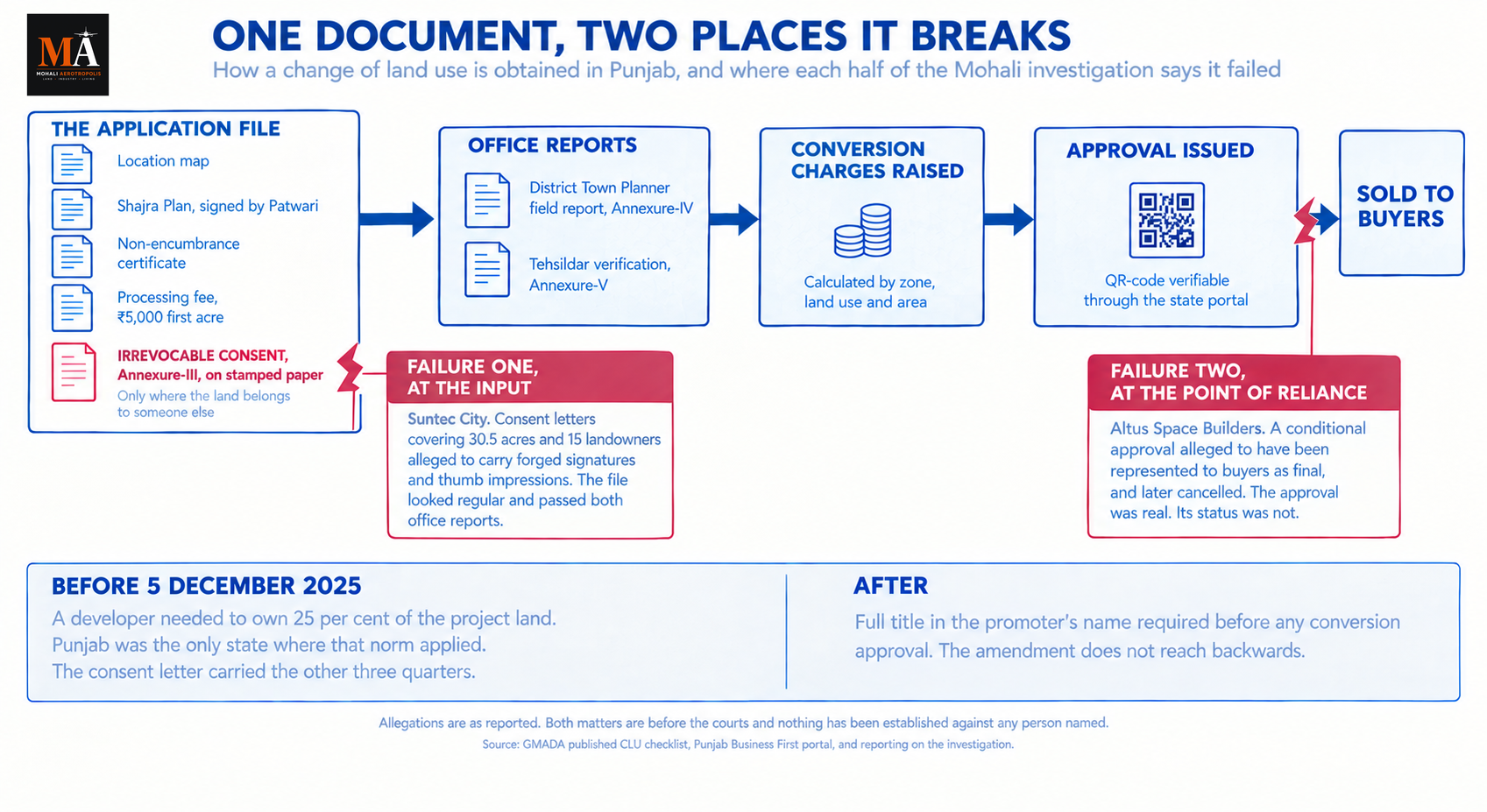
The applicant files a location map showing the site and nearby roads, a copy of the Shajra Plan signed by the Patwari, proof of ownership in the form of a Fard Jamabandi no older than two months together with copies of sale deeds, a non-encumbrance certificate issued by the concerned Tehsildar, and a processing fee by draft. That fee is ₹5,000 for the first acre and ₹1,000 for every subsequent acre, under state government memo 18/65/2005-6hg-2/7102 dated 14 July 2005.
Two office reports then follow. The District Town Planner files a field report against the checklist at Annexure-IV, and the Tehsildar files a verification report against the checklist at Annexure-V. If the documents are in order, GMADA raises a demand for conversion charges at notified rates immediately.
Five thousand rupees is the cost of being considered. The conversion charges that follow, along with external development charges and the social infrastructure levy, are the real money and they are calculated by zone, land use and area.
Applications now run through the state's Business First portal, where an applicant registers, files a Common Application Form, receives a project identification number, pays an auto-calculated fee, and the department issues what the state describes as a QR-code-based verifiable approval, with a stated delivery time of 23 days. GMADA's own note attaches a condition to that: the time schedule is valid where the CLU is issued at local level.
The document at the centre of the first case
Where the land belongs to someone other than the applicant, the file must contain a copy of irrevocable consent, in the specimen form at Annexure-III of the authority's own documents, executed on non-judicial stamp paper, authorising the promoter to obtain the CLU and the licence for developing a colony on that land.
That is the document. A promoter who does not own the land is permitted to apply, provided the owners have consented in a specified form on stamped paper. It stands in place of the Fard Jamabandi and the sale deeds that an owner-applicant would file.
In the Suntec City matter, the Enforcement Directorate alleges that consent letters covering 30.5 acres belonging to 15 landowners carried forged signatures and thumb impressions, and were used to obtain the approval. An FIR was registered at Mullanpur police station in November 2022, and GMADA subsequently cancelled the society's licence after litigation in the High Court.
So the first failure mode is at the input. The approval itself may look entirely regular, because on the file it is. The defect sits in a document the authority required and accepted, and it survived a District Town Planner's field report and a Tehsildar's verification before it surfaced, which it only did when the actual owners said the signature was not theirs.
Why the consent route existed in the first place
Until last year, Punjab required a developer to own only 25 per cent of the project land before proceeding with a CLU, provided a registered agreement covered the rest. According to The Tribune's explainer on this investigation, Punjab was the only state in the country where that norm prevailed. Haryana, Maharashtra and Uttar Pradesh required either full ownership or collaboration agreements with the landowners.
That 25 per cent threshold is what made the consent letter load-bearing. Three quarters of a project's land could belong to somebody else, and the document standing between the promoter and the approval was a signature on stamped paper.
On 5 December 2025 the Department of Housing and Urban Development notified an amendment to Section 5 of the Punjab Apartment and Property Regulation Act, 1995, requiring the entire project land to be registered in the promoter's clear title before any conversion approval is granted. The same amendment requires a mortgage deed at 90 per cent of the collector rate to secure unpaid external development charges, and bars a developer who fails to pay EDC or complete a project from obtaining further approvals until the dues are cleared.
The change closes the route the first failure mode ran through. It does not reach backwards. Every approval granted before December 2025 was granted under the 25 per cent regime, which is most of what is standing in this district.
The second case attacks the same document from the other end
The Altus Space Builders matter is not a consent case at all.
The allegation there, per reporting on the ED's investigation, is that buyers were induced by a representation that the project held final CLU clearance from GMADA, when the approval was in fact conditional and was subsequently cancelled. A police FIR was registered at Phase 11 police station in Mohali in February 2024 against the company and its director under the Bharatiya Nyaya Sanhita, and the ED has reportedly moved a court at Kharar seeking registration of a further FIR.
That last detail connects to something running through the whole investigation. The ED has separately said it emailed the Mohali Senior Superintendent of Police five times since July seeking the registration of new offences over the cheating of farmers, received no response on that point, and summoned him. An agency asking a court to order an FIR, and an agency summoning a district police chief over unregistered offences, are the same problem appearing twice.
Conditional approval is an ordinary feature of this system rather than an anomaly. CLU and layout sanctions routinely come with conditions attached: phased development, infrastructure obligations, time-bound compliances. Approvals also carry a validity period rather than running indefinitely.
Which produces the second failure mode. The consent was real, the application was real, the approval was real. What was not real was its status at the moment it was described to a buyer, and a conditional approval that is later cancelled leaves everything built on it standing on nothing.
Between the two cases, "the project has CLU" is not a complete statement. It has to be followed by two more questions.
The two questions, and how to answer them
Was the consent genuine? This one a buyer cannot verify directly, because the consent sits inside the promoter's application file. What a buyer can establish is whether the promoter owned the land outright, in which case the file runs on Jamabandi and sale deeds, or applied on somebody else's consent, in which case Annexure-III is doing the work. And whether any of the recorded owners have since litigated. A land where the owners are in court against the promoter is a land where the consent question is live.
The December 2025 amendment gives that question a date. An approval granted after it should rest on full title. An approval granted before it may rest on a quarter of the land and a stack of consent letters, and the revenue records for the whole project land are the way to tell.
Is the approval final, unconditional and current? This one is checkable. Ask whether the CLU is final or conditional. Ask what conditions attach and whether they have been met. Ask for the validity period and the date. And ask for the document itself.
That last request is where the QR code earns its place. Approvals issued through the state portal are described as QR-code-based and verifiable, which means the copy in front of you either scans to a live record or it does not. A promoter who cannot produce a CLU copy that verifies, or who says the approval is in process or coming shortly, has answered the question.
What a CLU still does not give you
Where the area demarcated by revenue authorities differs from the area in the revenue records, GMADA's procedure allows the CLU and levies charges on the actual area, but it confers no legal rights as to ownership. The permission changes what land may be used for. It does not establish whose land it is.
Nor is it a layout approval. A CLU changes the recorded use of the land. The layout approval sanctions what goes inside it: the plot sizes, the roads, the parks, the services. Most projects need both, and having one says nothing about the other.
Nor is it a coloniser's licence. The licence under the Punjab Apartment and Property Regulation Act is a separate permission, granted after the CLU, and it is the one that entitles a promoter to develop and sell.
And it is not RERA registration, which is a further requirement again for projects being marketed as units.
Our buyer's guide covers how the document set stacks, the glossary sets out the terms, and our report on the CLU trail follows the Suntec City investigation in detail.
A change of land use is a single document that everything else is built on, it can be defective at the moment it is obtained or at the moment it is described, and the two halves of one investigation in this district have now produced an example of each.
None of the above is legal advice, both matters are before the courts, and nothing has been established against any person named.
---
Sources
- Permission for Change of Land Use, Greater Mohali Area Development Authority, for the document checklist, the Shajra Plan, the Fard Jamabandi and sale deeds, the non-encumbrance certificate, the irrevocable consent at Annexure-III on non-judicial stamp paper, the processing fee and the 2005 memo, the District Town Planner and Tehsildar reports at Annexures IV and V, the raising of conversion charges, the local-level time schedule condition, and the clause on area discrepancy conferring no legal rights as to ownership
- Change of Land Use (CLU) from Housing and Urban Development in Punjab, National Government Services Portal, for the Business First application route, the Common Application Form and project identification number, the QR-code-based verifiable approval and the 23 day delivery time
- Explainer: Punjab's Change of Land Use scam unravels, The Tribune, May 2026, on the 25 per cent ownership norm, Punjab being the only state where it prevailed, the comparison with Haryana, Maharashtra and Uttar Pradesh, and the 2025 amendment
- Punjab tightens real estate rules: full land title now mandatory for CLU approvals, Outlook Money, December 2025, on the Department of Housing and Urban Development notification of 5 December 2025, the amendment to Section 5 of PAPRA, the mortgage deed at 90 per cent of collector rate, and the bar on future approvals for unpaid EDC
- Apply for Change of Land Use, Punjab Urban Planning and Development Authority, for the application route outside GMADA's jurisdiction
- ED raids Suntec City, Altus Space Builders in Punjab CLU scam, PTC News, May 2026, for the allegation that Altus represented a conditional and later cancelled CLU as final clearance, and for the February 2024 FIR at Phase 11 police station
- Rs 21 lakh cash thrown from 9th floor balcony during ED raid linked to land fraud scam in Mohali, India TV, 7 May 2026, for the forged consent allegation, the November 2022 FIR at Mullanpur police station and the sections invoked
- Former Punjab Chief Secretary Anurag Verma appears before ED in Suntec City case, Deepkamal Kaur, The Tribune, 9 September 2026, for the five emails to the Mohali SSP and the summons over registration of new offences
पंजाब में हर कानूनी रूप से बनी कॉलोनी एक अनुमति पर टिकी है, और ज़्यादातर खरीदारों ने उसे कभी पढ़ा ही नहीं है।
भूमि उपयोग का परिवर्तन (change of land use) राज्य की उस सहमति है जिसके तहत वह किसी भूखंड को कृषि भूमि मानना बंद करके उसे आवासीय, वाणिज्यिक या औद्योगिक मानना शुरू करता है। इसके बिना कुछ भी कानूनी रूप से नहीं बनाया जा सकता। यह कॉलोनाइज़र के लाइसेंस से पहले आता है, लेआउट अनुमोदन से पहले, RERA पंजीकरण से पहले, और ब्रोशर से तो बहुत पहले।
प्रवर्तन निदेशालय (Enforcement Directorate) की मोहाली जाँच में दो कंपनियाँ शामिल हैं, और कथित तौर पर उन्होंने एक ही दस्तावेज़ में विपरीत तरीकों से चूक की। एक ने उस समय जब वह प्राप्त किया गया। दूसरे ने उस समय जब उस पर भरोसा किया गया।
ये दोनों मिलकर उन दो चीज़ों का वर्णन करते हैं जो एक CLU के साथ गलत हो सकती हैं, और इसलिए वे दो चीज़ें जिन्हें जाँचने लायक है।
CLU कब ज़रूरी है, और कब नहीं
जवाब हमेशा नहीं होता।
अगर भूमि पहले से ही लागू मास्टर प्लान के तहत इच्छित उपयोग के लिए निर्धारित है, तो भूमि उपयोग का परिवर्तन बिल्कुल भी आवश्यक नहीं हो सकता। यह अनुमति किसी भूखंड को एक श्रेणी से दूसरी में ले जाने के लिए होती है। जो भूमि पहले से सही श्रेणी में है, उसमें बदलने के लिए कुछ नहीं है।
प्लान आपको बताता है कि भूमि किस श्रेणी में है। CLU आपको बताता है कि उस श्रेणी से बाहर ले जाने की अनुमति दी गई थी या नहीं। एक भूखंड सही ज़ोनिंग वाला हो सकता है और उसका कोई CLU न हो क्योंकि ज़रूरत ही नहीं थी, और एक भूखंड का CLU हो सकता है और फिर भी वह बाकी सब कुछ के अधीन हो सकता है।
यह वास्तव में कैसे प्राप्त किया जाता है
GMADA अपनी चेकलिस्ट प्रकाशित करता है, और वह इतनी छोटी है कि पूरी पढ़ी जा सके।
आवेदक साइट और आसपास की सड़कों को दर्शाने वाला एक स्थान मानचित्र (location map), पटवारी द्वारा हस्ताक्षरित शजरा प्लान (Shajra Plan) की एक प्रति, स्वामित्व का प्रमाण दो महीने से पुरानी न हो ऐसी फर्द जमाबंदी (Fard Jamabandi) के रूप में विक्रय विलेखों (sale deeds) की प्रतियों सहित, संबंधित तहसीलदार द्वारा जारी गैर-भार प्रमाणपत्र (non-encumbrance certificate), और ड्राफ्ट द्वारा एक प्रोसेसिंग शुल्क जमा करता है। वह शुल्क पहले एकड़ के लिए ₹5,000 और हर अगले एकड़ के लिए ₹1,000 है, राज्य सरकार के ज्ञापन 18/65/2005-6hg-2/7102 दिनांक 14 जुलाई 2005 के तहत।
इसके बाद दो कार्यालय रिपोर्टें आती हैं। जिला नगर योजनाकार (District Town Planner) अनुलग्नक-IV पर चेकलिस्ट के अनुसार एक फील्ड रिपोर्ट दाखिल करता है, और तहसीलदार अनुलग्नक-V पर चेकलिस्ट के अनुसार एक सत्यापन रिपोर्ट दाखिल करता है। यदि दस्तावेज़ ठीक हैं, तो GMADA तुरंत अधिसूचित दरों पर परिवर्तन शुल्क (conversion charges) की माँग उठाता है।
पाँच हज़ार रुपये विचार किए जाने की लागत है। इसके बाद आने वाले परिवर्तन शुल्क, बाह्य विकास शुल्क (external development charges) और सामाजिक अवसंरचना उपकर (social infrastructure levy) के साथ, असली पैसा हैं और इनकी गणना ज़ोन, भूमि उपयोग और क्षेत्रफल के आधार पर की जाती है।
आवेदन अब राज्य के Business First पोर्टल के माध्यम से चलते हैं, जहाँ आवेदक पंजीकरण करता है, एक Common Application Form दाखिल करता है, एक परियोजना पहचान संख्या (project identification number) प्राप्त करता है, स्वतः-गणना किया गया शुल्क भुगतान करता है, और विभाग वह जारी करता है जिसे राज्य QR-कोड-आधारित सत्यापन योग्य अनुमोदन (QR-code-based verifiable approval) बताता है, जिसका निर्धारित वितरण समय 23 दिन है। GMADA का अपना नोट उस पर एक शर्त जोड़ता है: समय सारणी वहाँ मान्य है जहाँ CLU स्थानीय स्तर पर जारी किया जाता है।
पहले मामले के केंद्र में मौजूद दस्तावेज़
जहाँ भूमि आवेदक के अलावा किसी और की है, वहाँ फ़ाइल में अपरिवर्तनीय सहमति की एक प्रति (copy of irrevocable consent) होनी चाहिए, जो प्राधिकरण के अपने दस्तावेज़ों के अनुलग्नक-III में दिए नमूना प्रपत्र में हो, गैर-न्यायिक स्टाम्प पेपर पर निष्पादित हो, और प्रमोटर को उस भूमि पर कॉलोनी विकसित करने के लिए CLU और लाइसेंस प्राप्त करने का अधिकार देती हो।
वही दस्तावेज़ है। जो प्रमोटर भूमि का मालिक नहीं है, उसे आवेदन करने की अनुमति है, बशर्ते मालिकों ने स्टाम्प पेपर पर एक निर्दिष्ट प्रपत्र में सहमति दी हो। यह उस फर्द जमाबंदी और विक्रय विलेखों के स्थान पर आता है जो एक मालिक-आवेदक दाखिल करता।
Suntec City मामले में, प्रवर्तन निदेशालय का आरोप है कि 15 भूमि मालिकों से संबंधित 30.5 एकड़ को कवर करने वाले सहमति पत्रों पर जाली हस्ताक्षर और अंगूठे के निशान थे, और इन्हें अनुमोदन प्राप्त करने के लिए इस्तेमाल किया गया। नवंबर 2022 में मुल्लांपुर पुलिस स्टेशन में एक FIR दर्ज की गई, और GMADA ने बाद में उच्च न्यायालय में मुकदमेबाज़ी के बाद सोसाइटी का लाइसेंस रद्द कर दिया।
तो पहली विफलता का तरीका इनपुट पर है। अनुमोदन स्वयं पूरी तरह नियमित दिख सकता है, क्योंकि फ़ाइल पर वह है भी। दोष उस दस्तावेज़ में है जिसकी प्राधिकरण ने माँग की और स्वीकार किया, और वह जिला नगर योजनाकार की फील्ड रिपोर्ट और तहसीलदार के सत्यापन से भी बच निकला, जो तभी सामने आया जब असली मालिकों ने कहा कि हस्ताक्षर उनके नहीं हैं।
सहमति मार्ग पहली जगह क्यों मौजूद था
पिछले साल तक, पंजाब में एक डेवलपर को CLU के साथ आगे बढ़ने से पहले परियोजना भूमि का केवल 25 प्रतिशत स्वामित्व रखने की आवश्यकता थी, बशर्ते शेष के लिए एक पंजीकृत समझौता हो। इस जाँच पर The Tribune के व्याख्यात्मक लेख के अनुसार, पंजाब देश का एकमात्र राज्य था जहाँ यह मानदंड प्रचलित था। हरियाणा, महाराष्ट्र और उत्तर प्रदेश में या तो पूर्ण स्वामित्व या भूमि मालिकों के साथ सहयोग समझौतों की आवश्यकता थी।
वही 25 प्रतिशत की सीमा सहमति पत्र को इतना महत्वपूर्ण बनाती थी। किसी परियोजना की भूमि का तीन-चौथाई किसी और का हो सकता था, और प्रमोटर और अनुमोदन के बीच खड़ा दस्तावेज़ स्टाम्प पेपर पर एक हस्ताक्षर था।
5 दिसंबर 2025 को आवास और शहरी विकास विभाग (Department of Housing and Urban Development) ने पंजाब अपार्टमेंट एंड प्रॉपर्टी रेगुलेशन एक्ट, 1995 की धारा 5 में एक संशोधन अधिसूचित किया, जिसमें कोई भी परिवर्तन अनुमोदन दिए जाने से पहले पूरी परियोजना भूमि को प्रमोटर के स्पष्ट स्वामित्व में पंजीकृत होना आवश्यक बनाया गया। वही संशोधन बकाया बाह्य विकास शुल्क को सुरक्षित करने के लिए संग्रहकर्ता दर के 90 प्रतिशत पर एक बंधक विलेख (mortgage deed) की आवश्यकता रखता है, और उस डेवलपर को प्रतिबंधित करता है जो EDC का भुगतान करने या परियोजना पूरी करने में विफल रहता है, बकाया चुकाए जाने तक आगे के अनुमोदन प्राप्त करने से।
यह परिवर्तन उस मार्ग को बंद कर देता है जिससे पहली विफलता का तरीका गुज़रता था। यह पीछे की ओर तक नहीं पहुँचता। दिसंबर 2025 से पहले दिया गया हर अनुमोदन 25 प्रतिशत व्यवस्था के तहत दिया गया था, जो इस जिले में खड़ी ज़्यादातर चीज़ें हैं।
दूसरा मामला उसी दस्तावेज़ पर दूसरे छोर से हमला करता है
Altus Space Builders का मामला सहमति का मामला बिल्कुल नहीं है।
वहाँ का आरोप, ED की जाँच पर रिपोर्टिंग के अनुसार, यह है कि खरीदारों को इस प्रस्तुति द्वारा प्रेरित किया गया कि परियोजना के पास GMADA से अंतिम CLU मंज़ूरी है, जबकि अनुमोदन वास्तव में सशर्त था और बाद में रद्द कर दिया गया। फरवरी 2024 में मोहाली के फेज़ 11 पुलिस स्टेशन में भारतीय न्याय संहिता के तहत कंपनी और उसके निदेशक के खिलाफ एक पुलिस FIR दर्ज की गई, और बताया जाता है कि ED ने एक और FIR दर्ज कराने के लिए खरड़ की एक अदालत में याचिका दायर की है।
वह अंतिम विवरण पूरी जाँच में चल रही किसी चीज़ से जुड़ता है। ED ने अलग से कहा है कि उसने जुलाई से पाँच बार मोहाली के वरिष्ठ पुलिस अधीक्षक (Senior Superintendent of Police) को ईमेल किया, किसानों के साथ धोखाधड़ी पर नए अपराध दर्ज करने की माँग की, उस बिंदु पर कोई प्रतिक्रिया नहीं मिली, और उन्हें समन भेजा। एक एजेंसी का अदालत से FIR का आदेश देने की माँग करना, और एक एजेंसी का एक जिला पुलिस प्रमुख को अपंजीकृत अपराधों पर समन भेजना, एक ही समस्या दो बार सामने आना है।
सशर्त अनुमोदन इस प्रणाली की एक सामान्य विशेषता है, विसंगति नहीं। CLU और लेआउट मंज़ूरियाँ नियमित रूप से शर्तें जोड़कर आती हैं: चरणबद्ध विकास, अवसंरचना दायित्व, समयबद्ध अनुपालन। अनुमोदनों में अनिश्चित काल तक चलने के बजाय एक वैधता अवधि भी होती है।
जो दूसरी विफलता का तरीका उत्पन्न करती है। सहमति असली थी, आवेदन असली था, अनुमोदन असली था। जो असली नहीं था वह खरीदार को बताए जाने के क्षण में उसकी स्थिति थी, और बाद में रद्द किया गया सशर्त अनुमोदन उस पर बनी हर चीज़ को कुछ भी नहीं पर खड़ा छोड़ देता है।
दोनों मामलों के बीच, "परियोजना के पास CLU है" एक पूर्ण कथन नहीं है। इसके बाद दो और प्रश्न आने चाहिए।
दो प्रश्न, और उनके उत्तर कैसे दें
क्या सहमति वास्तविक थी? इसे एक खरीदार सीधे सत्यापित नहीं कर सकता, क्योंकि सहमति प्रमोटर की आवेदन फ़ाइल के अंदर होती है। एक खरीदार जो स्थापित कर सकता है वह यह है कि क्या प्रमोटर भूमि का पूर्ण स्वामी था, जिस स्थिति में फ़ाइल जमाबंदी और विक्रय विलेखों पर चलती है, या किसी और की सहमति पर आवेदन किया, जिस स्थिति में अनुलग्नक-III काम कर रहा है। और यह कि क्या अभिलिखित मालिकों में से किसी ने तब से मुकदमा किया है। जिस भूमि पर मालिक प्रमोटर के खिलाफ अदालत में हैं, वह भूमि ऐसी है जहाँ सहमति का प्रश्न जीवित है।
दिसंबर 2025 का संशोधन उस प्रश्न को एक तारीख देता है। उसके बाद दिया गया अनुमोदन पूर्ण स्वामित्व पर टिका होना चाहिए। उससे पहले दिया गया अनुमोदन भूमि के एक चौथाई और सहमति पत्रों के ढेर पर टिका हो सकता है, और पूरी परियोजना भूमि के राजस्व अभिलेख इसे बताने का तरीका हैं।
क्या अनुमोदन अंतिम, बिना शर्त और वर्तमान है? इसे जाँचा जा सकता है। पूछें कि CLU अंतिम है या सशर्त। पूछें कि कौन सी शर्तें जुड़ी हैं और क्या वे पूरी हुई हैं। वैधता अवधि और तारीख माँगें। और दस्तावेज़ स्वयं माँगें।
वह अंतिम अनुरोध वह जगह है जहाँ QR कोड अपनी जगह कमाता है। राज्य पोर्टल के माध्यम से जारी अनुमोदनों को QR-कोड-आधारित और सत्यापन योग्य बताया जाता है, जिसका अर्थ है कि आपके सामने रखी प्रति या तो एक जीवंत अभिलेख तक स्कैन होती है या नहीं। जो प्रमोटर सत्यापित होने वाली CLU प्रति प्रस्तुत नहीं कर सकता, या जो कहता है कि अनुमोदन प्रक्रिया में है या जल्द ही आ रहा है, उसने प्रश्न का उत्तर दे दिया है।
एक CLU फिर भी आपको क्या नहीं देता
जहाँ राजस्व अधिकारियों द्वारा सीमांकित क्षेत्र राजस्व अभिलेखों में दर्ज क्षेत्र से भिन्न है, वहाँ GMADA की प्रक्रिया CLU की अनुमति देती है और वास्तविक क्षेत्र पर शुल्क लगाती है, लेकिन यह स्वामित्व के संबंध में कोई कानूनी अधिकार प्रदान नहीं करती। यह अनुमति बदलती है कि भूमि का उपयोग किस लिए किया जा सकता है। यह स्थापित नहीं करती कि भूमि किसकी है।
यह लेआउट अनुमोदन भी नहीं है। एक CLU भूमि के अभिलिखित उपयोग को बदलता है। लेआउट अनुमोदन उसके अंदर जो आता है उसे मंज़ूरी देता है: प्लॉट के आकार, सड़कें, पार्क, सेवाएँ। ज़्यादातर परियोजनाओं को दोनों की आवश्यकता होती है, और एक का होना दूसरे के बारे में कुछ नहीं बताता।
यह कॉलोनाइज़र का लाइसेंस भी नहीं है। पंजाब अपार्टमेंट एंड प्रॉपर्टी रेगुलेशन एक्ट के तहत लाइसेंस एक अलग अनुमति है, जो CLU के बाद दी जाती है, और यही वह है जो एक प्रमोटर को विकसित करने और बेचने का हक देती है।
और यह RERA पंजीकरण नहीं है, जो इकाइयों के रूप में विपणन की जा रही परियोजनाओं के लिए एक और अतिरिक्त आवश्यकता है।
हमारी खरीदार मार्गदर्शिका बताती है कि दस्तावेज़ समूह कैसे एक के ऊपर एक बनते हैं, शब्दावली शब्दों को परिभाषित करती है, और CLU ट्रेल पर हमारी रिपोर्ट Suntec City जाँच का विस्तार से अनुसरण करती है।
भूमि उपयोग का परिवर्तन एक ऐसा एकल दस्तावेज़ है जिस पर बाकी सब कुछ बनाया जाता है, यह उस समय दोषपूर्ण हो सकता है जब इसे प्राप्त किया गया हो या उस समय जब इसका वर्णन किया गया हो, और इस जिले में एक ही जाँच के दोनों हिस्सों ने अब हर एक का एक उदाहरण प्रस्तुत किया है।
ऊपर दिया गया कुछ भी कानूनी सलाह नहीं है, दोनों मामले अदालतों में विचाराधीन हैं, और नामित किसी भी व्यक्ति के खिलाफ कुछ भी सिद्ध नहीं हुआ है।
---
स्रोत
- Permission for Change of Land Use, ग्रेटर मोहाली एरिया डेवलपमेंट अथॉरिटी, दस्तावेज़ चेकलिस्ट, शजरा प्लान, फर्द जमाबंदी और विक्रय विलेख, गैर-भार प्रमाणपत्र, गैर-न्यायिक स्टाम्प पेपर पर अनुलग्नक-III में अपरिवर्तनीय सहमति, प्रोसेसिंग शुल्क और 2005 का ज्ञापन, अनुलग्नक IV और V में जिला नगर योजनाकार और तहसीलदार रिपोर्ट, परिवर्तन शुल्क की माँग, स्थानीय-स्तर समय सारणी की शर्त, और क्षेत्र विसंगति पर स्वामित्व के संबंध में कोई कानूनी अधिकार न देने वाले खंड के लिए
- [Change of Land Use (CLU) from Housing and Urban Development in Punjab](https://services.india.gov.in/service/detail/change-of-land-use-clu-from-local-government-in-punj
ਪੰਜਾਬ ਦੀ ਹਰ ਕਾਨੂੰਨੀ ਤੌਰ ‘ਤੇ ਬਣੀ ਕਲੋਨੀ ਇੱਕ ਇਜਾਜ਼ਤ ‘ਤੇ ਟਿਕੀ ਹੁੰਦੀ ਹੈ, ਅਤੇ ਜ਼ਿਆਦਾਤਰ ਖਰੀਦਦਾਰਾਂ ਨੇ ਕਦੇ ਉਹ ਇਜਾਜ਼ਤ ਪੜ੍ਹੀ ਵੀ ਨਹੀਂ ਹੁੰਦੀ।
ਜ਼ਮੀਨ ਦੀ ਵਰਤੋਂ ਵਿੱਚ ਤਬਦੀਲੀ (Change of Land Use) ਰਾਜ ਦੀ ਇਹ ਸਹਿਮਤੀ ਹੁੰਦੀ ਹੈ ਕਿ ਉਹ ਕਿਸੇ ਜ਼ਮੀਨੀ ਟੁਕੜੇ ਨੂੰ ਖੇਤੀ ਵਾਲੀ ਨਾ ਮੰਨ ਕੇ ਹੁਣ ਰਿਹਾਇਸ਼ੀ, ਵਪਾਰਕ ਜਾਂ ਉਦਯੋਗਿਕ ਮੰਨੇਗਾ। ਇਸ ਤੋਂ ਬਿਨਾਂ ਕਾਨੂੰਨੀ ਤੌਰ ‘ਤੇ ਕੁਝ ਵੀ ਨਹੀਂ ਬਣਾਇਆ ਜਾ ਸਕਦਾ। ਇਹ coloniser ਦੇ ਲਾਇਸੈਂਸ ਤੋਂ ਪਹਿਲਾਂ ਆਉਂਦੀ ਹੈ, layout approval ਤੋਂ ਪਹਿਲਾਂ ਆਉਂਦੀ ਹੈ, RERA ਰਜਿਸਟ੍ਰੇਸ਼ਨ ਤੋਂ ਪਹਿਲਾਂ ਆਉਂਦੀ ਹੈ, ਅਤੇ brochure ਤੋਂ ਤਾਂ ਬਹੁਤ ਪਹਿਲਾਂ ਆਉਂਦੀ ਹੈ।
Enforcement Directorate ਦੀ ਮੋਹਾਲੀ ਜਾਂਚ ਦੋ ਕੰਪਨੀਆਂ ਨੂੰ ਕਵਰ ਕਰਦੀ ਹੈ, ਅਤੇ ਉਨ੍ਹਾਂ ‘ਤੇ ਇਲਜ਼ਾਮ ਹੈ ਕਿ ਉਨ੍ਹਾਂ ਦੋਹਾਂ ਨੇ ਇੱਕੋ ਦਸਤਾਵੇਜ਼ ਨੂੰ ਉਲਟ-ਉਲਟ ਤਰੀਕਿਆਂ ਨਾਲ ਫੇਲ੍ਹ ਕੀਤਾ। ਇੱਕ ਨੇ ਉਸ ਵੇਲੇ, ਜਦੋਂ ਇਹ ਲਿਆ ਗਿਆ ਸੀ। ਦੂਜੇ ਨੇ ਉਸ ਵੇਲੇ, ਜਦੋਂ ਇਸ ‘ਤੇ ਭਰੋਸਾ ਕੀਤਾ ਗਿਆ ਸੀ।
ਇਹ ਦੋਵੇਂ ਮਿਲ ਕੇ ਉਹ ਦੋ ਗੱਲਾਂ ਦੱਸਦੇ ਹਨ ਜੋ ਇੱਕ CLU ਨਾਲ ਗਲਤ ਹੋ ਸਕਦੀਆਂ ਹਨ, ਅਤੇ ਇਸ ਲਈ ਉਹ ਦੋ ਗੱਲਾਂ ਵੀ ਦੱਸਦੇ ਹਨ ਜੋ ਜਾਂਚਣ ਯੋਗ ਹਨ।
CLU ਕਦੋਂ ਲੋੜੀਂਦੀ ਹੈ, ਅਤੇ ਕਦੋਂ ਨਹੀਂ
ਜਵਾਬ ਹਮੇਸ਼ਾ ਨਹੀਂ ਹੁੰਦਾ।
ਜੇ ਜ਼ਮੀਨ ਲਾਗੂ master plan ਅਧੀਨ ਪਹਿਲਾਂ ਹੀ ਮਕਸਦ ਵਾਲੀ ਵਰਤੋਂ ਲਈ ਨਿਰਧਾਰਤ ਹੈ, ਤਾਂ ਜ਼ਮੀਨ ਦੀ ਵਰਤੋਂ ਵਿੱਚ ਤਬਦੀਲੀ ਦੀ ਲੋੜ ਬਿਲਕੁਲ ਵੀ ਨਹੀਂ ਹੋ ਸਕਦੀ। ਇਹ ਇਜਾਜ਼ਤ ਕਿਸੇ ਟੁਕੜੇ ਨੂੰ ਇੱਕ ਸ਼੍ਰੇਣੀ ਤੋਂ ਦੂਜੀ ਵਿੱਚ ਲਿਜਾਣ ਲਈ ਹੁੰਦੀ ਹੈ। ਜੋ ਜ਼ਮੀਨ ਪਹਿਲਾਂ ਹੀ ਸਹੀ ਸ਼੍ਰੇਣੀ ਵਿੱਚ ਹੈ, ਉਸ ਵਿੱਚ ਬਦਲਣ ਲਈ ਕੁਝ ਨਹੀਂ ਹੁੰਦਾ।
Plan ਤੁਹਾਨੂੰ ਦੱਸਦਾ ਹੈ ਕਿ ਜ਼ਮੀਨ ਕਿਹੜੀ ਸ਼੍ਰੇਣੀ ਵਿੱਚ ਹੈ। CLU ਤੁਹਾਨੂੰ ਦੱਸਦੀ ਹੈ ਕਿ ਉਸ ਸ਼੍ਰੇਣੀ ਵਿੱਚੋਂ ਬਾਹਰ ਕੱਢਣ ਦੀ ਇਜਾਜ਼ਤ ਦਿੱਤੀ ਗਈ ਸੀ ਜਾਂ ਨਹੀਂ। ਇੱਕ ਟੁਕੜਾ ਸਹੀ ਜ਼ੋਨ ਵਿੱਚ ਹੋ ਸਕਦਾ ਹੈ ਅਤੇ ਉਸ ਕੋਲ CLU ਨਾ ਹੋਵੇ ਕਿਉਂਕਿ ਲੋੜ ਹੀ ਨਹੀਂ ਸੀ, ਅਤੇ ਇੱਕ ਟੁਕੜੇ ਕੋਲ CLU ਹੋ ਸਕਦੀ ਹੈ ਅਤੇ ਫਿਰ ਵੀ ਬਾਕੀ ਸਭ ਕੁਝ ਲਾਗੂ ਹੋ ਸਕਦਾ ਹੈ।
ਇਹ ਅਸਲ ਵਿੱਚ ਕਿਵੇਂ ਲਈ ਜਾਂਦੀ ਹੈ
GMADA ਆਪਣੀ ਚੈਕਲਿਸਟ ਪ੍ਰਕਾਸ਼ਿਤ ਕਰਦੀ ਹੈ, ਅਤੇ ਇਹ ਪੂਰੀ ਪੜ੍ਹਨ ਲਈ ਕਾਫ਼ੀ ਛੋਟੀ ਹੈ।
ਅਰਜ਼ੀਕਰਤਾ ਸਾਈਟ ਅਤੇ ਨੇੜਲੀਆਂ ਸੜਕਾਂ ਦਿਖਾਉਂਦਾ ਇੱਕ location map ਫਾਈਲ ਕਰਦਾ ਹੈ, Patwari ਦੁਆਰਾ ਦਸਤਖਤ ਕੀਤੀ Shajra Plan ਦੀ ਇੱਕ ਕਾਪੀ, ਮਾਲਕੀ ਦਾ ਸਬੂਤ ਦੋ ਮਹੀਨਿਆਂ ਤੋਂ ਪੁਰਾਣੀ Fard Jamabandi ਦੀ ਸ਼ਕਲ ਵਿੱਚ ਨਾਲ ਹੀ sale deeds ਦੀਆਂ ਕਾਪੀਆਂ, ਸੰਬੰਧਿਤ Tehsildar ਦੁਆਰਾ ਜਾਰੀ non-encumbrance certificate, ਅਤੇ draft ਰਾਹੀਂ processing fee। ਇਹ ਫੀਸ ਪਹਿਲੇ ਏਕੜ ਲਈ ₹5,000 ਅਤੇ ਹਰ ਅਗਲੇ ਏਕੜ ਲਈ ₹1,000 ਹੈ, ਰਾਜ ਸਰਕਾਰ ਦੇ memo 18/65/2005-6hg-2/7102 ਮਿਤੀ 14 ਜੁਲਾਈ 2005 ਅਧੀਨ।
ਫਿਰ ਦੋ ਦਫ਼ਤਰੀ ਰਿਪੋਰਟਾਂ ਆਉਂਦੀਆਂ ਹਨ। District Town Planner Annexure-IV ‘ਤੇ ਚੈਕਲਿਸਟ ਦੇ ਮੁਤਾਬਕ field report ਫਾਈਲ ਕਰਦਾ ਹੈ, ਅਤੇ Tehsildar Annexure-V ‘ਤੇ ਚੈਕਲਿਸਟ ਦੇ ਮੁਤਾਬਕ verification report ਫਾਈਲ ਕਰਦਾ ਹੈ। ਜੇ ਦਸਤਾਵੇਜ਼ ਠੀਕ ਹਨ, ਤਾਂ GMADA ਤੁਰੰਤ ਨੋਟੀਫਾਈਡ ਦਰਾਂ ‘ਤੇ conversion charges ਦੀ ਮੰਗ ਉਠਾ ਦਿੰਦੀ ਹੈ।
ਪੰਜ ਹਜ਼ਾਰ ਰੁਪਏ ਵਿਚਾਰੇ ਜਾਣ ਦੀ ਕੀਮਤ ਹੈ। ਇਸ ਤੋਂ ਬਾਅਦ ਆਉਣ ਵਾਲੇ conversion charges, ਨਾਲ ਹੀ external development charges ਅਤੇ social infrastructure levy, ਅਸਲ ਪੈਸਾ ਹਨ ਅਤੇ ਇਹ ਜ਼ੋਨ, land use ਅਤੇ ਖੇਤਰ ਦੇ ਹਿਸਾਬ ਨਾਲ ਗਿਣੇ ਜਾਂਦੇ ਹਨ।
ਅਰਜ਼ੀਆਂ ਹੁਣ ਰਾਜ ਦੇ Business First portal ਰਾਹੀਂ ਚੱਲਦੀਆਂ ਹਨ, ਜਿੱਥੇ ਅਰਜ਼ੀਕਰਤਾ ਰਜਿਸਟਰ ਕਰਦਾ ਹੈ, Common Application Form ਫਾਈਲ ਕਰਦਾ ਹੈ, project identification number ਪ੍ਰਾਪਤ ਕਰਦਾ ਹੈ, ਸਵੈ-ਗਿਣਤੀ ਫੀਸ ਅਦਾ ਕਰਦਾ ਹੈ, ਅਤੇ ਵਿਭਾਗ ਉਹ ਜਾਰੀ ਕਰਦਾ ਹੈ ਜਿਸਨੂੰ ਰਾਜ QR-code-based verifiable approval ਦੱਸਦਾ ਹੈ, ਜਿਸਦਾ ਨਿਰਧਾਰਿਤ ਸਮਾਂ 23 ਦਿਨ ਹੈ। GMADA ਦਾ ਆਪਣਾ ਨੋਟ ਇਸ ‘ਤੇ ਇੱਕ ਸ਼ਰਤ ਲਗਾਉਂਦਾ ਹੈ: ਸਮਾਂ-ਸਾਰਣੀ ਉਦੋਂ ਲਾਗੂ ਹੁੰਦੀ ਹੈ ਜਦੋਂ CLU ਸਥਾਨਕ ਪੱਧਰ ‘ਤੇ ਜਾਰੀ ਕੀਤੀ ਜਾਂਦੀ ਹੈ।
ਪਹਿਲੇ ਕੇਸ ਦੇ ਕੇਂਦਰ ਵਿੱਚ ਮੌਜੂਦ ਦਸਤਾਵੇਜ਼
ਜਿੱਥੇ ਜ਼ਮੀਨ ਅਰਜ਼ੀਕਰਤਾ ਤੋਂ ਇਲਾਵਾ ਕਿਸੇ ਹੋਰ ਦੀ ਹੈ, ਉੱਥੇ ਫਾਈਲ ਵਿੱਚ copy of irrevocable consent ਹੋਣੀ ਚਾਹੀਦੀ ਹੈ, ਅਥਾਰਟੀ ਦੇ ਆਪਣੇ ਦਸਤਾਵੇਜ਼ਾਂ ਦੇ Annexure-III ਵਿੱਚ ਦਿੱਤੇ ਨਮੂਨੇ ਦੇ ਫਾਰਮ ਵਿੱਚ, non-judicial stamp paper ‘ਤੇ ਨੇਪਰੇ ਚੜ੍ਹੀ, ਜੋ promoter ਨੂੰ ਉਸ ਜ਼ਮੀਨ ‘ਤੇ ਕਲੋਨੀ ਵਿਕਸਿਤ ਕਰਨ ਲਈ CLU ਅਤੇ ਲਾਇਸੈਂਸ ਲੈਣ ਦਾ ਅਧਿਕਾਰ ਦਿੰਦੀ ਹੈ।
ਇਹੀ ਉਹ ਦਸਤਾਵੇਜ਼ ਹੈ। ਜੋ promoter ਜ਼ਮੀਨ ਦਾ ਮਾਲਕ ਨਹੀਂ ਹੈ, ਉਸਨੂੰ ਅਰਜ਼ੀ ਦੇਣ ਦੀ ਇਜਾਜ਼ਤ ਹੈ, ਬਸ਼ਰਤੇ ਕਿ ਮਾਲਕਾਂ ਨੇ ਸਟੈਂਪ ਪੇਪਰ ‘ਤੇ ਨਿਰਧਾਰਿਤ ਫਾਰਮ ਵਿੱਚ ਸਹਿਮਤੀ ਦਿੱਤੀ ਹੋਵੇ। ਇਹ ਉਸ Fard Jamabandi ਅਤੇ sale deeds ਦੀ ਥਾਂ ਲੈਂਦੀ ਹੈ ਜੋ ਮਾਲਕ-ਅਰਜ਼ੀਕਰਤਾ ਫਾਈਲ ਕਰਦਾ।
Suntec City ਮਾਮਲੇ ਵਿੱਚ, Enforcement Directorate ਦਾ ਇਲਜ਼ਾਮ ਹੈ ਕਿ 15 ਜ਼ਮੀਨ ਮਾਲਕਾਂ ਦੀ 30.5 ਏਕੜ ਜ਼ਮੀਨ ਨੂੰ ਕਵਰ ਕਰਨ ਵਾਲੇ consent letters ‘ਤੇ ਜਾਅਲੀ ਦਸਤਖਤ ਅਤੇ ਅੰਗੂਠੇ ਦੇ ਨਿਸ਼ਾਨ ਸਨ, ਅਤੇ ਇਹ ਮਨਜ਼ੂਰੀ ਲੈਣ ਲਈ ਵਰਤੇ ਗਏ ਸਨ। ਨਵੰਬਰ 2022 ਵਿੱਚ Mullanpur ਥਾਣੇ ਵਿੱਚ FIR ਦਰਜ ਕੀਤੀ ਗਈ ਸੀ, ਅਤੇ ਬਾਅਦ ਵਿੱਚ GMADA ਨੇ High Court ਵਿੱਚ ਮੁਕੱਦਮੇਬਾਜ਼ੀ ਤੋਂ ਬਾਅਦ ਸੋਸਾਇਟੀ ਦਾ ਲਾਇਸੈਂਸ ਰੱਦ ਕਰ ਦਿੱਤਾ।
ਇਸ ਲਈ ਪਹਿਲਾ failure mode ਇਨਪੁਟ ਵਿੱਚ ਹੈ। ਮਨਜ਼ੂਰੀ ਆਪਣੇ ਆਪ ਵਿੱਚ ਪੂਰੀ ਤਰ੍ਹਾਂ ਨਿਯਮਿਤ ਲੱਗ ਸਕਦੀ ਹੈ, ਕਿਉਂਕਿ ਫਾਈਲ ‘ਤੇ ਇਹ ਨਿਯਮਿਤ ਹੀ ਹੈ। ਨੁਕਸ ਉਸ ਦਸਤਾਵੇਜ਼ ਵਿੱਚ ਬੈਠਾ ਹੈ ਜੋ ਅਥਾਰਟੀ ਨੇ ਮੰਗਿਆ ਅਤੇ ਸਵੀਕਾਰ ਕੀਤਾ, ਅਤੇ ਇਹ District Town Planner ਦੀ field report ਅਤੇ Tehsildar ਦੀ verification ਵਿੱਚੋਂ ਵੀ ਬਚ ਨਿਕਲਿਆ, ਜੋ ਸਿਰਫ਼ ਉਦੋਂ ਸਾਹਮਣੇ ਆਇਆ ਜਦੋਂ ਅਸਲ ਮਾਲਕਾਂ ਨੇ ਕਿਹਾ ਕਿ ਦਸਤਖਤ ਉਨ੍ਹਾਂ ਦੇ ਨਹੀਂ ਸਨ।
Consent ਵਾਲਾ ਰਸਤਾ ਸ਼ੁਰੂ ਵਿੱਚ ਕਿਉਂ ਹੋਂਦ ਵਿੱਚ ਸੀ
ਪਿਛਲੇ ਸਾਲ ਤੱਕ, ਪੰਜਾਬ ਵਿੱਚ ਇੱਕ developer ਲਈ ਇਹ ਲੋੜ ਸੀ ਕਿ CLU ਨਾਲ ਅੱਗੇ ਵਧਣ ਤੋਂ ਪਹਿਲਾਂ ਉਹ ਪ੍ਰੋਜੈਕਟ ਦੀ ਜ਼ਮੀਨ ਦਾ ਸਿਰਫ਼ 25 ਪ੍ਰਤੀਸ਼ਤ ਮਾਲਕ ਹੋਵੇ, ਬਸ਼ਰਤੇ ਕਿ ਇੱਕ ਰਜਿਸਟਰਡ ਇਕਰਾਰਨਾਮਾ ਬਾਕੀ ਹਿੱਸੇ ਨੂੰ ਕਵਰ ਕਰਦਾ ਹੋਵੇ। The Tribune ਦੇ ਇਸ ਜਾਂਚ ਸੰਬੰਧੀ explainer ਅਨੁਸਾਰ, ਪੰਜਾਬ ਦੇਸ਼ ਦਾ ਇੱਕੋ-ਇੱਕ ਰਾਜ ਸੀ ਜਿੱਥੇ ਇਹ ਨਿਯਮ ਚੱਲਦਾ ਸੀ। ਹਰਿਆਣਾ, ਮਹਾਰਾਸ਼ਟਰ ਅਤੇ ਉੱਤਰ ਪ੍ਰਦੇਸ਼ ਵਿੱਚ ਜਾਂ ਤਾਂ ਪੂਰੀ ਮਾਲਕੀ ਜਾਂ ਜ਼ਮੀਨ ਮਾਲਕਾਂ ਨਾਲ collaboration agreements ਲੋੜੀਂਦੇ ਸਨ।
ਇਹੀ 25 ਪ੍ਰਤੀਸ਼ਤ ਦੀ ਸੀਮਾ ਸੀ ਜਿਸਨੇ consent letter ਨੂੰ ਭਾਰ-ਚੁੱਕਣ ਵਾਲਾ ਬਣਾਇਆ। ਪ੍ਰੋਜੈਕਟ ਦੀ ਜ਼ਮੀਨ ਦਾ ਤਿੰਨ ਚੌਥਾਈ ਹਿੱਸਾ ਕਿਸੇ ਹੋਰ ਦਾ ਹੋ ਸਕਦਾ ਸੀ, ਅਤੇ promoter ਅਤੇ ਮਨਜ਼ੂਰੀ ਦੇ ਵਿਚਕਾਰ ਖੜ੍ਹਾ ਦਸਤਾਵੇਜ਼ ਸਟੈਂਪ ਪੇਪਰ ‘ਤੇ ਇੱਕ ਦਸਤਖਤ ਸੀ।
5 ਦਸੰਬਰ 2025 ਨੂੰ Department of Housing and Urban Development ਨੇ Punjab Apartment and Property Regulation Act, 1995 ਦੀ ਧਾਰਾ 5 ਵਿੱਚ ਇੱਕ ਸੋਧ ਨੋਟੀਫਾਈ ਕੀਤੀ, ਜਿਸ ਵਿੱਚ ਲੋੜ ਪਾਈ ਗਈ ਕਿ ਕੋਈ ਵੀ conversion approval ਦਿੱਤੀ ਜਾਣ ਤੋਂ ਪਹਿਲਾਂ ਪੂਰੀ ਪ੍ਰੋਜੈਕਟ ਜ਼ਮੀਨ promoter ਦੇ ਸਾਫ਼ title ਵਿੱਚ ਰਜਿਸਟਰਡ ਹੋਵੇ। ਇਹੀ ਸੋਧ ਬਕਾਇਆ external development charges ਨੂੰ ਸੁਰੱਖਿਅਤ ਕਰਨ ਲਈ collector rate ਦੇ 90 ਪ੍ਰਤੀਸ਼ਤ ‘ਤੇ mortgage deed ਦੀ ਲੋੜ ਪਾਉਂਦੀ ਹੈ, ਅਤੇ ਉਸ developer ਨੂੰ ਅੱਗੇ ਮਨਜ਼ੂਰੀਆਂ ਲੈਣ ਤੋਂ ਰੋਕਦੀ ਹੈ ਜੋ EDC ਨਹੀਂ ਭਰਦਾ ਜਾਂ ਪ੍ਰੋਜੈਕਟ ਪੂਰਾ ਨਹੀਂ ਕਰਦਾ, ਜਦ ਤੱਕ ਬਕਾਇਆ ਸਾਫ਼ ਨਾ ਹੋ ਜਾਵੇ।
ਇਹ ਬਦਲਾਅ ਉਸ ਰਸਤੇ ਨੂੰ ਬੰਦ ਕਰਦਾ ਹੈ ਜਿਸ ਵਿੱਚੋਂ ਪਹਿਲਾ failure mode ਲੰਘਿਆ। ਇਹ ਪਿੱਛੇ ਵੱਲ ਨਹੀਂ ਜਾਂਦਾ। ਦਸੰਬਰ 2025 ਤੋਂ ਪਹਿਲਾਂ ਦਿੱਤੀ ਗਈ ਹਰ ਮਨਜ਼ੂਰੀ 25 ਪ੍ਰਤੀਸ਼ਤ ਵਾਲੇ ਨਿਜ਼ਾਮ ਅਧੀਨ ਦਿੱਤੀ ਗਈ ਸੀ, ਜੋ ਇਸ ਜ਼ਿਲ੍ਹੇ ਵਿੱਚ ਖੜ੍ਹੀ ਜ਼ਿਆਦਾਤਰ ਚੀਜ਼ ਹੈ।
ਦੂਜਾ ਕੇਸ ਉਸੇ ਦਸਤਾਵੇਜ਼ ‘ਤੇ ਦੂਜੇ ਸਿਰੇ ਤੋਂ ਹਮਲਾ ਕਰਦਾ ਹੈ
Altus Space Builders ਮਾਮਲਾ consent ਦਾ ਕੇਸ ਬਿਲਕੁਲ ਨਹੀਂ ਹੈ।
ਉੱਥੇ ਇਲਜ਼ਾਮ, ED ਦੀ ਜਾਂਚ ਬਾਰੇ ਰਿਪੋਰਟਿੰਗ ਅਨੁਸਾਰ, ਇਹ ਹੈ ਕਿ ਖਰੀਦਦਾਰਾਂ ਨੂੰ ਇਸ ਪੇਸ਼ਕਸ਼ ਨਾਲ ਪ੍ਰੇਰਿਤ ਕੀਤਾ ਗਿਆ ਕਿ ਪ੍ਰੋਜੈਕਟ ਕੋਲ GMADA ਤੋਂ final CLU clearance ਹੈ, ਜਦੋਂ ਕਿ ਮਨਜ਼ੂਰੀ ਅਸਲ ਵਿੱਚ conditional ਸੀ ਅਤੇ ਬਾਅਦ ਵਿੱਚ ਰੱਦ ਕਰ ਦਿੱਤੀ ਗਈ ਸੀ। ਫਰਵਰੀ 2024 ਵਿੱਚ ਮੋਹਾਲੀ ਦੇ Phase 11 ਥਾਣੇ ਵਿੱਚ ਕੰਪਨੀ ਅਤੇ ਇਸਦੇ ਡਾਇਰੈਕਟਰ ਖ਼ਿਲਾਫ਼ Bharatiya Nyaya Sanhita ਅਧੀਨ ਪੁਲਿਸ FIR ਦਰਜ ਕੀਤੀ ਗਈ ਸੀ, ਅਤੇ ED ਨੇ ਕਥਿਤ ਤੌਰ ‘ਤੇ ਖਰੜ ਦੀ ਅਦਾਲਤ ਵਿੱਚ ਇੱਕ ਹੋਰ FIR ਦਰਜ ਕਰਨ ਦੀ ਮੰਗ ਕੀਤੀ ਹੈ।
ਇਹ ਆਖਰੀ ਵੇਰਵਾ ਉਸ ਗੱਲ ਨਾਲ ਜੁੜਦਾ ਹੈ ਜੋ ਪੂਰੀ ਜਾਂਚ ਵਿੱਚ ਚੱਲ ਰਹੀ ਹੈ। ED ਨੇ ਵੱਖਰੇ ਤੌਰ ‘ਤੇ ਕਿਹਾ ਹੈ ਕਿ ਉਸਨੇ ਜੁਲਾਈ ਤੋਂ ਲੈ ਕੇ ਕਿਸਾਨਾਂ ਨਾਲ ਧੋਖੇ ਸਬੰਧੀ ਨਵੇਂ ਅਪਰਾਧ ਦਰਜ ਕਰਨ ਦੀ ਮੰਗ ਨੂੰ ਲੈ ਕੇ ਮੋਹਾਲੀ ਦੇ Senior Superintendent of Police ਨੂੰ ਪੰਜ ਵਾਰ ਈਮੇਲ ਕੀਤੀ, ਉਸ ਨੁਕਤੇ ‘ਤੇ ਕੋਈ ਜਵਾਬ ਨਹੀਂ ਮਿਲਿਆ, ਅਤੇ ਉਸਨੂੰ ਸੰਮਨ ਭੇਜਿਆ। ਇੱਕ ਏਜੰਸੀ ਦਾ ਅਦਾਲਤ ਤੋਂ FIR ਦਾ ਹੁਕਮ ਮੰਗਣਾ, ਅਤੇ ਇੱਕ ਏਜੰਸੀ ਦਾ ਬਿਨਾਂ ਦਰਜ ਅਪਰਾਧਾਂ ‘ਤੇ ਜ਼ਿਲ੍ਹਾ ਪੁਲਿਸ ਮੁਖੀ ਨੂੰ ਸੰਮਨ ਭੇਜਣਾ, ਇੱਕੋ ਸਮੱਸਿਆ ਦਾ ਦੋ ਵਾਰ ਪ੍ਰਗਟ ਹੋਣਾ ਹੈ।
Conditional approval ਇਸ ਨਿਜ਼ਾਮ ਦੀ ਇੱਕ ਆਮ ਖਾਸੀਅਤ ਹੈ, ਕੋਈ ਅਸਧਾਰਨ ਗੱਲ ਨਹੀਂ। CLU ਅਤੇ layout sanctions ਨਿਯਮਿਤ ਤੌਰ ‘ਤੇ ਸ਼ਰਤਾਂ ਨਾਲ ਆਉਂਦੇ ਹਨ: ਪੜਾਅਵਾਰ ਵਿਕਾਸ, ਬੁਨਿਆਦੀ ਢਾਂਚੇ ਦੀਆਂ ਜ਼ਿੰਮੇਵਾਰੀਆਂ, ਸਮਾਂ-ਬੱਧ ਪਾਲਣਾਵਾਂ। ਮਨਜ਼ੂਰੀਆਂ ਵਿੱਚ ਵੀ ਇੱਕ ਵੈਧਤਾ ਅਵਧੀ ਹੁੰਦੀ ਹੈ, ਬਜਾਏ ਇਸਦੇ ਕਿ ਇਹ ਅਨੰਤ ਕਾਲ ਤੱਕ ਚੱਲਣ।
ਜਿਸ ਤੋਂ ਦੂਜਾ failure mode ਪੈਦਾ ਹੁੰਦਾ ਹੈ। Consent ਅਸਲੀ ਸੀ, ਅਰਜ਼ੀ ਅਸਲੀ ਸੀ, ਮਨਜ਼ੂਰੀ ਅਸਲੀ ਸੀ। ਜੋ ਅਸਲੀ ਨਹੀਂ ਸੀ ਉਹ ਇਸਦੀ ਸਥਿਤੀ ਸੀ ਉਸ ਪਲ, ਜਦੋਂ ਇਹ ਖਰੀਦਦਾਰ ਨੂੰ ਦੱਸੀ ਗਈ, ਅਤੇ ਬਾਅਦ ਵਿੱਚ ਰੱਦ ਹੋਈ conditional approval ਆਪਣੇ ਉੱਤੇ ਬਣੀ ਹਰ ਚੀਜ਼ ਨੂੰ ਕਿਸੇ ਚੀਜ਼ ‘ਤੇ ਨਹੀਂ ਖੜ੍ਹਾ ਛੱਡਦੀ।
ਦੋਵਾਂ ਕੇਸਾਂ ਵਿਚਕਾਰ, “ਪ੍ਰੋਜੈਕਟ ਕੋਲ CLU ਹੈ” ਇੱਕ ਪੂਰਾ ਬਿਆਨ ਨਹੀਂ ਹੈ। ਇਸਦੇ ਬਾਅਦ ਦੋ ਹੋਰ ਸਵਾਲ ਆਉਣੇ ਲਾਜ਼ਮੀ ਹਨ।
ਦੋ ਸਵਾਲ, ਅਤੇ ਉਨ੍ਹਾਂ ਦੇ ਜਵਾਬ ਕਿਵੇਂ ਲੱਭਣੇ ਹਨ
ਕੀ consent ਅਸਲੀ ਸੀ? ਇਹ ਖਰੀਦਦਾਰ ਸਿੱਧਾ ਤਸਦੀਕ ਨਹੀਂ ਕਰ ਸਕਦਾ, ਕਿਉਂਕਿ consent promoter ਦੀ ਅਰਜ਼ੀ ਫਾਈਲ ਦੇ ਅੰਦਰ ਬੈਠੀ ਹੁੰਦੀ ਹੈ। ਖਰੀਦਦਾਰ ਇਹ ਪਤਾ ਕਰ ਸਕਦਾ ਹੈ ਕਿ promoter ਜ਼ਮੀਨ ਦਾ ਪੂਰਾ ਮਾਲਕ ਸੀ, ਜਿਸ ਹਾਲਤ ਵਿੱਚ ਫਾਈਲ Jamabandi ਅਤੇ sale deeds ‘ਤੇ ਚੱਲਦੀ ਹੈ, ਜਾਂ ਕਿਸੇ ਹੋਰ ਦੀ ਸਹਿਮਤੀ ‘ਤੇ ਅਰਜ਼ੀ ਦਿੱਤੀ, ਜਿਸ ਹਾਲਤ ਵਿੱਚ Annexure-III ਕੰਮ ਕਰ ਰਿਹਾ ਹੈ। ਅਤੇ ਇਹ ਕਿ ਦਰਜ ਮਾਲਕਾਂ ਵਿੱਚੋਂ ਕਿਸੇ ਨੇ ਵੀ ਬਾਅਦ ਵਿੱਚ ਮੁਕੱਦਮੇਬਾਜ਼ੀ ਕੀਤੀ ਹੈ ਜਾਂ ਨਹੀਂ। ਜਿਸ ਜ਼ਮੀਨ ‘ਤੇ ਮਾਲਕ promoter ਖ਼ਿਲਾਫ਼ ਅਦਾਲਤ ਵਿੱਚ ਹਨ, ਉਹ ਜ਼ਮੀਨ ਉਹ ਹੈ ਜਿੱਥੇ consent ਵਾਲਾ ਸਵਾਲ ਜ਼ਿੰਦਾ ਹੈ।
ਦਸੰਬਰ 2025 ਦੀ ਸੋਧ ਇਸ ਸਵਾਲ ਨੂੰ ਇੱਕ ਤਾਰੀਖ਼ ਦਿੰਦੀ ਹ