

A flat in Sector Seventy or a tower in Zirakpur is often let out by a family that has since moved to Canada or the US. The rent lands in an Indian account every month, and the tenant usually assumes the paperwork belongs to the landlord. Under the Income-tax Act, 2025, it does not. When the landlord is a non-resident, the tenant is the one the law asks to deduct tax from the rent and pay it to the government.
That surprises many tenants in Mohali, and it surprises many owners abroad too. The rules for a landlord living in India and a landlord living overseas sit in different parts of the same section, and they work very differently.
The tenant deducts because the landlord lives abroad
The tax deduction rules sit in section 393 of the Act. Its first sub-section covers payments to residents. Its second, section 393(2), covers payments to non-residents, and it places the duty on "the person responsible for paying such income or sum".
Rent paid to a landlord abroad falls under the residual entry of that second table, serial number seventeen. The entry covers "any other sum chargeable under the provisions of this Act, not being income chargeable under the head Salaries", paid to a non-resident individual or a foreign company, and it names the payer simply as "Any person". The Act names no separate rent entry for non-residents, so the reading that rent sits here is ours, drawn from that wording.
A note to the entry adds that the duty to deduct extends to all persons, whether or not the non-resident has a residence, business or any other presence in India. A Mohali flat whose owner now lives in Toronto is caught by this.
What changes when the owner moves abroad
For a landlord who lives in India, the Act has a separate rent entry in section 393(1). It applies only above a monthly threshold set in the Act, and where it applies, a tenant who is an individual deducts once, at the end of the tax year or the end of the tenancy. Below the threshold, a tenant paying a resident landlord deducts nothing.
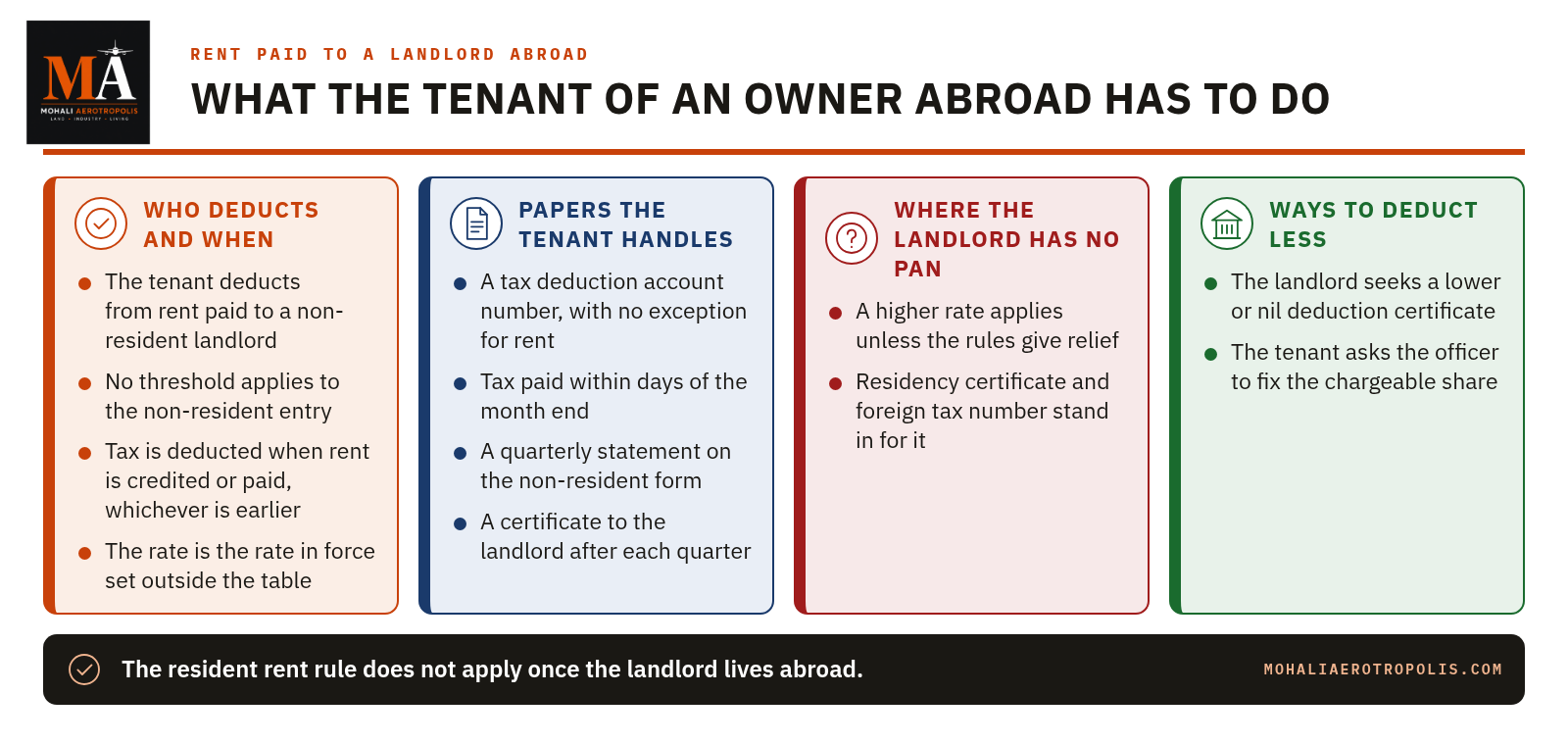
The non-resident entry has no threshold at all. Deduction runs on every payment, at the time the rent is credited or paid, whichever comes first. The rate is not a fixed figure written in the table. The Act gives it as "Rates in force", which points to the rates the Finance Act sets each year.
This is why the same Mohali flat can bring two different obligations to the same tenant. If the owner returns to India and becomes resident again, the tenant moves back to the resident rule.
A tax number for the tenant
A tenant paying a resident landlord does not need a tax deduction account number. Under section 397(1) of the Act, every person deducting tax shall apply for one. The same clause then lists exceptions. The resident rent entry is among them.
The non-resident rent entry is not on that list. The October amendment to section 397 added an exception for a resident individual or family buying immovable property from a seller abroad, which MA covered when it ran its piece on sales. It added nothing for rent. So on the text of the Act as it stands, a tenant who deducts from rent paid to a landlord abroad has to hold a tax deduction account number and quote it on its challans and statements.
For many Mohali tenants, a salaried family renting a flat in Aerocity for example, this is the first time they have dealt with such a number at all.
Paying the tax and filing the return
The Income-tax Rules, 2026 set the calendar. For deductions that fall outside the special rent and property routes, rule 218(2) asks for the tax to reach the government within seven days from the end of the month of deduction, with deductions made in March due by the end of April.
The thirty day route through a single challan cum statement, Form No. 141, is open to tenants of resident landlords and, since October, to resident buyers from sellers abroad. The text of rule 218(3) does not extend it to rent paid to non-residents.
The tenant then files a quarterly statement. The table in rule 219 assigns Form No. 144 to deductions under section 393(2) where the payee is a non-resident individual or a foreign company. A certificate of the tax deducted then goes to the landlord in Form No. 131, generated from the department's portal within fifteen days of the due date of that quarterly statement.
The Act also has a separate reporting duty. Under section 397(3)(d), every person paying a non-resident individual any sum, "whether or not chargeable under this Act", shall report the payment in the prescribed form. The department's form note says Form No. 145 is the form for payments to non-residents under rule 220, with a chartered accountant's certificate in Form No. 146 in some cases. The note does not say how that duty plays out where the rent goes into an account in India, and this piece does not settle it.
When the landlord has no PAN
Under section 397(2), every person receiving a sum on which tax is deductible shall give the payer a valid Permanent Account Number. Where that is missing, tax is deducted at a higher rate set in the same clause.
For non-resident individuals, the clause allows relief from that higher rate on conditions set in the rules. The CBDT notification of the twenty second of September lists the details that stand in for a PAN in that case: the landlord's tax residency certificate number and the tax identification number from the country of residence. An overseas address and contact details are asked for in every case. A Mohali owner in Vancouver or Birmingham without a PAN therefore needs those papers in the tenant's hands.
Ways the deduction can come down
The Act gives two routes to deduct less, and both go through the Assessing Officer.
Under section 395(1), the landlord can apply for a certificate for deduction at a lower rate or no deduction, where the landlord's total income justifies it. Once the certificate is issued, the tenant deducts at the rate it names for as long as it stays valid.
Under section 395(2), the tenant can apply for the officer to decide what proportion of the payment is actually chargeable. Tax is then deducted only on that proportion. This route exists for the serial number seventeen entry alone, so it is open in the landlord abroad case and has no counterpart in the resident rent rule.
A tax treaty between India and the landlord's country can also shape the final tax. The Act links that relief to a tax residency certificate, and its effect on rent from a Mohali flat depends on the treaty and the landlord's own return. MA has not read the treaties with Canada or the US for this piece.
When the rent is paid net of tax
Some leases say the landlord receives a set rent and the tenant bears any tax. Under section 393(10), where the payer bears the tax under an agreement, the income is increased to the amount which, after deduction, equals the net amount payable. The tenant's cost is then higher than the rent written in the lease.
What the tenant and owner can establish
A tenant in Mohali can establish where the landlord is resident for tax purposes by asking for it in writing at the start of the lease, and can ask for a PAN or the residency details listed above. A lease that names the landlord's address abroad makes the position plain.
An owner abroad can ask the tenant for each quarter's certificate in Form No. 131. The certificate shows the tax deducted and the rate used.
What this piece does not cover
It does not cover the landlord's own return or how the rent is taxed overall. It does not cover moving rent money out of India. MA covered that for sale money, and disputes with tenants in a separate piece.
Related reading
- Can an NRI owner take back a rented Mohali house from a tenant
- Selling a Mohali property from abroad: the new TDS filing rule for buyers
- Taking Mohali sale money abroad: how NRI repatriation works now
- Mohali property tax for owners living abroad: penalty dates and exemptions
Sources: The sources we use are listed on our Editorial Sources page.
This piece describes the text of the Income-tax Act, 2025 and the Income-tax Rules, 2026 as the Income Tax Department publishes them. Nothing here is tax or legal advice, and any tenancy turns on its own lease and facts.
A flat in Sector Seventy or a tower in Zirakpur is often let out by a family that has since moved to Canada or the US. The rent lands in an Indian account every month, and the tenant usually assumes the paperwork belongs to the landlord. Under the Income-tax Act, 2025, it does not. When the landlord is a non-resident, the tenant is the one the law asks to deduct tax from the rent and pay it to the government.
That surprises many tenants in Mohali, and it surprises many owners abroad too. The rules for a landlord living in India and a landlord living overseas sit in different parts of the same section, and they work very differently.
The tenant deducts because the landlord lives abroad
The tax deduction rules sit in section 393 of the Act. Its first sub-section covers payments to residents. Its second, section 393(2), covers payments to non-residents, and it places the duty on "the person responsible for paying such income or sum".
Rent paid to a landlord abroad falls under the residual entry of that second table, serial number seventeen. The entry covers "any other sum chargeable under the provisions of this Act, not being income chargeable under the head Salaries", paid to a non-resident individual or a foreign company, and it names the payer simply as "Any person". The Act names no separate rent entry for non-residents, so the reading that rent sits here is ours, drawn from that wording.
A note to the entry adds that the duty to deduct extends to all persons, whether or not the non-resident has a residence, business or any other presence in India. A Mohali flat whose owner now lives in Toronto is caught by this.
What changes when the owner moves abroad
For a landlord who lives in India, the Act has a separate rent entry in section 393(1). It applies only above a monthly threshold set in the Act, and where it applies, a tenant who is an individual deducts once, at the end of the tax year or the end of the tenancy. Below the threshold, a tenant paying a resident landlord deducts nothing.
The non-resident entry has no threshold at all. Deduction runs on every payment, at the time the rent is credited or paid, whichever comes first. The rate is not a fixed figure written in the table. The Act gives it as "Rates in force", which points to the rates the Finance Act sets each year.
This is why the same Mohali flat can bring two different obligations to the same tenant. If the owner returns to India and becomes resident again, the tenant moves back to the resident rule.
A tax number for the tenant
A tenant paying a resident landlord does not need a tax deduction account number. Under section 397(1) of the Act, every person deducting tax shall apply for one. The same clause then lists exceptions. The resident rent entry is among them.
The non-resident rent entry is not on that list. The October amendment to section 397 added an exception for a resident individual or family buying immovable property from a seller abroad, which MA covered when it ran its piece on sales. It added nothing for rent. So on the text of the Act as it stands, a tenant who deducts from rent paid to a landlord abroad has to hold a tax deduction account number and quote it on its challans and statements.
For many Mohali tenants, a salaried family renting a flat in Aerocity for example, this is the first time they have dealt with such a number at all.
Paying the tax and filing the return
The Income-tax Rules, 2026 set the calendar. For deductions that fall outside the special rent and property routes, rule 218(2) asks for the tax to reach the government within seven days from the end of the month of deduction, with deductions made in March due by the end of April.
The thirty day route through a single challan cum statement, Form No. 141, is open to tenants of resident landlords and, since October, to resident buyers from sellers abroad. The text of rule 218(3) does not extend it to rent paid to non-residents.
The tenant then files a quarterly statement. The table in rule 219 assigns Form No. 144 to deductions under section 393(2) where the payee is a non-resident individual or a foreign company. A certificate of the tax deducted then goes to the landlord in Form No. 131, generated from the department's portal within fifteen days of the due date of that quarterly statement.
The Act also has a separate reporting duty. Under section 397(3)(d), every person paying a non-resident individual any sum, "whether or not chargeable under this Act", shall report the payment in the prescribed form. The department's form note says Form No. 145 is the form for payments to non-residents under rule 220, with a chartered accountant's certificate in Form No. 146 in some cases. The note does not say how that duty plays out where the rent goes into an account in India, and this piece does not settle it.
When the landlord has no PAN
Under section 397(2), every person receiving a sum on which tax is deductible shall give the payer a valid Permanent Account Number. Where that is missing, tax is deducted at a higher rate set in the same clause.
For non-resident individuals, the clause allows relief from that higher rate on conditions set in the rules. The CBDT notification of the twenty second of September lists the details that stand in for a PAN in that case: the landlord's tax residency certificate number and the tax identification number from the country of residence. An overseas address and contact details are asked for in every case. A Mohali owner in Vancouver or Birmingham without a PAN therefore needs those papers in the tenant's hands.
Ways the deduction can come down
The Act gives two routes to deduct less, and both go through the Assessing Officer.
Under section 395(1), the landlord can apply for a certificate for deduction at a lower rate or no deduction, where the landlord's total income justifies it. Once the certificate is issued, the tenant deducts at the rate it names for as long as it stays valid.
Under section 395(2), the tenant can apply for the officer to decide what proportion of the payment is actually chargeable. Tax is then deducted only on that proportion. This route exists for the serial number seventeen entry alone, so it is open in the landlord abroad case and has no counterpart in the resident rent rule.
A tax treaty between India and the landlord's country can also shape the final tax. The Act links that relief to a tax residency certificate, and its effect on rent from a Mohali flat depends on the treaty and the landlord's own return. MA has not read the treaties with Canada or the US for this piece.
When the rent is paid net of tax
Some leases say the landlord receives a set rent and the tenant bears any tax. Under section 393(10), where the payer bears the tax under an agreement, the income is increased to the amount which, after deduction, equals the net amount payable. The tenant's cost is then higher than the rent written in the lease.
What the tenant and owner can establish
A tenant in Mohali can establish where the landlord is resident for tax purposes by asking for it in writing at the start of the lease, and can ask for a PAN or the residency details listed above. A lease that names the landlord's address abroad makes the position plain.
An owner abroad can ask the tenant for each quarter's certificate in Form No. 131. The certificate shows the tax deducted and the rate used.
What this piece does not cover
It does not cover the landlord's own return or how the rent is taxed overall. It does not cover moving rent money out of India. MA covered that for sale money, and disputes with tenants in a separate piece.
Related reading
- Can an NRI owner take back a rented Mohali house from a tenant
- Selling a Mohali property from abroad: the new TDS filing rule for buyers
- Taking Mohali sale money abroad: how NRI repatriation works now
- Mohali property tax for owners living abroad: penalty dates and exemptions
Sources: The sources we use are listed on our Editorial Sources page.
This piece describes the text of the Income-tax Act, 2025 and the Income-tax Rules, 2026 as the Income Tax Department publishes them. Nothing here is tax or legal advice, and any tenancy turns on its own lease and facts.
A flat in Sector Seventy or a tower in Zirakpur is often let out by a family that has since moved to Canada or the US. The rent lands in an Indian account every month, and the tenant usually assumes the paperwork belongs to the landlord. Under the Income-tax Act, 2025, it does not. When the landlord is a non-resident, the tenant is the one the law asks to deduct tax from the rent and pay it to the government.
That surprises many tenants in Mohali, and it surprises many owners abroad too. The rules for a landlord living in India and a landlord living overseas sit in different parts of the same section, and they work very differently.
The tenant deducts because the landlord lives abroad
The tax deduction rules sit in section 393 of the Act. Its first sub-section covers payments to residents. Its second, section 393(2), covers payments to non-residents, and it places the duty on "the person responsible for paying such income or sum".
Rent paid to a landlord abroad falls under the residual entry of that second table, serial number seventeen. The entry covers "any other sum chargeable under the provisions of this Act, not being income chargeable under the head Salaries", paid to a non-resident individual or a foreign company, and it names the payer simply as "Any person". The Act names no separate rent entry for non-residents, so the reading that rent sits here is ours, drawn from that wording.
A note to the entry adds that the duty to deduct extends to all persons, whether or not the non-resident has a residence, business or any other presence in India. A Mohali flat whose owner now lives in Toronto is caught by this.
What changes when the owner moves abroad
For a landlord who lives in India, the Act has a separate rent entry in section 393(1). It applies only above a monthly threshold set in the Act, and where it applies, a tenant who is an individual deducts once, at the end of the tax year or the end of the tenancy. Below the threshold, a tenant paying a resident landlord deducts nothing.
The non-resident entry has no threshold at all. Deduction runs on every payment, at the time the rent is credited or paid, whichever comes first. The rate is not a fixed figure written in the table. The Act gives it as "Rates in force", which points to the rates the Finance Act sets each year.
This is why the same Mohali flat can bring two different obligations to the same tenant. If the owner returns to India and becomes resident again, the tenant moves back to the resident rule.
A tax number for the tenant
A tenant paying a resident landlord does not need a tax deduction account number. Under section 397(1) of the Act, every person deducting tax shall apply for one. The same clause then lists exceptions. The resident rent entry is among them.
The non-resident rent entry is not on that list. The October amendment to section 397 added an exception for a resident individual or family buying immovable property from a seller abroad, which MA covered when it ran its piece on sales. It added nothing for rent. So on the text of the Act as it stands, a tenant who deducts from rent paid to a landlord abroad has to hold a tax deduction account number and quote it on its challans and statements.
For many Mohali tenants, a salaried family renting a flat in Aerocity for example, this is the first time they have dealt with such a number at all.
Paying the tax and filing the return
The Income-tax Rules, 2026 set the calendar. For deductions that fall outside the special rent and property routes, rule 218(2) asks for the tax to reach the government within seven days from the end of the month of deduction, with deductions made in March due by the end of April.
The thirty day route through a single challan cum statement, Form No. 141, is open to tenants of resident landlords and, since October, to resident buyers from sellers abroad. The text of rule 218(3) does not extend it to rent paid to non-residents.
The tenant then files a quarterly statement. The table in rule 219 assigns Form No. 144 to deductions under section 393(2) where the payee is a non-resident individual or a foreign company. A certificate of the tax deducted then goes to the landlord in Form No. 131, generated from the department's portal within fifteen days of the due date of that quarterly statement.
The Act also has a separate reporting duty. Under section 397(3)(d), every person paying a non-resident individual any sum, "whether or not chargeable under this Act", shall report the payment in the prescribed form. The department's form note says Form No. 145 is the form for payments to non-residents under rule 220, with a chartered accountant's certificate in Form No. 146 in some cases. The note does not say how that duty plays out where the rent goes into an account in India, and this piece does not settle it.
When the landlord has no PAN
Under section 397(2), every person receiving a sum on which tax is deductible shall give the payer a valid Permanent Account Number. Where that is missing, tax is deducted at a higher rate set in the same clause.
For non-resident individuals, the clause allows relief from that higher rate on conditions set in the rules. The CBDT notification of the twenty second of September lists the details that stand in for a PAN in that case: the landlord's tax residency certificate number and the tax identification number from the country of residence. An overseas address and contact details are asked for in every case. A Mohali owner in Vancouver or Birmingham without a PAN therefore needs those papers in the tenant's hands.
Ways the deduction can come down
The Act gives two routes to deduct less, and both go through the Assessing Officer.
Under section 395(1), the landlord can apply for a certificate for deduction at a lower rate or no deduction, where the landlord's total income justifies it. Once the certificate is issued, the tenant deducts at the rate it names for as long as it stays valid.
Under section 395(2), the tenant can apply for the officer to decide what proportion of the payment is actually chargeable. Tax is then deducted only on that proportion. This route exists for the serial number seventeen entry alone, so it is open in the landlord abroad case and has no counterpart in the resident rent rule.
A tax treaty between India and the landlord's country can also shape the final tax. The Act links that relief to a tax residency certificate, and its effect on rent from a Mohali flat depends on the treaty and the landlord's own return. MA has not read the treaties with Canada or the US for this piece.
When the rent is paid net of tax
Some leases say the landlord receives a set rent and the tenant bears any tax. Under section 393(10), where the payer bears the tax under an agreement, the income is increased to the amount which, after deduction, equals the net amount payable. The tenant's cost is then higher than the rent written in the lease.
What the tenant and owner can establish
A tenant in Mohali can establish where the landlord is resident for tax purposes by asking for it in writing at the start of the lease, and can ask for a PAN or the residency details listed above. A lease that names the landlord's address abroad makes the position plain.
An owner abroad can ask the tenant for each quarter's certificate in Form No. 131. The certificate shows the tax deducted and the rate used.
What this piece does not cover
It does not cover the landlord's own return or how the rent is taxed overall. It does not cover moving rent money out of India. MA covered that for sale money, and disputes with tenants in a separate piece.
Related reading
- Can an NRI owner take back a rented Mohali house from a tenant
- Selling a Mohali property from abroad: the new TDS filing rule for buyers
- Taking Mohali sale money abroad: how NRI repatriation works now
- Mohali property tax for owners living abroad: penalty dates and exemptions
Sources: The sources we use are listed on our Editorial Sources page.
This piece describes the text of the Income-tax Act, 2025 and the Income-tax Rules, 2026 as the Income Tax Department publishes them. Nothing here is tax or legal advice, and any tenancy turns on its own lease and facts.