
Below the level of the big builders, this region runs on a second market that almost nobody writes about.
Hundreds of small societies and colonies across Mohali, Kharar, Zirakpur, Dhakoli and Dera Bassi, each with a few dozen to a few hundred homes, most of them decades old or built in the last fifteen years by promoters nobody outside the district has heard of. Ordinary housing, often good value, frequently long settled.
What a buyer wants to know about any of them is the same thing every time: what is this place, who signed off on it, and is it safe to buy into.
Three different things, sold under similar names
The first problem is that "society" and "colony" get used interchangeably and mean different things.
A cooperative house building society is a members' body. It is registered under cooperative law, it owns or holds the land, and you join it as a member rather than buying from a seller. Membership of a society is not the same as ownership of land, and a receipt for a membership payment is not a conveyance.
A licensed colony is a private development. A promoter obtains a licence to set up a colony, develops it, and sells plots or units to buyers who take title directly.
An authority scheme is GMADA, PUDA or a municipal body developing and allotting land itself.
All three produce places with similar-sounding names, and a listing rarely tells you which you are dealing with.
How a private colony is supposed to get approved
Punjab licenses colonies under the Punjab Apartment and Property Regulation Act, 1995, usually shortened to PAPRA. GMADA describes the licence as involving two stages, and the sequence around it is fixed.
The promoter first has to be registered as a promoter, which runs on a five year validity with renewal to be applied for three months before expiry, and requires among other things an affidavit of non-conviction by any court in the preceding five years. The land needs a change of land use, converting it from agricultural to residential or commercial. The promoter then applies in Form APR-I, the authority issues a letter of intent, and on satisfying the conditions the licence is granted.
That letter of intent is a stage in colony licensing and has nothing to do with the LOI traded in the Aerotropolis pockets, which is a GMADA entitlement to a plot. Two different documents, the same three letters.
Change of land use sits before the licence in that chain. A colony whose CLU was defective has a problem upstream of everything built on top of it, which is exactly the mechanism at issue in the Suntec City case.
The lists that answer the question
All of this is public, and almost nobody opens it. GMADA carries most of it on its own site.
The approved colonies register is searchable by promoter name and carries licence expiry dates, which means it answers not only whether a colony was licensed but whether that licence is still running.
Office orders cancelling the licences of colonies are published alongside it. A colony that once held a licence and no longer does is a materially different proposition from one that never had one, and both are different again from one that holds a current licence.
The list of plots to whom NOCs have been issued under the regularisation policy is the record of unapproved development brought into the fold after the fact, governed by the 2018 notification on regularisation of unauthorised colonies, plots and buildings, with its own portal at punjabregularization.in.
And the promoter registration requirement means there is a record of who is entitled to sell at all.
Where these have been uploaded fully, as the Amritsar authority did under a state drive against illegal colonies, they carry khasra numbers, the duration of the licence and the layout plan, with copies sent to the Deputy Commissioner's office.
The shortcut worth knowing
One test cuts through all of it, and it comes from the authorities' own wording.
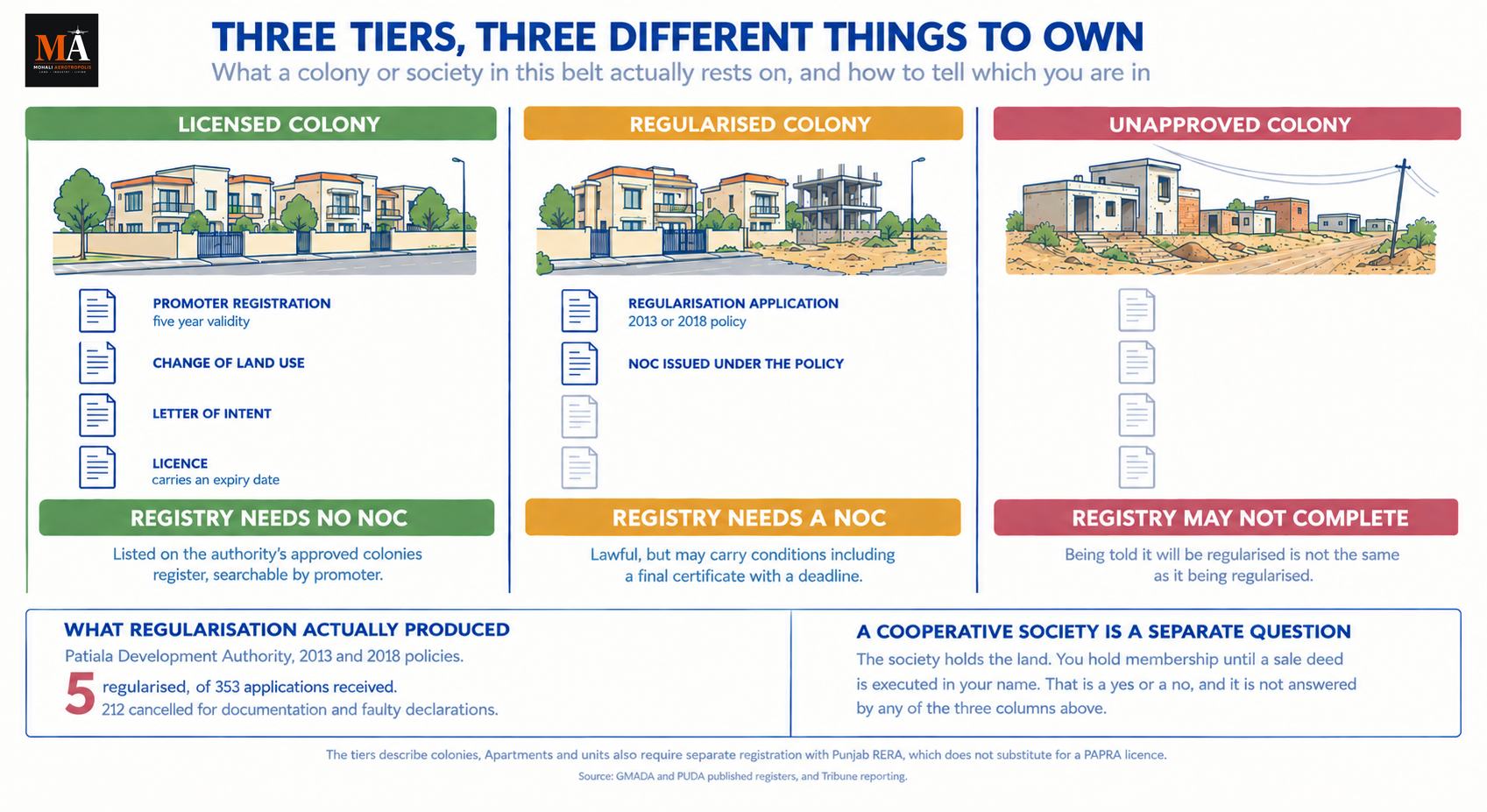
Licensed colonies and mega projects are listed as those for which an NOC is not required for registry.
Turn that around and you have a diagnostic. If a sale in a colony requires a no objection certificate before it can be registered, that colony is not on the licensed list. That does not automatically make it unlawful, since regularisation exists precisely for this situation, but it tells you which of the three tiers you are in without reading a single document.
So the question to ask, early and plainly, is whether registry in that colony needs an NOC. The answer is a fact rather than an opinion, and the seller will know it.
Regularisation is not a formality
Anyone told that a colony is unapproved but will be regularised should know what the success rate looks like.
In Patiala district, across the 2013 and 2018 regularisation policies, the Patiala Development Authority received 353 applications. Five passed. Two hundred and twelve were cancelled for lack of proper documentation and faulty declarations. Under the 2013 policy, 242 applications produced four regularisations. Under the 2018 policy, 111 applications produced one.
That is a different district and a different authority, but it is the same two state policies, and it is the only published measure of how often this route actually works.
What the enforcement record looks like
This is not a theoretical tier of the market.
In Zirakpur, the district administration moved against 37 housing colonies and societies that had not taken their final certificate after a one-year deadline expired, with officials saying registration of ownership of houses in those colonies could be put on hold. The colonies fall in Zirakpur, Pabhat, Lohgarh, Dyalpura, Peer Muchalla, Nabha, Nagla, Ramgarh Bhudda and Chhath, and they range in size from under 2,000 square yards to 15 acres. The stated reason was that the colonisers had failed to pay pending Local Bodies Department charges well past the deadline.
What was at risk there was not demolition but registration. People who had bought in those colonies faced not being able to register their own houses because of a payment their coloniser had not made.
Elsewhere the response has been physical. GMADA's regulatory branch demolished roads, sewerage lines, electricity poles and under-construction houses at five colonies in the Dera Bassi villages of Kheri, Sundra and Mor Lakhkri. In Jhampur, a GMADA team demolished 25 unauthorised constructions across several colonies including Guru Nanak Enclave, Sai Enclave Extension, Khui Enclave and Chirag Enclave, and dug up their roads.
The sales pattern behind it is old. In January 2000, the Zirakpur SDM ordered colonisers and property dealers to remove signboards reading "formal approval of colony awaited" and "to be approved by PUDA", and threatened cheating cases if they did not. Those colonisers held no licence from PUDA or the Nagar Panchayat.
Where societies differ, and why it matters more
For a cooperative housing society the checks are different, because the thing you are acquiring is different.
The society holds the land. What you get is membership, and converting that into individual ownership requires a sale deed executed in your name. Until that happens, the society owns the land and you own a position in the society.
In the Suntec City matter, the Enforcement Directorate has alleged that the society developed the project and collected more than ₹150 crore by enrolling members into the housing society without executing sale deeds. People had paid, lived with the expectation of ownership, and held nothing that would survive a title search.
So for a society, the questions are whether the society is registered, whether the land is in the society's name, whether a sale deed has been or can be executed in yours, and what the society's own records show about dues, disputes and litigation.
What the three tiers actually mean for a buyer
A licensed colony sits on a promoter registration, a change of land use, a letter of intent and a licence, each of which is a document that either exists or does not, and registry needs no NOC. The licence also has an expiry date, which is on the register.
A regularised colony was not licensed and has been brought into the fold afterwards, which is a real and lawful position, but registry needs an NOC and the paperwork may carry conditions, including a final certificate with a deadline attached. Thirty-seven colonies in the Zirakpur belt show what happens when that deadline passes.
An unapproved colony has none of it, and being told it will be regularised is not the same as it being regularised. The risk runs from a registry that cannot be completed to a bulldozer in Kheri.
A cooperative society is a different question entirely, because the tier system above describes colonies. What matters there is whether a sale deed exists in your name, and that is a yes or a no.
For anything sold as an apartment or unit rather than a plot, registration with Punjab RERA is a separate requirement from the PAPRA licence and does not substitute for it. Our comparison of GMADA, PUDA and RERA sets out which body does what, and the buyer's guide covers the wider document set.
Why this tier is worth the trouble
The smaller societies and colonies across Kharar, Zirakpur, Dhakoli and the older Mohali phases are where a great deal of ordinary housing in this district actually is. They are frequently better value than the branded alternatives, they are often long established with settled communities, and plenty of them are entirely in order.
The difficulty is that nothing about them is documented in the places buyers look. There is no brochure, no sales office, and no portal page setting out who licensed the place and when. What there is instead is a set of public lists maintained by the authority, which take an afternoon to work through and which very few people ever open.
Current listings across these areas sit on our Mohali page and Tricity page.
None of the above is legal advice, and the position for any particular colony or society turns on its own records.
---
Sources
- Issue of License for Setting up of Colony Under PAPRA, Greater Mohali Area Development Authority, on the two-stage licence under the Punjab Apartment and Property Regulation Act, 1995, Form APR-I, and the listing of licensed colonies and mega projects for which an NOC is not required for registry
- Registration as Promoter, GMADA, on the promoter registration requirement, the five year validity, the renewal window and the non-conviction affidavit
- Approved Colonies, GMADA, for the register of approved colonies searchable by promoter name and carrying licence expiry dates
- Apply for Regularization of Unauthorized Colony, GMADA, on the 2018 policy for regularisation of unauthorised colonies, plots and buildings, and the list of plots to whom NOCs have been issued under it
- Development Authority rejects 212 illegal colonies, The Tribune, on the Patiala Development Authority's disposal of 353 regularisation applications under the 2013 and 2018 policies
- 37 illegal colonies in Zirakpur face action, Gaurav Kanthwal, The Tribune, on the colonies facing a hold on registration, the areas involved, the final certificate deadline and the unpaid Local Bodies Department charges
- GMADA razes 5 illegal colonies, The Tribune, on the demolitions at Kheri, Sundra and Mor Lakhkri
- Illegal structures razed in Mohali, The Tribune, on the 25 unauthorised constructions demolished at Jhampur
- Deceptive signboards to mislead investors, Bipin Bhardwaj, The Tribune, 11 January 2000, on the SDM's order against approval-awaited signboards in Zirakpur
- Rs 21 lakh tossed from flat in Kharar as ED raids Punjab realtors, The Tribune, 7 May 2026, on the allegation that more than ₹150 crore was collected by enrolling members into the housing society without executing sale deeds
बड़े बिल्डरों के स्तर के नीचे, यह क्षेत्र एक दूसरे बाज़ार पर चलता है जिसके बारे में लगभग कोई नहीं लिखता।
Mohali, Kharar, Zirakpur, Dhakoli और Dera Bassi में सैकड़ों छोटी सोसाइटियाँ और कॉलोनियाँ हैं, जिनमें से प्रत्येक में कुछ दर्जन से लेकर कुछ सौ घर हैं, जिनमें से अधिकांश दशकों पुराने हैं या पिछले पंद्रह वर्षों में ऐसे प्रमोटरों द्वारा बनाए गए हैं जिनके बारे में ज़िले के बाहर किसी ने नहीं सुना है। साधारण आवास, अक्सर अच्छा मूल्य, बार-बार लंबे समय से बसे हुए।
किसी भी खरीदार के लिए इनमें से किसी के बारे में जानने योग्य बात हर बार एक ही होती है: यह जगह क्या है, इसे किसने मंज़ूरी दी, और क्या इसमें खरीदना सुरक्षित है।
तीन अलग-अलग चीज़ें, जो मिलते-जुलते नामों से बेची जाती हैं
पहली समस्या यह है कि "society" और "colony" का प्रयोग एक-दूसरे के स्थान पर किया जाता है और इनका अर्थ अलग-अलग होता है।
एक सहकारी गृह निर्माण सोसाइटी एक सदस्य निकाय है। यह सहकारी कानून के अंतर्गत पंजीकृत होती है, यह भूमि की मालिक होती है या उसे धारण करती है, और आप किसी विक्रेता से खरीदने के बजाय इसके सदस्य के रूप में शामिल होते हैं। सोसाइटी की सदस्यता भूमि के स्वामित्व के समान नहीं है, और सदस्यता भुगतान की रसीद कोई विलेख (conveyance) नहीं है।
एक लाइसेंस प्राप्त कॉलोनी एक निजी विकास है। एक प्रमोटर कॉलोनी स्थापित करने का लाइसेंस प्राप्त करता है, उसका विकास करता है, और खरीदारों को भूखंड या यूनिट बेचता है जो सीधे स्वामित्व (title) लेते हैं।
एक प्राधिकरण योजना GMADA, PUDA या कोई नगर निकाय द्वारा स्वयं भूमि का विकास और आवंटन है।
तीनों से मिलते-जुलते नामों वाली जगहें बनती हैं, और किसी लिस्टिंग में शायद ही बताया जाता है कि आप किससे निपट रहे हैं।
एक निजी कॉलोनी को कैसे मंज़ूरी मिलनी चाहिए
पंजाब कॉलोनियों को पंजाब अपार्टमेंट एंड प्रॉपर्टी रेगुलेशन एक्ट, 1995 के अंतर्गत लाइसेंस देता है, जिसे आमतौर पर PAPRA कहा जाता है। GMADA लाइसेंस को दो चरणों वाला बताता है, और इसके आसपास का क्रम निश्चित है।
प्रमोटर को पहले प्रमोटर के रूप में पंजीकृत होना पड़ता है, जो पाँच वर्ष की वैधता पर चलता है और समाप्ति से तीन महीने पहले नवीनीकरण के लिए आवेदन करना होता है, और इसमें अन्य बातों के साथ-साथ पिछले पाँच वर्षों में किसी भी अदालत द्वारा दोषसिद्धि न होने का शपथ पत्र आवश्यक है। भूमि के उपयोग में परिवर्तन (change of land use) चाहिए, जो इसे कृषि से आवासीय या वाणिज्यिक में बदलता है। फिर प्रमोटर Form APR-I में आवेदन करता है, प्राधिकरण एक letter of intent जारी करता है, और शर्तों को पूरा करने पर लाइसेंस दिया जाता है।
वह letter of intent कॉलोनी लाइसेंसिंग का एक चरण है और इसका Aerotropolis pockets में कारोबार किए जाने वाले LOI से कोई संबंध नहीं है, जो एक भूखंड के लिए GMADA की पात्रता है। दो अलग-अलग दस्तावेज़, वही तीन अक्षर।
उस श्रृंखला में भूमि उपयोग परिवर्तन लाइसेंस से पहले आता है। जिस कॉलोनी का CLU दोषपूर्ण था, उसके ऊपर बनी हर चीज़ से पहले ही उसमें समस्या है, और यही वह तंत्र है जो Suntec City मामले में विवाद का विषय है।
वे सूचियाँ जो सवाल का जवाब देती हैं
यह सब सार्वजनिक है, और लगभग कोई इसे नहीं खोलता। GMADA इसका अधिकांश भाग अपनी ही साइट पर रखता है।
अनुमोदित कॉलोनियों का रजिस्टर प्रमोटर के नाम से खोजा जा सकता है और इसमें लाइसेंस की समाप्ति तिथियाँ होती हैं, जिसका अर्थ है कि यह न केवल बताता है कि कॉलोनी को लाइसेंस मिला था या नहीं, बल्कि यह भी कि वह लाइसेंस अभी भी चालू है या नहीं।
कॉलोनियों के लाइसेंस रद्द करने वाले कार्यालय आदेश इसके साथ प्रकाशित किए जाते हैं। जिस कॉलोनी के पास कभी लाइसेंस था और अब नहीं है, वह उस कॉलोनी से अलग स्थिति में है जिसके पास कभी था ही नहीं, और दोनों उस कॉलोनी से भी अलग हैं जिसके पास वर्तमान लाइसेंस है।
नियमितीकरण नीति के अंतर्गत जिन भूखंडों को NOC जारी किए गए हैं, उनकी सूची बाद में मुख्यधारा में लाए गए अनुमोदित-रहित विकास का अभिलेख है, जो अवैध कॉलोनियों, भूखंडों और भवनों के नियमितीकरण पर 2018 की अधिसूचना द्वारा शासित है, जिसका अपना पोर्टल punjabregularization.in पर है।
और प्रमोटर पंजीकरण की आवश्यकता का अर्थ है कि इस बात का अभिलेख है कि बेचने का हक किसे है।
जहाँ इन्हें पूरी तरह अपलोड किया गया है, जैसा कि अमृतसर प्राधिकरण ने अवैध कॉलोनियों के विरुद्ध राज्यव्यापी अभियान के तहत किया, वहाँ इनमें खसरा नंबर, लाइसेंस की अवधि और layout plan होते हैं, और प्रतियाँ उपायुक्त के कार्यालय को भेजी जाती हैं।
एक जानने योग्य शॉर्टकट
एक परीक्षण इस सब से पार निकल जाता है, और यह प्राधिकरणों के अपने शब्दों से आता है।
लाइसेंस प्राप्त कॉलोनियाँ और मेगा प्रोजेक्ट उनके रूप में सूचीबद्ध हैं जिनके लिए रजिस्ट्री के लिए NOC की आवश्यकता नहीं है।
इसे उलट दें और आपके पास एक निदान होगा। यदि किसी कॉलोनी में बिक्री के लिए पंजीकरण से पहले अनापत्ति प्रमाण पत्र की आवश्यकता होती है, तो वह कॉलोनी लाइसेंस प्राप्त सूची में नहीं है। इससे यह स्वतः अवैध नहीं हो जाती, क्योंकि नियमितीकरण इसी स्थिति के लिए मौजूद है, लेकिन यह आपको बताता है कि आप तीन स्तरों में से किसमें हैं, बिना एक भी दस्तावेज़ पढ़े।
तो जो सवाल पूछना है, जल्दी और सीधे तौर पर, वह यह है कि क्या उस कॉलोनी में रजिस्ट्री के लिए NOC चाहिए। जवाब एक तथ्य है, राय नहीं, और विक्रेता इसे जानता होगा।
नियमितीकरण कोई औपचारिकता नहीं है
जिसे भी यह बताया जाए कि कॉलोनी अनुमोदित-रहित है लेकिन नियमित हो जाएगी, उसे पता होना चाहिए कि सफलता दर कैसी दिखती है।
पटियाला ज़िले में, 2013 और 2018 की नियमितीकरण नीतियों के दौरान, पटियाला विकास प्राधिकरण को 353 आवेदन प्राप्त हुए। पाँच पास हुए। दो सौ बारह उचित दस्तावेज़ों की कमी और दोषपूर्ण घोषणाओं के कारण रद्द कर दिए गए। 2013 की नीति के तहत, 242 आवेदनों से चार नियमितीकरण हुए। 2018 की नीति के तहत, 111 आवेदनों से एक हुआ।
वह एक अलग ज़िला और एक अलग प्राधिकरण है, लेकिन यह वही दो राज्य नीतियाँ हैं, और यह एकमात्र प्रकाशित मापदंड है कि यह रास्ता वास्तव में कितनी बार काम करता है।
प्रवर्तन का अभिलेख कैसा दिखता है
यह बाज़ार का कोई सैद्धांतिक स्तर नहीं है।
Zirakpur में, ज़िला प्रशासन ने 37 आवासीय कॉलोनियों और सोसाइटियों के विरुद्ध कार्रवाई की जिन्होंने एक वर्ष की समय सीमा समाप्त होने के बाद अपना अंतिम प्रमाण पत्र नहीं लिया था, और अधिकारियों ने कहा कि उन कॉलोनियों में घरों के स्वामित्व का पंजीकरण रोका जा सकता है। ये कॉलोनियाँ Zirakpur, Pabhat, Lohgarh, Dyalpura, Peer Muchalla, Nabha, Nagla, Ramgarh Bhudda और Chhath में हैं, और इनका आकार 2,000 वर्ग गज से कम से लेकर 15 एकड़ तक है। बताया गया कारण यह था कि कॉलोनाइज़रों ने समय सीमा के काफी बाद तक लंबित स्थानीय निकाय विभाग (Local Bodies Department) के शुल्क नहीं चुकाए थे।
वहाँ जो जोखिम में था वह विध्वंस नहीं बल्कि पंजीकरण था। उन कॉलोनियों में खरीद चुके लोगों को अपने घरों का पंजीकरण न कर पाने का सामना करना पड़ा क्योंकि उनके कॉलोनाइज़र ने भुगतान नहीं किया था।
अन्यत्र प्रतिक्रिया भौतिक रही है। GMADA की नियामक शाखा ने Dera Bassi के Kheri, Sundra और Mor Lakhkri गाँवों में पाँच कॉलोनियों में सड़कें, सीवरेज लाइनें, बिजली के खंभे और निर्माणाधीन घर ध्वस्त कर दिए। Jhampur में, एक GMADA टीम ने Guru Nanak Enclave, Sai Enclave Extension, Khui Enclave और Chirag Enclave सहित कई कॉलोनियों में 25 अनधिकृत निर्माणों को ध्वस्त कर दिया, और उनकी सड़कें खोद डालीं।
इसके पीछे की बिक्री का पैटर्न पुराना है। जनवरी 2000 में, Zirakpur के SDM ने कॉलोनाइज़रों और संपत्ति डीलरों को "formal approval of colony awaited" और "to be approved by PUDA" पढ़ने वाले साइनबोर्ड हटाने का आदेश दिया, और ऐसा न करने पर धोखाधड़ी के मामले दर्ज करने की धमकी दी। उन कॉलोनाइज़रों के पास PUDA या नगर पंचायत से कोई लाइसेंस नहीं था।
सोसाइटियाँ कहाँ भिन्न हैं, और यह अधिक क्यों मायने रखता है
एक सहकारी आवास सोसाइटी के लिए जाँच अलग होती है, क्योंकि जो चीज़ आप प्राप्त कर रहे हैं वह अलग है।
भूमि सोसाइटी के पास होती है। आपको जो मिलता है वह सदस्यता है, और उसे व्यक्तिगत स्वामित्व में बदलने के लिए आपके नाम पर एक विक्रय विलेख (sale deed) निष्पादित होना चाहिए। जब तक ऐसा नहीं होता, भूमि सोसाइटी की है और आपके पास सोसाइटी में एक स्थिति है।
Suntec City मामले में, प्रवर्तन निदेशालय (Enforcement Directorate) ने आरोप लगाया है कि सोसाइटी ने परियोजना विकसित की और विक्रय विलेख निष्पादित किए बिना आवास सोसाइटी में सदस्यों को भर्ती करके ₹150 करोड़ से अधिक एकत्र किए। लोगों ने भुगतान किया था, स्वामित्व की अपेक्षा के साथ रहे थे, और उनके पास ऐसा कुछ नहीं था जो टाइटल सर्च में टिक पाता।
तो एक सोसाइटी के लिए, सवाल यह हैं कि क्या सोसाइटी पंजीकृत है, क्या भूमि सोसाइटी के नाम पर है, क्या आपके नाम पर विक्रय विलेख निष्पादित हुआ है या हो सकता है, और सोसाइटी के अपने अभिलेख बकाया, विवादों और मुकदमेबाज़ी के बारे में क्या दिखाते हैं।
तीनों स्तरों का खरीदार के लिए वास्तव में क्या अर्थ है
एक लाइसेंस प्राप्त कॉलोनी प्रमोटर पंजीकरण, भूमि उपयोग परिवर्तन, letter of intent और लाइसेंस पर टिकी होती है, जिनमें से प्रत्येक एक दस्तावेज़ है जो या तो मौजूद है या नहीं, और रजिस्ट्री के लिए NOC की आवश्यकता नहीं होती। लाइसेंस की एक समाप्ति तिथि भी होती है, जो रजिस्टर पर होती है।
एक नियमितीकृत कॉलोनी लाइसेंस प्राप्त नहीं थी और उसे बाद में मुख्यधारा में लाया गया है, जो एक वास्तविक और वैध स्थिति है, लेकिन रजिस्ट्री के लिए NOC चाहिए और कागज़ी कार्रवाई में शर्तें हो सकती हैं, जिसमें समय सीमा से जुड़ा अंतिम प्रमाण पत्र भी शामिल है। Zirakpur पट्टी की सैंतीस कॉलोनियाँ दिखाती हैं कि वह समय सीमा बीतने पर क्या होता है।
एक अनुमोदित-रहित कॉलोनी में इनमें से कुछ भी नहीं है, और यह बताया जाना कि इसे नियमित किया जाएगा, इसके वास्तव में नियमित होने के समान नहीं है। जोखिम एक ऐसी रजिस्ट्री से लेकर जो पूरी नहीं हो सकती, Kheri में एक बुलडोज़र तक फैला हुआ है।
एक सहकारी सोसाइटी पूरी तरह से एक अलग सवाल है, क्योंकि ऊपर दी गई स्तर प्रणाली कॉलोनियों का वर्णन करती है। वहाँ यह मायने रखता है कि आपके नाम पर विक्रय विलेख मौजूद है या नहीं, और यह हाँ या ना है।
भूखंड के बजाय अपार्टमेंट या यूनिट के रूप में बेची जाने वाली किसी भी चीज़ के लिए, पंजाब RERA के साथ पंजीकरण PAPRA लाइसेंस से एक अलग आवश्यकता है और उसका विकल्प नहीं है। GMADA, PUDA और RERA की हमारी तुलना बताती है कि कौन सा निकाय क्या करता है, और खरीदार की मार्गदर्शिका व्यापक दस्तावेज़ समूह को कवर करती है।
यह स्तर इतनी मेहनत के लायक क्यों है
Kharar, Zirakpur, Dhakoli और Mohali के पुराने चरणों में फैली छोटी सोसाइटियाँ और कॉलोनियाँ वह जगह हैं जहाँ इस ज़िले का बहुत सारा साधारण आवास वास्तव में है। ये अक्सर ब्रांडेड विकल्पों से बेहतर मूल्य पर होती हैं, ये अक्सर बसे हुए समुदायों के साथ लंबे समय से स्थापित होती हैं, और इनमें से बहुत सी पूरी तरह से ठीक हैं।
कठिनाई यह है कि इनके बारे में खरीदारों द्वारा देखी जाने वाली जगहों पर कुछ भी प्रलेखित नहीं है। कोई ब्रोशर नहीं, कोई बिक्री कार्यालय नहीं, और कोई पोर्टल पृष्ठ नहीं जो बताए कि इस जगह को किसने और कब लाइसेंस दिया। इसके बजाय जो है वह प्राधिकरण द्वारा रखी गई सार्वजनिक सूचियों का एक समूह है, जिन्हें पूरा करने में एक दोपहर लगती है और जिन्हें बहुत कम लोग कभी खोलते हैं।
इन क्षेत्रों में वर्तमान लिस्टिंग हमारे Mohali पृष्ठ और Tricity पृष्ठ पर हैं।
उपरोक्त में से कुछ भी कानूनी सलाह नहीं है, और किसी विशेष कॉलोनी या सोसाइटी की स्थिति उसके अपने अभिलेखों पर निर्भर करती है।
---
स्रोत
- Issue of License for Setting up of Colony Under PAPRA, Greater Mohali Area Development Authority, पंजाब अपार्टमेंट एंड प्रॉपर्टी रेगुलेशन एक्ट, 1995 के अंतर्गत दो-चरणीय लाइसेंस, Form APR-I, और उन लाइसेंस प्राप्त कॉलोनियों और मेगा प्रोजेक्ट्स की सूची पर जिनके लिए रजिस्ट्री के लिए NOC की आवश्यकता नहीं है
- Registration as Promoter, GMADA, प्रमोटर पंजीकरण आवश्यकता, पाँच वर्ष की वैधता, नवीनीकरण अवधि और दोषसिद्धि-न-होने के शपथ पत्र पर
- Approved Colonies, GMADA, अनुमोदित कॉलोनियों के रजिस्टर के लिए जो प्रमोटर के नाम से खोजा जा सकता है और ज
ਵੱਡੇ ਬਿਲਡਰਾਂ ਦੇ ਪੱਧਰ ਤੋਂ ਹੇਠਾਂ, ਇਹ ਖੇਤਰ ਇੱਕ ਦੂਜੇ ਬਾਜ਼ਾਰ 'ਤੇ ਚੱਲਦਾ ਹੈ ਜਿਸ ਬਾਰੇ ਲਗਭਗ ਕੋਈ ਨਹੀਂ ਲਿਖਦਾ।
Mohali, Kharar, Zirakpur, Dhakoli ਅਤੇ Dera Bassi ਵਿੱਚ ਸੈਕੜੇ ਛੋਟੀਆਂ ਸੋਸਾਇਟੀਆਂ ਅਤੇ ਕਾਲੋਨੀਆਂ ਹਨ, ਹਰ ਇੱਕ ਵਿੱਚ ਕੁਝ ਦਰਜਨ ਤੋਂ ਲੈ ਕੇ ਕੁਝ ਸੌ ਘਰ, ਜਿਨ੍ਹਾਂ ਵਿੱਚੋਂ ਜ਼ਿਆਦਾਤਰ ਦਹਾਕਿਆਂ ਪੁਰਾਣੇ ਹਨ ਜਾਂ ਪਿਛਲੇ ਪੰਦਰਾਂ ਸਾਲਾਂ ਵਿੱਚ ਅਜਿਹੇ ਪ੍ਰਮੋਟਰਾਂ ਦੁਆਰਾ ਬਣਾਏ ਗਏ ਹਨ ਜਿਨ੍ਹਾਂ ਬਾਰੇ ਜ਼ਿਲ੍ਹੇ ਤੋਂ ਬਾਹਰ ਕਿਸੇ ਨੇ ਨਹੀਂ ਸੁਣਿਆ। ਆਮ ਰਿਹਾਇਸ਼ੀ ਘਰ, ਅਕਸਰ ਚੰਗੀ ਕੀਮਤ ਵਾਲੇ, ਅਕਸਰ ਲੰਬੇ ਸਮੇਂ ਤੋਂ ਵਸੇ ਹੋਏ।
ਕਿਸੇ ਵੀ ਖਰੀਦਦਾਰ ਨੂੰ ਇਨ੍ਹਾਂ ਵਿੱਚੋਂ ਕਿਸੇ ਵੀ ਬਾਰੇ ਜੋ ਜਾਣਨਾ ਹੁੰਦਾ ਹੈ ਉਹ ਹਰ ਵਾਰ ਇੱਕੋ ਹੀ ਗੱਲ ਹੁੰਦੀ ਹੈ: ਇਹ ਥਾਂ ਕੀ ਹੈ, ਇਸਨੂੰ ਕਿਸਨੇ ਮਨਜ਼ੂਰੀ ਦਿੱਤੀ, ਅਤੇ ਕੀ ਇਸ ਵਿੱਚ ਖਰੀਦਣਾ ਸੁਰੱਖਿਅਤ ਹੈ।
ਤਿੰਨ ਵੱਖਰੀਆਂ ਚੀਜ਼ਾਂ, ਜੋ ਮਿਲਦੇ-ਜੁਲਦੇ ਨਾਵਾਂ ਹੇਠ ਵੇਚੀਆਂ ਜਾਂਦੀਆਂ ਹਨ
ਪਹਿਲੀ ਸਮੱਸਿਆ ਇਹ ਹੈ ਕਿ "ਸੋਸਾਇਟੀ" ਅਤੇ "ਕਾਲੋਨੀ" ਇੱਕੋ ਵਾਂਗ ਵਰਤੇ ਜਾਂਦੇ ਹਨ ਅਤੇ ਵੱਖਰੀਆਂ ਚੀਜ਼ਾਂ ਦਰਸਾਉਂਦੇ ਹਨ।
ਇੱਕ ਕੋਆਪਰੇਟਿਵ ਹਾਊਸ ਬਿਲਡਿੰਗ ਸੋਸਾਇਟੀ ਮੈਂਬਰਾਂ ਦੀ ਸੰਸਥਾ ਹੁੰਦੀ ਹੈ। ਇਹ ਕੋਆਪਰੇਟਿਵ ਕਾਨੂੰਨ ਅਧੀਨ ਰਜਿਸਟਰਡ ਹੁੰਦੀ ਹੈ, ਇਹ ਜ਼ਮੀਨ ਦੀ ਮਾਲਕ ਹੁੰਦੀ ਹੈ ਜਾਂ ਇਸਨੂੰ ਰੱਖਦੀ ਹੈ, ਅਤੇ ਤੁਸੀਂ ਵਿਕਰੇਤਾ ਤੋਂ ਖਰੀਦਣ ਦੀ ਬਜਾਏ ਇਸ ਵਿੱਚ ਮੈਂਬਰ ਵਜੋਂ ਸ਼ਾਮਲ ਹੁੰਦੇ ਹੋ। ਸੋਸਾਇਟੀ ਦੀ ਮੈਂਬਰਸ਼ਿਪ ਜ਼ਮੀਨ ਦੀ ਮਾਲਕੀ ਵਰਗੀ ਨਹੀਂ ਹੁੰਦੀ, ਅਤੇ ਮੈਂਬਰਸ਼ਿਪ ਭੁਗਤਾਨ ਦੀ ਰਸੀਦ ਇੱਕ ਵਿਕਰੀ-ਪੱਤਰ (conveyance) ਨਹੀਂ ਹੁੰਦੀ।
ਇੱਕ ਲਾਇਸੰਸਸ਼ੁਦਾ ਕਾਲੋਨੀ ਇੱਕ ਨਿੱਜੀ ਡਿਵੈਲਪਮੈਂਟ ਹੁੰਦੀ ਹੈ। ਇੱਕ ਪ੍ਰਮੋਟਰ ਕਾਲੋਨੀ ਸਥਾਪਤ ਕਰਨ ਲਈ ਲਾਇਸੰਸ ਲੈਂਦਾ ਹੈ, ਇਸਨੂੰ ਵਿਕਸਤ ਕਰਦਾ ਹੈ, ਅਤੇ ਖਰੀਦਦਾਰਾਂ ਨੂੰ ਪਲਾਟ ਜਾਂ ਯੂਨਿਟ ਵੇਚਦਾ ਹੈ ਜੋ ਸਿੱਧਾ ਟਾਈਟਲ ਲੈਂਦੇ ਹਨ।
ਇੱਕ ਅਥਾਰਟੀ ਸਕੀਮ GMADA, PUDA ਜਾਂ ਕੋਈ ਨਗਰ ਨਿਕਾਇ ਖੁਦ ਜ਼ਮੀਨ ਵਿਕਸਤ ਕਰਕੇ ਅਲਾਟ ਕਰਦੀ ਹੈ।
ਇਹ ਤਿੰਨੇ ਮਿਲਦੇ-ਜੁਲਦੇ ਨਾਵਾਂ ਵਾਲੀਆਂ ਥਾਵਾਂ ਬਣਾਉਂਦੇ ਹਨ, ਅਤੇ ਇੱਕ ਲਿਸਟਿੰਗ ਭਾਗਾਂ ਵਿਰਲੇ ਹੀ ਦੱਸਦੀ ਹੈ ਕਿ ਤੁਸੀਂ ਕਿਸ ਨਾਲ ਵਿਵਹਾਰ ਕਰ ਰਹੇ ਹੋ।
ਇੱਕ ਨਿੱਜੀ ਕਾਲੋਨੀ ਨੂੰ ਕਿਵੇਂ ਮਨਜ਼ੂਰੀ ਮਿਲਣੀ ਚਾਹੀਦੀ ਹੈ
ਪੰਜਾਬ ਕਾਲੋਨੀਆਂ ਨੂੰ ਪੰਜਾਬ ਅਪਾਰਟਮੈਂਟ ਐਂਡ ਪ੍ਰਾਪਰਟੀ ਰੈਗੂਲੇਸ਼ਨ ਐਕਟ, 1995 ਅਧੀਨ ਲਾਇਸੰਸ ਦਿੰਦਾ ਹੈ, ਜਿਸਨੂੰ ਆਮ ਤੌਰ 'ਤੇ PAPRA ਕਿਹਾ ਜਾਂਦਾ ਹੈ। GMADA ਲਾਇਸੰਸ ਨੂੰ ਦੋ ਪੜਾਵਾਂ ਵਾਲਾ ਦੱਸਦੀ ਹੈ, ਅਤੇ ਇਸਦੇ ਆਲੇ-ਦੁਆਲੇ ਦਾ ਕ੍ਰਮ ਨਿਰਧਾਰਤ ਹੈ।
ਪ੍ਰਮੋਟਰ ਨੂੰ ਪਹਿਲਾਂ ਪ੍ਰਮੋਟਰ ਵਜੋਂ ਰਜਿਸਟਰਡ ਹੋਣਾ ਪੈਂਦਾ ਹੈ, ਜੋ ਪੰਜ ਸਾਲ ਦੀ ਵੈਧਤਾ 'ਤੇ ਚੱਲਦਾ ਹੈ ਅਤੇ ਇਸਦੀ ਮਿਆਦ ਖਤਮ ਹੋਣ ਤੋਂ ਤਿੰਨ ਮਹੀਨੇ ਪਹਿਲਾਂ ਨਵੀਨੀਕਰਨ ਲਈ ਅਰਜ਼ੀ ਦੇਣੀ ਹੁੰਦੀ ਹੈ, ਅਤੇ ਹੋਰ ਚੀਜ਼ਾਂ ਦੇ ਨਾਲ-ਨਾਲ ਪਿਛਲੇ ਪੰਜ ਸਾਲਾਂ ਵਿੱਚ ਕਿਸੇ ਵੀ ਅਦਾਲਤ ਦੁਆਰਾ ਸਜ਼ਾ ਨਾ ਹੋਣ ਦਾ ਹਲਫਨਾਮਾ ਲੋੜੀਂਦਾ ਹੈ। ਜ਼ਮੀਨ ਨੂੰ ਜ਼ਮੀਨੀ ਵਰਤੋਂ ਵਿੱਚ ਤਬਦੀਲੀ (change of land use) ਦੀ ਲੋੜ ਹੁੰਦੀ ਹੈ, ਜੋ ਇਸਨੂੰ ਖੇਤੀਬਾੜੀ ਤੋਂ ਰਿਹਾਇਸ਼ੀ ਜਾਂ ਵਪਾਰਕ ਵਿੱਚ ਬਦਲਦੀ ਹੈ। ਫਿਰ ਪ੍ਰਮੋਟਰ ਫਾਰਮ APR-I ਵਿੱਚ ਅਰਜ਼ੀ ਦਿੰਦਾ ਹੈ, ਅਥਾਰਟੀ ਇੱਕ ਲੈਟਰ ਆਫ਼ ਇੰਟੈਂਟ (letter of intent) ਜਾਰੀ ਕਰਦੀ ਹੈ, ਅਤੇ ਸ਼ਰਤਾਂ ਪੂਰੀਆਂ ਹੋਣ 'ਤੇ ਲਾਇਸੰਸ ਦਿੱਤਾ ਜਾਂਦਾ ਹੈ।
ਉਹ ਲੈਟਰ ਆਫ਼ ਇੰਟੈਂਟ ਕਾਲੋਨੀ ਲਾਇਸੰਸਿੰਗ ਵਿੱਚ ਇੱਕ ਪੜਾਅ ਹੈ ਅਤੇ ਇਸਦਾ Aerotropolis ਪਾਕੇਟਾਂ ਵਿੱਚ ਵਪਾਰ ਕੀਤੇ ਜਾਂਦੇ LOI ਨਾਲ ਕੋਈ ਸਬੰਧ ਨਹੀਂ, ਜੋ ਇੱਕ ਪਲਾਟ ਲਈ GMADA ਦਾ ਹੱਕ (entitlement) ਹੁੰਦਾ ਹੈ। ਦੋ ਵੱਖਰੇ ਦਸਤਾਵੇਜ਼, ਉਹੀ ਤਿੰਨ ਅੱਖਰ।
ਜ਼ਮੀਨੀ ਵਰਤੋਂ ਵਿੱਚ ਤਬਦੀਲੀ ਉਸ ਲੜੀ ਵਿੱਚ ਲਾਇਸੰਸ ਤੋਂ ਪਹਿਲਾਂ ਆਉਂਦੀ ਹੈ। ਜਿਸ ਕਾਲੋਨੀ ਦੀ CLU ਨੁਕਸਦਾਰ ਸੀ ਉਸਦੀ ਸਮੱਸਿਆ ਉਸਦੇ ਉੱਪਰ ਬਣੀ ਹਰ ਚੀਜ਼ ਤੋਂ ਉੱਪਰ ਵੱਲ (upstream) ਹੁੰਦੀ ਹੈ, ਜੋ ਕਿ ਬਿਲਕੁਲ ਉਹੀ ਵਿਧੀ ਹੈ ਜੋ Suntec City ਕੇਸ ਵਿੱਚ ਵਿਵਾਦ ਦਾ ਵਿਸ਼ਾ ਹੈ।
ਉਹ ਸੂਚੀਆਂ ਜੋ ਸਵਾਲ ਦਾ ਜਵਾਬ ਦਿੰਦੀਆਂ ਹਨ
ਇਹ ਸਭ ਜਨਤਕ ਹੈ, ਅਤੇ ਲਗਭਗ ਕੋਈ ਵੀ ਇਸਨੂੰ ਨਹੀਂ ਖੋਲ੍ਹਦਾ। GMADA ਇਸਦਾ ਜ਼ਿਆਦਾਤਰ ਹਿੱਸਾ ਆਪਣੀ ਸਾਈਟ 'ਤੇ ਰੱਖਦੀ ਹੈ।
ਪ੍ਰਵਾਨਿਤ ਕਾਲੋਨੀਆਂ ਦਾ ਰਜਿਸਟਰ ਪ੍ਰਮੋਟਰ ਦੇ ਨਾਮ ਨਾਲ ਖੋਜਯੋਗ ਹੁੰਦਾ ਹੈ ਅਤੇ ਇਸ ਵਿੱਚ ਲਾਇਸੰਸ ਦੀ ਮਿਆਦ ਖਤਮ ਹੋਣ ਦੀਆਂ ਤਾਰੀਖਾਂ ਹੁੰਦੀਆਂ ਹਨ, ਜਿਸਦਾ ਮਤਲਬ ਹੈ ਕਿ ਇਹ ਨਾ ਸਿਰਫ਼ ਇਹ ਦੱਸਦਾ ਹੈ ਕਿ ਕਾਲੋਨੀ ਲਾਇਸੰਸਸ਼ੁਦਾ ਸੀ ਜਾਂ ਨਹੀਂ ਸਗੋਂ ਇਹ ਵੀ ਕਿ ਉਹ ਲਾਇਸੰਸ ਅਜੇ ਵੀ ਚੱਲ ਰਿਹਾ ਹੈ ਜਾਂ ਨਹੀਂ।
ਕਾਲੋਨੀਆਂ ਦੇ ਲਾਇਸੰਸ ਰੱਦ ਕਰਨ ਵਾਲੇ ਦਫ਼ਤਰੀ ਹੁਕਮ ਇਸਦੇ ਨਾਲ ਪ੍ਰਕਾਸ਼ਿਤ ਕੀਤੇ ਜਾਂਦੇ ਹਨ। ਜਿਸ ਕਾਲੋਨੀ ਕੋਲ ਕਦੇ ਲਾਇਸੰਸ ਸੀ ਅਤੇ ਹੁਣ ਨਹੀਂ, ਉਹ ਉਸ ਕਾਲੋਨੀ ਤੋਂ ਵੱਖਰੀ ਗੱਲ ਹੈ ਜਿਸ ਕੋਲ ਕਦੇ ਸੀ ਹੀ ਨਹੀਂ, ਅਤੇ ਦੋਵੇਂ ਫਿਰ ਉਸ ਤੋਂ ਵੱਖਰੀਆਂ ਹਨ ਜਿਸ ਕੋਲ ਮੌਜੂਦਾ ਲਾਇਸੰਸ ਹੈ।
ਰੈਗੂਲਰਾਈਜ਼ੇਸ਼ਨ ਪਾਲਿਸੀ ਅਧੀਨ ਜਿਨ੍ਹਾਂ ਪਲਾਟਾਂ ਨੂੰ NOC ਜਾਰੀ ਕੀਤੇ ਗਏ ਹਨ ਉਨ੍ਹਾਂ ਦੀ ਸੂਚੀ ਬਾਅਦ ਵਿੱਚ ਗ਼ੈਰ-ਪ੍ਰਵਾਨਿਤ ਡਿਵੈਲਪਮੈਂਟ ਨੂੰ ਸ਼ਾਮਲ ਕਰਨ ਦਾ ਰਿਕਾਰਡ ਹੈ, ਜੋ ਗ਼ੈਰ-ਪ੍ਰਵਾਨਿਤ ਕਾਲੋਨੀਆਂ, ਪਲਾਟਾਂ ਅਤੇ ਇਮਾਰਤਾਂ ਦੇ ਰੈਗੂਲਰਾਈਜ਼ੇਸ਼ਨ ਬਾਰੇ 2018 ਦੀ ਨੋਟੀਫਿਕੇਸ਼ਨ ਦੁਆਰਾ ਨਿਯੰਤਰਿਤ ਹੈ, ਜਿਸਦਾ ਆਪਣਾ ਪੋਰਟਲ punjabregularization.in 'ਤੇ ਹੈ।
ਅਤੇ ਪ੍ਰਮੋਟਰ ਰਜਿਸਟ੍ਰੇਸ਼ਨ ਦੀ ਲੋੜ ਦਾ ਮਤਲਬ ਹੈ ਕਿ ਇਹ ਰਿਕਾਰਡ ਮੌਜੂਦ ਹੈ ਕਿ ਕੌਣ ਵੇਚਣ ਦਾ ਹੱਕ ਰੱਖਦਾ ਹੈ।
ਜਿੱਥੇ ਇਹ ਪੂਰੀ ਤਰ੍ਹਾਂ ਅੱਪਲੋਡ ਕੀਤੇ ਗਏ ਹਨ, ਜਿਵੇਂ ਕਿ ਅੰਮ੍ਰਿਤਸਰ ਅਥਾਰਟੀ ਨੇ ਗ਼ੈਰ-ਕਾਨੂੰਨੀ ਕਾਲੋਨੀਆਂ ਵਿਰੁੱਧ ਇੱਕ ਸੂਬਾਈ ਮੁਹਿੰਮ ਅਧੀਨ ਕੀਤਾ, ਉੱਥੇ ਇਨ੍ਹਾਂ ਵਿੱਚ ਖਸਰਾ ਨੰਬਰ, ਲਾਇਸੰਸ ਦੀ ਮਿਆਦ ਅਤੇ ਲੇਆਉਟ ਪਲਾਨ ਹੁੰਦੇ ਹਨ, ਜਿਨ੍ਹਾਂ ਦੀਆਂ ਕਾਪੀਆਂ ਡਿਪਟੀ ਕਮਿਸ਼ਨਰ ਦੇ ਦਫ਼ਤਰ ਨੂੰ ਭੇਜੀਆਂ ਜਾਂਦੀਆਂ ਹਨ।
ਜਾਣਨ ਯੋਗ ਛੋਟਾ ਰਾਹ
ਇੱਕ ਟੈਸਟ ਇਸ ਸਭ ਨੂੰ ਪਾਰ ਕਰ ਜਾਂਦਾ ਹੈ, ਅਤੇ ਇਹ ਅਥਾਰਟੀਆਂ ਦੇ ਆਪਣੇ ਸ਼ਬਦਾਂ ਤੋਂ ਆਉਂਦਾ ਹੈ।
ਲਾਇਸੰਸਸ਼ੁਦਾ ਕਾਲੋਨੀਆਂ ਅਤੇ ਮੈਗਾ ਪ੍ਰੋਜੈਕਟ ਉਹਨਾਂ ਵਜੋਂ ਸੂਚੀਬੱਧ ਹਨ ਜਿਨ੍ਹਾਂ ਲਈ ਰਜਿਸਟਰੀ ਲਈ NOC ਦੀ ਲੋੜ ਨਹੀਂ ਹੁੰਦੀ।
ਇਸਨੂੰ ਉਲਟਾ ਕਰੋ ਅਤੇ ਤੁਹਾਡੇ ਕੋਲ ਇੱਕ ਨਿਦਾਨ ਹੈ। ਜੇ ਕਿਸੇ ਕਾਲੋਨੀ ਵਿੱਚ ਵਿਕਰੀ ਨੂੰ ਰਜਿਸਟਰ ਹੋਣ ਤੋਂ ਪਹਿਲਾਂ ਇੱਕ ਨੋ-ਆਬਜੈਕਸ਼ਨ ਸਰਟੀਫਿਕੇਟ ਦੀ ਲੋੜ ਹੁੰਦੀ ਹੈ, ਤਾਂ ਉਹ ਕਾਲੋਨੀ ਲਾਇਸੰਸਸ਼ੁਦਾ ਸੂਚੀ ਵਿੱਚ ਨਹੀਂ ਹੈ। ਇਹ ਆਪਣੇ ਆਪ ਵਿੱਚ ਇਸਨੂੰ ਗ਼ੈਰ-ਕਾਨੂੰਨੀ ਨਹੀਂ ਬਣਾਉਂਦਾ, ਕਿਉਂਕਿ ਰੈਗੂਲਰਾਈਜ਼ੇਸ਼ਨ ਬਿਲਕੁਲ ਇਸੇ ਸਥਿਤੀ ਲਈ ਮੌਜੂਦ ਹੈ, ਪਰ ਇਹ ਤੁਹਾਨੂੰ ਦੱਸਦਾ ਹੈ ਕਿ ਤੁਸੀਂ ਤਿੰਨ ਪੱਧਰਾਂ ਵਿੱਚੋਂ ਕਿਸ ਵਿੱਚ ਹੋ, ਇੱਕ ਵੀ ਦਸਤਾਵੇਜ਼ ਪੜ੍ਹੇ ਬਿਨਾਂ।
ਇਸ ਲਈ ਪੁੱਛਣ ਵਾਲਾ ਸਵਾਲ, ਜਲਦੀ ਅਤੇ ਸਪਸ਼ਟ ਤੌਰ 'ਤੇ, ਇਹ ਹੈ ਕਿ ਕੀ ਉਸ ਕਾਲੋਨੀ ਵਿੱਚ ਰਜਿਸਟਰੀ ਲਈ NOC ਦੀ ਲੋੜ ਹੈ। ਜਵਾਬ ਇੱਕ ਰਾਏ ਦੀ ਬਜਾਏ ਇੱਕ ਤੱਥ ਹੈ, ਅਤੇ ਵਿਕਰੇਤਾ ਇਸਨੂੰ ਜਾਣਦਾ ਹੋਵੇਗਾ।
ਰੈਗੂਲਰਾਈਜ਼ੇਸ਼ਨ ਕੋਈ ਰਸਮ ਨਹੀਂ ਹੈ
ਜਿਸਨੂੰ ਵੀ ਇਹ ਦੱਸਿਆ ਜਾਵੇ ਕਿ ਕੋਈ ਕਾਲੋਨੀ ਗ਼ੈਰ-ਪ੍ਰਵਾਨਿਤ ਹੈ ਪਰ ਰੈਗੂਲਰ ਕਰ ਦਿੱਤੀ ਜਾਵੇਗੀ, ਉਸਨੂੰ ਇਹ ਜਾਣਨਾ ਚਾਹੀਦਾ ਹੈ ਕਿ ਸਫਲਤਾ ਦੀ ਦਰ ਕੀ ਦਿਖਦੀ ਹੈ।
ਪਟਿਆਲਾ ਜ਼ਿਲ੍ਹੇ ਵਿੱਚ, 2013 ਅਤੇ 2018 ਦੀਆਂ ਰੈਗੂਲਰਾਈਜ਼ੇਸ਼ਨ ਪਾਲਿਸੀਆਂ ਦੌਰਾਨ, ਪਟਿਆਲਾ ਡਿਵੈਲਪਮੈਂਟ ਅਥਾਰਟੀ ਨੂੰ 353 ਅਰਜ਼ੀਆਂ ਪ੍ਰਾਪਤ ਹੋਈਆਂ। ਪੰਜ ਪਾਸ ਹੋਈਆਂ। ਦੋ ਸੌ ਬਾਰਾਂ ਢੁਕਵੇਂ ਦਸਤਾਵੇਜ਼ਾਂ ਦੀ ਘਾਟ ਅਤੇ ਗਲਤ ਐਲਾਨਾਂ ਕਾਰਨ ਰੱਦ ਕਰ ਦਿੱਤੀਆਂ ਗਈਆਂ। 2013 ਦੀ ਪਾਲਿਸੀ ਅਧੀਨ, 242 ਅਰਜ਼ੀਆਂ ਵਿੱਚੋਂ ਚਾਰ ਰੈਗੂਲਰਾਈਜ਼ੇਸ਼ਨ ਹੋਈਆਂ। 2018 ਦੀ ਪਾਲਿਸੀ ਅਧੀਨ, 111 ਅਰਜ਼ੀਆਂ ਵਿੱਚੋਂ ਇੱਕ।
ਇਹ ਇੱਕ ਵੱਖਰਾ ਜ਼ਿਲ੍ਹਾ ਅਤੇ ਵੱਖਰੀ ਅਥਾਰਟੀ ਹੈ, ਪਰ ਇਹ ਉਹੀ ਦੋ ਸੂਬਾਈ ਪਾਲਿਸੀਆਂ ਹਨ, ਅਤੇ ਇਹ ਇਕੋ ਹੀ ਪ੍ਰਕਾਸ਼ਿਤ ਮਾਪ ਹੈ ਕਿ ਇਹ ਰਾਹ ਅਸਲ ਵਿੱਚ ਕਿੰਨੀ ਵਾਰ ਕੰਮ ਕਰਦਾ ਹੈ।
ਲਾਗੂ ਕਰਨ ਦਾ ਰਿਕਾਰਡ ਕਿਹੋ ਜਿਹਾ ਦਿਖਦਾ ਹੈ
ਇਹ ਬਾਜ਼ਾਰ ਦਾ ਕੋਈ ਸਿਧਾਂਤਕ ਪੱਧਰ ਨਹੀਂ ਹੈ।
Zirakpur ਵਿੱਚ, ਜ਼ਿਲ੍ਹਾ ਪ੍ਰਸ਼ਾਸਨ ਨੇ 37 ਹਾਊਸਿੰਗ ਕਾਲੋਨੀਆਂ ਅਤੇ ਸੋਸਾਇਟੀਆਂ ਵਿਰੁੱਧ ਕਾਰਵਾਈ ਕੀਤੀ ਜਿਨ੍ਹਾਂ ਨੇ ਇੱਕ ਸਾਲ ਦੀ ਸਮਾਂ-ਸੀਮਾ ਖਤਮ ਹੋਣ ਤੋਂ ਬਾਅਦ ਆਪਣਾ ਅੰਤਿਮ ਸਰਟੀਫਿਕੇਟ ਨਹੀਂ ਲਿਆ ਸੀ, ਅਧਿਕਾਰੀਆਂ ਨੇ ਕਿਹਾ ਕਿ ਉਨ੍ਹਾਂ ਕਾਲੋਨੀਆਂ ਵਿੱਚ ਘਰਾਂ ਦੀ ਮਾਲਕੀ ਦੀ ਰਜਿਸਟ੍ਰੇਸ਼ਨ ਨੂੰ ਰੋਕਿਆ ਜਾ ਸਕਦਾ ਹੈ। ਕਾਲੋਨੀਆਂ Zirakpur, Pabhat, Lohgarh, Dyalpura, Peer Muchalla, Nabha, Nagla, Ramgarh Bhudda ਅਤੇ Chhath ਵਿੱਚ ਪੈਂਦੀਆਂ ਹਨ, ਅਤੇ ਇਨ੍ਹਾਂ ਦਾ ਆਕਾਰ 2,000 ਵਰਗ ਗਜ਼ ਤੋਂ ਘੱਟ ਤੋਂ ਲੈ ਕੇ 15 ਏਕੜ ਤੱਕ ਹੈ। ਦੱਸਿਆ ਗਿਆ ਕਾਰਨ ਇਹ ਸੀ ਕਿ ਕਾਲੋਨਾਈਜ਼ਰ ਸਮਾਂ-ਸੀਮਾ ਤੋਂ ਬਹੁਤ ਬਾਅਦ ਤੱਕ ਲੰਬਿਤ ਲੋਕਲ ਬਾਡੀਜ਼ ਵਿਭਾਗ ਦੇ ਖਰਚੇ ਨਹੀਂ ਭਰ ਸਕੇ ਸਨ।
ਉੱਥੇ ਜੋਖਮ ਵਿੱਚ ਤੋੜ-ਫੋੜ ਨਹੀਂ ਸਗੋਂ ਰਜਿਸਟ੍ਰੇਸ਼ਨ ਸੀ। ਜਿਨ੍ਹਾਂ ਲੋਕਾਂ ਨੇ ਉਨ੍ਹਾਂ ਕਾਲੋਨੀਆਂ ਵਿੱਚ ਖਰੀਦਿਆ ਸੀ ਉਨ੍ਹਾਂ ਨੂੰ ਆਪਣੇ ਘਰਾਂ ਨੂੰ ਰਜਿਸਟਰ ਨਾ ਕਰਵਾ ਪਾਉਣ ਦਾ ਸਾਹਮਣਾ ਕਰਨਾ ਪੈ ਸਕਦਾ ਸੀ ਕਿਉਂਕਿ ਉਨ੍ਹਾਂ ਦੇ ਕਾਲੋਨਾਈਜ਼ਰ ਨੇ ਇੱਕ ਭੁਗਤਾਨ ਨਹੀਂ ਕੀਤਾ ਸੀ।
ਹੋਰ ਥਾਵਾਂ 'ਤੇ ਜਵਾਬ ਭੌਤਿਕ ਰਿਹਾ ਹੈ। GMADA ਦੀ ਰੈਗੂਲੇਟਰੀ ਸ਼ਾਖਾ ਨੇ Dera Bassi ਦੇ ਪਿੰਡਾਂ Kheri, Sundra ਅਤੇ Mor Lakhkri ਵਿੱਚ ਪੰਜ ਕਾਲੋਨੀਆਂ ਵਿਖੇ ਸੜਕਾਂ, ਸੀਵਰੇਜ ਲਾਈਨਾਂ, ਬਿਜਲੀ ਦੇ ਖੰਭੇ ਅਤੇ ਉਸਾਰੀ ਅਧੀਨ ਘਰ ਢਾਹ ਦਿੱਤੇ। Jhampur ਵਿੱਚ, GMADA ਦੀ ਇੱਕ ਟੀਮ ਨੇ Guru Nanak Enclave, Sai Enclave Extension, Khui Enclave ਅਤੇ Chirag Enclave ਸਮੇਤ ਕਈ ਕਾਲੋਨੀਆਂ ਵਿੱਚ 25 ਗ਼ੈਰ-ਪ੍ਰਵਾਨਿਤ ਉਸਾਰੀਆਂ ਢਾਹ ਦਿੱਤੀਆਂ, ਅਤੇ ਉਨ੍ਹਾਂ ਦੀਆਂ ਸੜਕਾਂ ਪੁੱਟ ਦਿੱਤੀਆਂ।
ਇਸਦੇ ਪਿੱਛੇ ਵਿਕਰੀ ਦਾ ਪੈਟਰਨ ਪੁਰਾਣਾ ਹੈ। ਜਨਵਰੀ 2000 ਵਿੱਚ, Zirakpur ਦੇ SDM ਨੇ ਕਾਲੋਨਾਈਜ਼ਰਾਂ ਅਤੇ ਪ੍ਰਾਪਰਟੀ ਡੀਲਰਾਂ ਨੂੰ "formal approval of colony awaited" ਅਤੇ "to be approved by PUDA" ਪੜ੍ਹਦੇ ਸਾਈਨਬੋਰਡ ਹਟਾਉ