
An NRI or an OCI cardholder who buys a Mohali flat or plot under India's foreign exchange rules does so in that person's own name. A different question arises when the buyer wants the spouse's name on the deed as well, and the spouse is neither an NRI nor an OCI. The spouse may be a foreign citizen living abroad with the buyer. The spouse may hold no Indian passport and no Overseas Citizen of India card. In that case the ordinary purchase route for an NRI or an OCI does not cover the spouse.
The answer sits in a short rule. Rule twenty five of the Foreign Exchange Management Non-debt Instruments Rules of two thousand and nineteen deals with joint acquisition by the spouse of an NRI or an OCI. The Reserve Bank of India restates the same point in its frequently asked questions on the purchase of immovable property. This piece stays inside that rule and that answer. It does not invent further conditions.
What the Reserve Bank's answer says
The Reserve Bank's frequently asked question on this point, updated on the sixth of April twenty twenty three, asks whether a spouse of an NRI or an OCI who is not an NRI or an OCI can acquire property in India. The published answer is quoted here in full.
"A person resident outside India, not being a Non-Resident Indian or an Overseas Citizen of India, who is a spouse of a Non-Resident Indian or an Overseas Citizen of India may acquire one immovable property (other than agricultural land/ farm house/ plantation property), jointly with his/ her NRI/ OCI spouse subject to the conditions laid down in Rule 25 of Foreign Exchange Management (Non-Debt Instrument) Rules, 2019."
The answer itself points back to the rule. It does not add a fresh test. The work of reading the conditions therefore falls on the rule text.
What rule twenty five says
Rule twenty five is headed "Joint acquisition by the spouse of a NRI or an OCI". The operative text of the rule is quoted here in full from the rules.
"A person resident outside India, not being an NRI or an OCI, who is a spouse of an NRI or an OCI may acquire one immovable property (other than agricultural land or farm house or plantation property), jointly with his or her NRI or OCI spouse:
Provided that -
(a) consideration for transfer, shall be made out of -
(i) funds received in India through banking channels by way of inward remittance from any place outside India; or
(ii) funds held in any non-resident account maintained in accordance with the provisions of the Act and the regulations made by the Reserve Bank;
(b) no payment for any transfer of immovable property shall be made either by traveller's cheque or by foreign currency notes or by any other mode other than those specifically permitted under this clause:
Provided that the marriage has been registered and subsisted for a continuous period of not less than two years immediately preceding the acquisition of such property:
Provided further that the non-resident spouse is not otherwise prohibited from such acquisition."
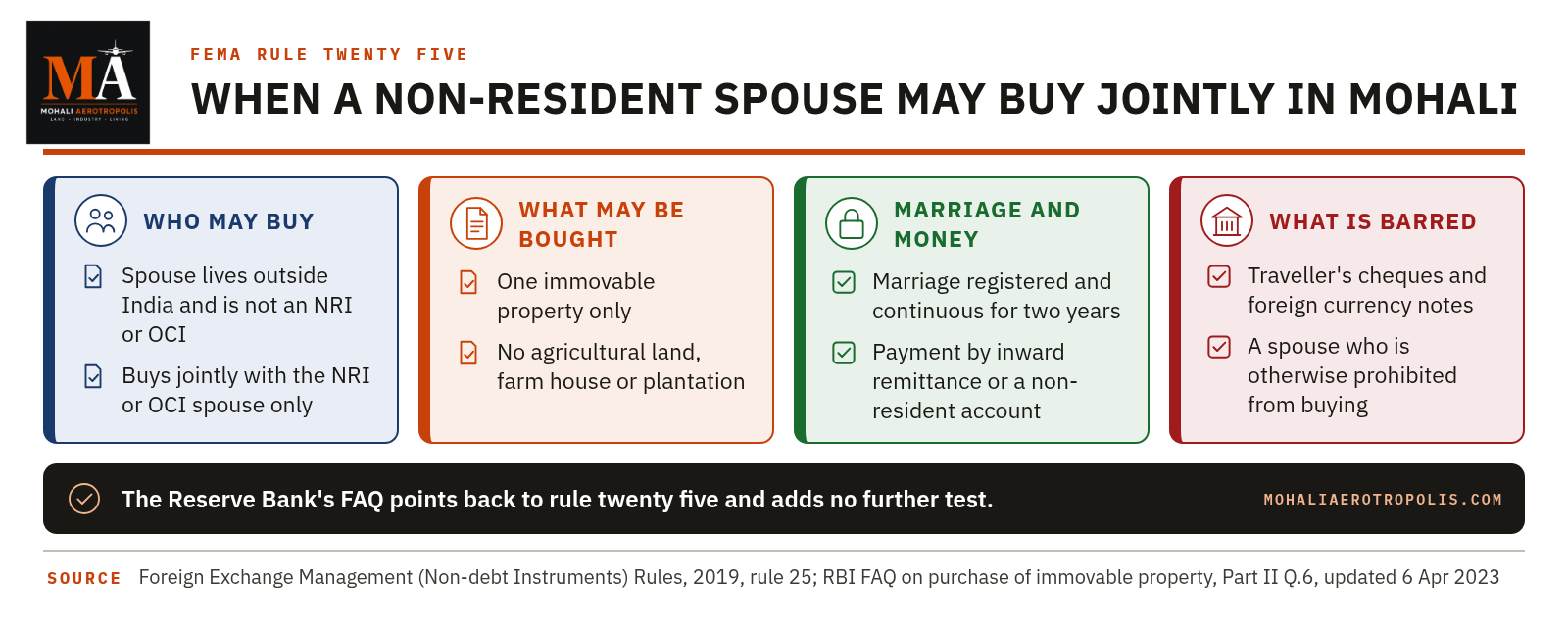
Those are the whole of the conditions the rule states. The rest of this piece unpacks each of them against a Mohali purchase, without adding terms the rule does not contain.
Who the spouse in the rule is
The rule opens with a person resident outside India who is not an NRI and not an OCI. An NRI, in the foreign exchange sense used here, is a person resident outside India who is a citizen of India. An OCI is a person resident outside India registered as an Overseas Citizen of India cardholder under the Citizenship Act. The spouse the rule describes holds neither status.
The same opening requires that this person be the spouse of an NRI or of an OCI. The joint purchase therefore always has two names on it. One name is the NRI or OCI spouse. The other is the non-NRI, non-OCI spouse who lives outside India. A purchase by that second person alone is outside the rule. A purchase by two NRIs, or by an NRI and an OCI, is also outside this rule, because those buyers already have their own routes under rule twenty four.
One property, and not farmland
The rule allows the spouse to acquire one immovable property. It does not say the couple may repeat the route for a second house. The property may not be agricultural land. A farm house and plantation property are excluded too. A Mohali residential flat, a residential plot in a GMADA sector, or a commercial shop that is not farmland, sits inside the kinds of property the rule leaves open. Farmland on the edge of the Aerotropolis does not.
The Reserve Bank's answer uses the same exclusion. It also repeats the word one. Neither text says how a later sale of that one property affects a further purchase. That silence is left as silence.
Jointly with the NRI or OCI spouse
The acquisition is joint. The rule does not describe a purchase in the foreign spouse's sole name. The NRI or OCI spouse is on the title with the other spouse. How the deed records the shares between them is a matter for the deed and for Indian property law, which this piece does not cover. The foreign exchange rule only requires that the acquisition be joint with the NRI or OCI spouse.
How the money may move
Two payment routes are listed. The first is funds received in India through banking channels by way of inward remittance from any place outside India. The second is funds held in any non-resident account maintained under the Act and the Reserve Bank's regulations. The rule then bars payment by traveller's cheque. Foreign currency notes are barred too. So is any other mode that the clause does not specifically permit.
A Mohali buyer who tries to settle a sale price in cash notes brought into India, or by a traveller's cheque handed to the seller, falls outside those permitted modes on the wording of the rule. A remittance that lands in an Indian bank account through banking channels, or a debit from a non-resident account of the kind the regulations allow, is the kind of route the rule describes. The rule does not itself name every account type. It points to non-resident accounts maintained under the Act and the Reserve Bank's regulations.
The two-year marriage condition
A further proviso states that the marriage has been registered and has subsisted for a continuous period of not less than two years immediately preceding the acquisition. A marriage that is recent, or that is not registered, does not meet that wording. The rule does not say which country's registration counts. It only says the marriage has been registered and has lasted for that continuous period up to the acquisition.
The spouse who is otherwise prohibited
The last proviso says the non-resident spouse is not otherwise prohibited from such acquisition. The rule does not list the prohibitions inside rule twenty five itself. Other parts of the same chapter deal with nationals of named countries and with foreign nationals who need prior Reserve Bank permission. This piece does not step into those other rules. It only records that rule twenty five itself ends with that proviso.
What rule twenty five does not decide
The rule does not say how a Mohali sub-registrar checks the spouse's status. It is also silent on how the marriage registration and the source of funds are checked. It does not set stamp duty. It does not replace GMADA's own transfer or allotment conditions where the property is a GMADA site. It does not cover a spouse who already lives in India as a resident. A resident spouse buying jointly with an NRI raises different questions under ordinary Indian property law and under the payment rules that apply when one buyer is abroad.
The rule also does not cover inheritance. Gifts and a later sale by the couple sit outside it too. Those sit in other clauses of the same chapter and in other pieces on this site.
How this fits a Mohali purchase
A couple living in Canada or Britain, where one holds an Indian passport as an NRI or holds an OCI card, and the other holds only a foreign passport, often want both names on a Mohali flat. Rule twenty five is the foreign exchange route that addresses that joint acquisition when the second spouse is not an NRI and not an OCI. The property has to be the one property the rule allows. It cannot be farmland. The marriage has to meet the registered two-year continuous period. The money has to move through the banking routes the rule names. The spouse has to be free of any separate prohibition.
None of those points is a step-by-step buying guide. They are a reading of the rule and of the Reserve Bank's restatement of it.
Related reading
- Can an NRI buy property in India: Mohali guide
- What do India's property rules say once an NRI takes Canadian or American citizenship
- Gifting a Mohali property from abroad: who can receive it under India's foreign exchange rules
- Inheriting a Mohali property while living abroad: what India's foreign exchange rules allow
Sources: Foreign Exchange Management Non-debt Instruments Rules, two thousand and nineteen, rule twenty five. Reserve Bank of India frequently asked questions on purchase of immovable property, Part II question six, page updated on the sixth of April twenty twenty three. The sources we use are listed on our Editorial Sources page.
This piece describes the published text of rule twenty five and the Reserve Bank's published answer that points to it. Nothing here is legal advice, and any purchase turns on its own papers and facts.
एनआरआई या ओसीआई कार्डधारक जो भारत के विदेशी मुद्रा नियमों के तहत मोहाली का फ़्लैट या प्लॉट ख़रीदता है, वह अपने ही नाम पर ख़रीदता है। जब ख़रीदार पति या पत्नी का नाम भी डीड पर चाहता है, और पति या पत्नी न एनआरआई है न ओसीआई, तो सवाल बदल जाता है। पति या पत्नी ख़रीदार के साथ विदेश में रहने वाला विदेशी नागरिक हो सकता है। उसके पास न भारतीय पासपोर्ट हो, न ओवरसीज़ सिटिज़न ऑफ़ इंडिया कार्ड। उस स्थिति में एनआरआई या ओसीआई का साधारण ख़रीद मार्ग पति या पत्नी को कवर नहीं करता।
जवाब एक छोटे नियम में है। दो हज़ार उन्नीस के फ़ॉरेन एक्सचेंज मैनेजमेंट नॉन-डेट इंस्ट्रूमेंट्स रूल्स का नियम पच्चीस एनआरआई या ओसीआई के पति या पत्नी की संयुक्त ख़रीद से जुड़ा है। रिज़र्व बैंक ऑफ़ इंडिया अचल संपत्ति की ख़रीद पर अपने अक्सर पूछे जाने वाले सवालों में वही बात दोहराता है। यह लेख उसी नियम और उसी जवाब के भीतर रहता है। यह कोई नई शर्त नहीं गढ़ता।
रिज़र्व बैंक का जवाब क्या कहता है
रिज़र्व बैंक का इस बिंदु पर अक्सर पूछा जाने वाला सवाल, जो छह अप्रैल दो हज़ार तेईस को अपडेट हुआ, पूछता है कि क्या एनआरआई या ओसीआई का वह पति या पत्नी जो स्वयं एनआरआई या ओसीआई नहीं है, भारत में संपत्ति ले सकता है। प्रकाशित जवाब यहाँ पूरा उद्धृत है।
"A person resident outside India, not being a Non-Resident Indian or an Overseas Citizen of India, who is a spouse of a Non-Resident Indian or an Overseas Citizen of India may acquire one immovable property (other than agricultural land/ farm house/ plantation property), jointly with his/ her NRI/ OCI spouse subject to the conditions laid down in Rule 25 of Foreign Exchange Management (Non-Debt Instrument) Rules, 2019."
जवाब स्वयं नियम की ओर वापस इशारा करता है। यह कोई नई कसौटी नहीं जोड़ता। इसलिए शर्तों को पढ़ने का काम नियम के पाठ पर है।
नियम पच्चीस क्या कहता है
नियम पच्चीस का शीर्षक है "Joint acquisition by the spouse of a NRI or an OCI"। नियम का लागू पाठ नियमों से यहाँ पूरा उद्धृत है।
"A person resident outside India, not being an NRI or an OCI, who is a spouse of an NRI or an OCI may acquire one immovable property (other than agricultural land or farm house or plantation property), jointly with his or her NRI or OCI spouse:
Provided that -
(a) consideration for transfer, shall be made out of -
(i) funds received in India through banking channels by way of inward remittance from any place outside India; or
(ii) funds held in any non-resident account maintained in accordance with the provisions of the Act and the regulations made by the Reserve Bank;
(b) no payment for any transfer of immovable property shall be made either by traveller's cheque or by foreign currency notes or by any other mode other than those specifically permitted under this clause:
Provided that the marriage has been registered and subsisted for a continuous period of not less than two years immediately preceding the acquisition of such property:
Provided further that the non-resident spouse is not otherwise prohibited from such acquisition."
ये नियम में कही गई सारी शर्तें हैं। इस लेख का बाक़ी हिस्सा मोहाली की ख़रीद के संदर्भ में उनमें से प्रत्येक को खोलता है, बिना वे शब्द जोड़े जो नियम में नहीं हैं।
नियम में पति या पत्नी कौन है
नियम की शुरुआत भारत के बाहर रहने वाले उस व्यक्ति से होती है जो न एनआरआई है न ओसीआई। यहाँ विदेशी मुद्रा के अर्थ में एनआरआई वह व्यक्ति है जो भारत के बाहर रहता है और भारत का नागरिक है। ओसीआई वह व्यक्ति है जो भारत के बाहर रहता है और सिटिज़नशिप एक्ट के तहत ओवरसीज़ सिटिज़न ऑफ़ इंडिया कार्डधारक के रूप में पंजीकृत है। नियम जिस पति या पत्नी का वर्णन करता है, उसके पास इनमें से कोई स्थिति नहीं होती।
वही शुरुआत यह भी माँगती है कि यह व्यक्ति किसी एनआरआई या ओसीआई का पति या पत्नी हो। इसलिए संयुक्त ख़रीद पर हमेशा दो नाम होते हैं। एक नाम एनआरआई या ओसीआई पति या पत्नी का है। दूसरा नाम गैर-एनआरआई, गैर-ओसीआई पति या पत्नी का है जो भारत के बाहर रहता है। केवल दूसरे व्यक्ति की अकेली ख़रीद इस नियम से बाहर है। दो एनआरआई की ख़रीद, या एक एनआरआई और एक ओसीआई की ख़रीद, भी इस नियम से बाहर है, क्योंकि उन ख़रीदारों के अपने मार्ग नियम चौबीस के तहत पहले से हैं।
एक संपत्ति, और खेती की ज़मीन नहीं
नियम पति या पत्नी को एक अचल संपत्ति लेने की अनुमति देता है। यह नहीं कहता कि जोड़ा दूसरे मकान के लिए मार्ग दोहरा सकता है। संपत्ति खेती की ज़मीन, फ़ार्म हाउस या प्लांटेशन प्रॉपर्टी नहीं हो सकती। मोहाली का आवासीय फ़्लैट, गमाडा सेक्टर का आवासीय प्लॉट, या वह व्यावसायिक दुकान जो खेती की ज़मीन नहीं है, उन श्रेणियों में बैठती है जिन्हें नियम खुला छोड़ता है। एरोट्रोपोलिस के किनारे की खेती की ज़मीन नहीं बैठती।
रिज़र्व बैंक का जवाब वही रोक दोहराता है। वह एक शब्द भी दोहराता है। कोई भी पाठ यह नहीं कहता कि उस एक संपत्ति की बाद की बिक्री आगे की ख़रीद को कैसे छूती है। वह चुप्पी चुप्पी ही रहती है।
एनआरआई या ओसीआई पति या पत्नी के साथ संयुक्त रूप से
अधिग्रहण संयुक्त है। नियम विदेशी पति या पत्नी के अकेले नाम की ख़रीद का वर्णन नहीं करता। एनआरआई या ओसीआई पति या पत्नी दूसरे पति या पत्नी के साथ टाइटल पर होता है। डीड उनके बीच शेयर कैसे दर्ज करती है, यह डीड और भारतीय संपत्ति क़ानून का विषय है, जिसे यह लेख नहीं छूता। विदेशी मुद्रा नियम केवल यह माँगता है कि अधिग्रहण एनआरआई या ओसीआई पति या पत्नी के साथ संयुक्त हो।
पैसा कैसे चल सकता है
दो भुगतान मार्ग गिनाए गए हैं। पहला है भारत के बाहर किसी भी स्थान से बैंकिंग चैनलों के ज़रिए आवक प्रेषण द्वारा भारत में मिले धन। दूसरा है एक्ट और रिज़र्व बैंक के नियमों के तहत रखे किसी भी अनिवासी खाते में रखा धन। फिर नियम यात्री चेक, विदेशी मुद्रा नोटों, या उस खंड में विशेष रूप से अनुमति न दिए गए किसी अन्य ढंग से भुगतान रोकता है।
मोहाली का ख़रीदार जो बिक्री मूल्य भारत में लाए नकद नोटों से, या विक्रेता को दिए यात्री चेक से चुकता करने की कोशिश करता है, नियम के शब्दों पर उन अनुमत ढंगों से बाहर पड़ता है। बैंकिंग चैनलों से भारतीय बैंक खाते में आने वाला प्रेषण, या नियमों द्वारा अनुमत क़िस्म के अनिवासी खाते से डेबिट, उसी क़िस्म का मार्ग है जिसका नियम वर्णन करता है। नियम स्वयं हर खाता क़िस्म का नाम नहीं लेता। वह एक्ट और रिज़र्व बैंक के नियमों के तहत रखे अनिवासी खातों की ओर इशारा करता है।
दो वर्ष की विवाह शर्त
एक और परंतुक कहता है कि विवाह पंजीकृत रहा है और अधिग्रहण से ठीक पहले लगातार दो वर्ष से कम नहीं चला है। जो विवाह नया है, या जो पंजीकृत नहीं है, वह उस शब्द से नहीं मिलता। नियम नहीं कहता कि किस देश का पंजीकरण गिना जाता है। वह केवल इतना कहता है कि विवाह पंजीकृत रहा है और अधिग्रहण तक उतनी लगातार अवधि तक चला है।
वह पति या पत्नी जिस पर अन्यथा रोक है
अंतिम परंतुक कहता है कि अनिवासी पति या पत्नी ऐसे अधिग्रहण से अन्यथा प्रतिबंधित नहीं है। नियम पच्चीस स्वयं उन प्रतिबंधों की सूची नहीं देता। उसी अध्याय के अन्य हिस्से नामित देशों के नागरिकों और उन विदेशी नागरिकों से निपटते हैं जिन्हें रिज़र्व बैंक की पूर्व अनुमति चाहिए। यह लेख उन अन्य नियमों में नहीं जाता। यह केवल दर्ज करता है कि नियम पच्चीस स्वयं उसी परंतुक पर ख़त्म होता है।
नियम पच्चीस क्या तय नहीं करता
नियम नहीं कहता कि मोहाली का सब-रजिस्ट्रार पति या पत्नी की स्थिति कैसे जाँचता है। विवाह पंजीकरण और धन के स्रोत की जाँच पर भी वह चुप है। यह स्टांप ड्यूटी तय नहीं करता। जहाँ संपत्ति गमाडा साइट है, वहाँ यह गमाडा की अपनी ट्रांसफ़र या अलॉटमेंट शर्तों की जगह नहीं लेता। यह उस पति या पत्नी को कवर नहीं करता जो पहले से भारत में निवासी के रूप में रहता है। निवासी पति या पत्नी का एनआरआई के साथ संयुक्त ख़रीदना साधारण भारतीय संपत्ति क़ानून और तब लागू भुगतान नियमों के तहत अलग सवाल उठाता है जब एक ख़रीदार विदेश में हो।
नियम विरासत, गिफ़्ट या जोड़े की बाद की बिक्री को भी कवर नहीं करता। वे उसी अध्याय के अन्य खंडों और इस साइट के अन्य लेखों में हैं।
यह मोहाली की ख़रीद में कैसे बैठता है
कनाडा या ब्रिटेन में रहने वाला जोड़ा, जहाँ एक भारतीय पासपोर्ट एनआरआई के रूप में रखता है या ओसीआई कार्ड रखता है, और दूसरा केवल विदेशी पासपोर्ट रखता है, अक्सर मोहाली के फ़्लैट पर दोनों नाम चाहता है। नियम पच्चीस वह विदेशी मुद्रा मार्ग है जो उस संयुक्त अधिग्रहण को संबोधित करता है जब दूसरा पति या पत्नी न एनआरआई है न ओसीआई। संपत्ति वही एक संपत्ति होनी चाहिए जिसकी नियम अनुमति देता है। वह खेती की ज़मीन नहीं हो सकती। विवाह को पंजीकृत दो-वर्ष की लगातार अवधि पूरी करनी होती है। पैसे को नियम के बताए बैंकिंग मार्गों से चलना होता है। पति या पत्नी किसी अलग प्रतिबंध से मुक्त होना चाहिए।
इनमें से कोई भी बिंदु क़दम-दर-क़दम ख़रीद गाइड नहीं है। वे नियम और रिज़र्व बैंक की उसकी पुनर्कथन की एक रीडिंग हैं।
संबंधित पढ़ाई
- Can an NRI buy property in India: Mohali guide
- What do India's property rules say once an NRI takes Canadian or American citizenship
- Gifting a Mohali property from abroad: who can receive it under India's foreign exchange rules
- Inheriting a Mohali property while living abroad: what India's foreign exchange rules allow
स्रोत: फ़ॉरेन एक्सचेंज मैनेजमेंट नॉन-डेट इंस्ट्रूमेंट्स रूल्स, दो हज़ार उन्नीस, नियम पच्चੀस। रिज़र्व बैंक ऑफ़ इंडिया अचल संपत्ति की ख़रीद पर अक्सर पूछे जाने वाले सवाल, भाग दो सवाल छह, पृष्ठ छह अप्रैल दो हज़ार तेईस को अपडेट। हम जिन स्रोतों का उपयोग करते हैं वे हमारे Editorial Sources पृष्ठ पर सूचीबद्ध हैं।
यह लेख नियम पच्चीस के प्रकाशित पाठ और रिज़र्व बैंक के उस प्रकाशित जवाब का वर्णन करता है जो उसी नियम की ओर इशारा करता है। यहाँ कुछ भी क़ानूनी सलाह नहीं है, और कोई भी ख़रीद अपने काग़ज़ों और तथ्यों पर टिकी होती है।
ਐਨਆਰਆਈ ਜਾਂ ਓਸੀਆਈ ਕਾਰਡਧਾਰਕ ਜੋ ਭਾਰਤ ਦੇ ਵਿਦੇਸ਼ੀ ਮੁਦਰਾ ਨਿਯਮਾਂ ਹੇਠ ਮੋਹਾਲੀ ਦਾ ਫਲੈਟ ਜਾਂ ਪਲਾਟ ਖਰੀਦਦਾ ਹੈ, ਉਹ ਆਪਣੇ ਹੀ ਨਾਂ ’ਤੇ ਖਰੀਦਦਾ ਹੈ। ਜਦੋਂ ਖਰੀਦਦਾਰ ਪਤੀ ਜਾਂ ਪਤਨੀ ਦਾ ਨਾਂ ਵੀ ਡੀਡ ’ਤੇ ਚਾਹੁੰਦਾ ਹੈ, ਅਤੇ ਪਤੀ ਜਾਂ ਪਤਨੀ ਨਾ ਐਨਆਰਆਈ ਹੈ ਨਾ ਓਸੀਆਈ, ਤਾਂ ਸਵਾਲ ਬਦਲ ਜਾਂਦਾ ਹੈ। ਪਤੀ ਜਾਂ ਪਤਨੀ ਖਰੀਦਦਾਰ ਨਾਲ ਵਿਦੇਸ਼ ਵਿੱਚ ਰਹਿਣ ਵਾਲਾ ਵਿਦੇਸ਼ੀ ਨਾਗਰਿਕ ਹੋ ਸਕਦਾ ਹੈ। ਉਸ ਕੋਲ ਨਾ ਭਾਰਤੀ ਪਾਸਪੋਰਟ ਹੋਵੇ, ਨਾ ਓਵਰਸੀਜ਼ ਸਿਟੀਜ਼ਨ ਆਫ਼ ਇੰਡੀਆ ਕਾਰਡ। ਉਸ ਸਥਿਤੀ ਵਿੱਚ ਐਨਆਰਆਈ ਜਾਂ ਓਸੀਆਈ ਦਾ ਸਾਧਾਰਨ ਖਰੀਦ ਰਾਹ ਪਤੀ ਜਾਂ ਪਤਨੀ ਨੂੰ ਕਵਰ ਨਹੀਂ ਕਰਦਾ।
ਜਵਾਬ ਇੱਕ ਛੋਟੇ ਨਿਯਮ ਵਿੱਚ ਹੈ। ਦੋ ਹਜ਼ਾਰ ਉਨੀ ਦੇ ਫਾਰਨ ਐਕਸਚੇਂਜ ਮੈਨੇਜਮੈਂਟ ਨਾਨ-ਡੈਟ ਇੰਸਟ੍ਰੂਮੈਂਟਸ ਰੂਲਜ਼ ਦਾ ਨਿਯਮ ਪੱਚੀ ਐਨਆਰਆਈ ਜਾਂ ਓਸੀਆਈ ਦੇ ਪਤੀ ਜਾਂ ਪਤਨੀ ਦੀ ਸਾਂਝੀ ਖਰੀਦ ਨਾਲ ਜੁੜਿਆ ਹੈ। ਰਿਜ਼ਰਵ ਬੈਂਕ ਆਫ਼ ਇੰਡੀਆ ਅਚਲ ਸੰਪੱਤੀ ਦੀ ਖਰੀਦ ’ਤੇ ਆਪਣੇ ਅਕਸਰ ਪੁੱਛੇ ਜਾਣ ਵਾਲੇ ਸਵਾਲਾਂ ਵਿੱਚ ਉਹੀ ਗੱਲ ਦੁਹਰਾਉਂਦਾ ਹੈ। ਇਹ ਲੇਖ ਉਸੇ ਨਿਯਮ ਅਤੇ ਉਸੇ ਜਵਾਬ ਵਿੱਚ ਰਹਿੰਦਾ ਹੈ। ਇਹ ਕੋਈ ਨਵੀਂ ਸ਼ਰਤ ਨਹੀਂ ਘੜਦਾ।
ਰਿਜ਼ਰਵ ਬੈਂਕ ਦਾ ਜਵਾਬ ਕੀ ਕਹਿੰਦਾ ਹੈ
ਰਿਜ਼ਰਵ ਬੈਂਕ ਦਾ ਇਸ ਬਿੰਦੂ ’ਤੇ ਅਕਸਰ ਪੁੱਛਿਆ ਜਾਣ ਵਾਲਾ ਸਵਾਲ, ਜੋ ਛੇ ਅਪ੍ਰੈਲ ਦੋ ਹਜ਼ਾਰ ਤੇਈ ਨੂੰ ਅੱਪਡੇਟ ਹੋਇਆ, ਪੁੱਛਦਾ ਹੈ ਕਿ ਕੀ ਐਨਆਰਆਈ ਜਾਂ ਓਸੀਆਈ ਦਾ ਉਹ ਪਤੀ ਜਾਂ ਪਤਨੀ ਜੋ ਖੁਦ ਐਨਆਰਆਈ ਜਾਂ ਓਸੀਆਈ ਨਹੀਂ ਹੈ, ਭਾਰਤ ਵਿੱਚ ਸੰਪੱਤੀ ਲੈ ਸਕਦਾ ਹੈ। ਪ੍ਰਕਾਸ਼ਿਤ ਜਵਾਬ ਇੱਥੇ ਪੂਰਾ ਉਧ੍ਰਿਤ ਹੈ।
"A person resident outside India, not being a Non-Resident Indian or an Overseas Citizen of India, who is a spouse of a Non-Resident Indian or an Overseas Citizen of India may acquire one immovable property (other than agricultural land/ farm house/ plantation property), jointly with his/ her NRI/ OCI spouse subject to the conditions laid down in Rule 25 of Foreign Exchange Management (Non-Debt Instrument) Rules, 2019."
ਜਵਾਬ ਖੁਦ ਨਿਯਮ ਵੱਲ ਵਾਪਸ ਇਸ਼ਾਰਾ ਕਰਦਾ ਹੈ। ਇਹ ਕੋਈ ਨਵੀਂ ਕਸੌਟੀ ਨਹੀਂ ਜੋੜਦਾ। ਇਸ ਲਈ ਸ਼ਰਤਾਂ ਪੜ੍ਹਨ ਦਾ ਕੰਮ ਨਿਯਮ ਦੇ ਪਾਠ ’ਤੇ ਹੈ।
ਨਿਯਮ ਪੱਚੀ ਕੀ ਕਹਿੰਦਾ ਹੈ
ਨਿਯਮ ਪੱਚੀ ਦਾ ਸਿਰਲੇਖ ਹੈ "Joint acquisition by the spouse of a NRI or an OCI"। ਨਿਯਮ ਦਾ ਲਾਗੂ ਪਾਠ ਨਿਯਮਾਂ ਤੋਂ ਇੱਥੇ ਪੂਰਾ ਉਧ੍ਰਿਤ ਹੈ।
"A person resident outside India, not being an NRI or an OCI, who is a spouse of an NRI or an OCI may acquire one immovable property (other than agricultural land or farm house or plantation property), jointly with his or her NRI or OCI spouse:
Provided that -
(a) consideration for transfer, shall be made out of -
(i) funds received in India through banking channels by way of inward remittance from any place outside India; or
(ii) funds held in any non-resident account maintained in accordance with the provisions of the Act and the regulations made by the Reserve Bank;
(b) no payment for any transfer of immovable property shall be made either by traveller's cheque or by foreign currency notes or by any other mode other than those specifically permitted under this clause:
Provided that the marriage has been registered and subsisted for a continuous period of not less than two years immediately preceding the acquisition of such property:
Provided further that the non-resident spouse is not otherwise prohibited from such acquisition."
ਇਹ ਨਿਯਮ ਵਿੱਚ ਕਹੀਆਂ ਸਾਰੀਆਂ ਸ਼ਰਤਾਂ ਹਨ। ਇਸ ਲੇਖ ਦਾ ਬਾਕੀ ਹਿੱਸਾ ਮੋਹਾਲੀ ਦੀ ਖਰੀਦ ਦੇ ਸੰਦਰਭ ਵਿੱਚ ਉਨ੍ਹਾਂ ਵਿੱਚੋਂ ਹਰ ਇੱਕ ਨੂੰ ਖੋਲ੍ਹਦਾ ਹੈ, ਬਿਨਾਂ ਉਹ ਸ਼ਬਦ ਜੋੜੇ ਜੋ ਨਿਯਮ ਵਿੱਚ ਨਹੀਂ ਹਨ।
ਨਿਯਮ ਵਿੱਚ ਪਤੀ ਜਾਂ ਪਤਨੀ ਕੌਣ ਹੈ
ਨਿਯਮ ਦੀ ਸ਼ੁਰੂਆਤ ਭਾਰਤ ਤੋਂ ਬਾਹਰ ਰਹਿਣ ਵਾਲੇ ਉਸ ਵਿਅਕਤੀ ਤੋਂ ਹੁੰਦੀ ਹੈ ਜੋ ਨਾ ਐਨਆਰਆਈ ਹੈ ਨਾ ਓਸੀਆਈ। ਇੱਥੇ ਵਿਦੇਸ਼ੀ ਮੁਦਰਾ ਦੇ ਅਰਥ ਵਿੱਚ ਐਨਆਰਆਈ ਉਹ ਵਿਅਕਤੀ ਹੈ ਜੋ ਭਾਰਤ ਤੋਂ ਬਾਹਰ ਰਹਿੰਦਾ ਹੈ ਅਤੇ ਭਾਰਤ ਦਾ ਨਾਗਰਿਕ ਹੈ। ਓਸੀਆਈ ਉਹ ਵਿਅਕਤੀ ਹੈ ਜੋ ਭਾਰਤ ਤੋਂ ਬਾਹਰ ਰਹਿੰਦਾ ਹੈ ਅਤੇ ਸਿਟੀਜ਼ਨਸ਼ਿਪ ਐਕਟ ਹੇਠ ਓਵਰਸੀਜ਼ ਸਿਟੀਜ਼ਨ ਆਫ਼ ਇੰਡੀਆ ਕਾਰਡਧਾਰਕ ਵਜੋਂ ਰਜਿਸਟਰਡ ਹੈ। ਨਿਯਮ ਜਿਸ ਪਤੀ ਜਾਂ ਪਤਨੀ ਦਾ ਵਰਣਨ ਕਰਦਾ ਹੈ, ਉਸ ਕੋਲ ਇਨ੍ਹਾਂ ਵਿੱਚੋਂ ਕੋਈ ਸਥਿਤੀ ਨਹੀਂ ਹੁੰਦੀ।
ਉਹੀ ਸ਼ੁਰੂਆਤ ਇਹ ਵੀ ਮੰਗਦੀ ਹੈ ਕਿ ਇਹ ਵਿਅਕਤੀ ਕਿਸੇ ਐਨਆਰਆਈ ਜਾਂ ਓਸੀਆਈ ਦਾ ਪਤੀ ਜਾਂ ਪਤਨੀ ਹੋਵੇ। ਇਸ ਲਈ ਸਾਂਝੀ ਖਰੀਦ ’ਤੇ ਹਮੇਸ਼ਾ ਦੋ ਨਾਂ ਹੁੰਦੇ ਹਨ। ਇੱਕ ਨਾਂ ਐਨਆਰਆਈ ਜਾਂ ਓਸੀਆਈ ਪਤੀ ਜਾਂ ਪਤਨੀ ਦਾ ਹੈ। ਦੂਜਾ ਨਾਂ ਗੈਰ-ਐਨਆਰਆਈ, ਗੈਰ-ਓਸੀਆਈ ਪਤੀ ਜਾਂ ਪਤਨੀ ਦਾ ਹੈ ਜੋ ਭਾਰਤ ਤੋਂ ਬਾਹਰ ਰਹਿੰਦਾ ਹੈ। ਸਿਰਫ਼ ਦੂਜੇ ਵਿਅਕਤੀ ਦੀ ਇਕੱਲੀ ਖਰੀਦ ਇਸ ਨਿਯਮ ਤੋਂ ਬਾਹਰ ਹੈ। ਦੋ ਐਨਆਰਆਈ ਦੀ ਖਰੀਦ, ਜਾਂ ਇੱਕ ਐਨਆਰਆਈ ਅਤੇ ਇੱਕ ਓਸੀਆਈ ਦੀ ਖਰੀਦ, ਵੀ ਇਸ ਨਿਯਮ ਤੋਂ ਬਾਹਰ ਹੈ, ਕਿਉਂਕਿ ਉਨ੍ਹਾਂ ਖਰੀਦਦਾਰਾਂ ਦੇ ਆਪਣੇ ਰਾਹ ਨਿਯਮ ਚੌਵੀ ਹੇਠ ਪਹਿਲਾਂ ਤੋਂ ਹਨ।
ਇੱਕ ਸੰਪੱਤੀ, ਅਤੇ ਖੇਤੀ ਦੀ ਜ਼ਮੀਨ ਨਹੀਂ
ਨਿਯਮ ਪਤੀ ਜਾਂ ਪਤਨੀ ਨੂੰ ਇੱਕ ਅਚਲ ਸੰਪੱਤੀ ਲੈਣ ਦੀ ਇਜਾਜ਼ਤ ਦਿੰਦਾ ਹੈ। ਇਹ ਨਹੀਂ ਕਹਿੰਦਾ ਕਿ ਜੋੜਾ ਦੂਜੇ ਮਕਾਨ ਲਈ ਰਾਹ ਦੁਹਰਾ ਸਕਦਾ ਹੈ। ਸੰਪੱਤੀ ਖੇਤੀ ਦੀ ਜ਼ਮੀਨ, ਫਾਰਮ ਹਾਊਸ ਜਾਂ ਪਲਾਂਟੇਸ਼ਨ ਪ੍ਰਾਪਰਟੀ ਨਹੀਂ ਹੋ ਸਕਦੀ। ਮੋਹਾਲੀ ਦਾ ਰਿਹਾਇਸ਼ੀ ਫਲੈਟ, ਗਮਾਡਾ ਸੈਕਟਰ ਦਾ ਰਿਹਾਇਸ਼ੀ ਪਲਾਟ, ਜਾਂ ਉਹ ਵਪਾਰਕ ਦੁਕਾਨ ਜੋ ਖੇਤੀ ਦੀ ਜ਼ਮੀਨ ਨਹੀਂ ਹੈ, ਉਨ੍ਹਾਂ ਸ਼੍ਰੇਣੀਆਂ ਵਿੱਚ ਬੈਠਦੀ ਹੈ ਜਿਨ੍ਹਾਂ ਨੂੰ ਨਿਯਮ ਖੁੱਲ੍ਹਾ ਛੱਡਦਾ ਹੈ। ਐਰੋਟ੍ਰੋਪੋਲਿਸ ਦੇ ਕਿਨਾਰੇ ਦੀ ਖੇਤੀ ਦੀ ਜ਼ਮੀਨ ਨਹੀਂ ਬੈਠਦੀ।
ਰਿਜ਼ਰਵ ਬੈਂਕ ਦਾ ਜਵਾਬ ਉਹੀ ਰੋਕ ਦੁਹਰਾਉਂਦਾ ਹੈ। ਉਹ ਇੱਕ ਸ਼ਬਦ ਵੀ ਦੁਹਰਾਉਂਦਾ ਹੈ। ਕੋਈ ਵੀ ਪਾਠ ਇਹ ਨਹੀਂ ਕਹਿੰਦਾ ਕਿ ਉਸ ਇੱਕ ਸੰਪੱਤੀ ਦੀ ਬਾਅਦ ਦੀ ਵਿਕਰੀ ਅੱਗੇ ਦੀ ਖਰੀਦ ਨੂੰ ਕਿਵੇਂ ਛੂਹਦੀ ਹੈ। ਉਹ ਚੁੱਪੀ ਚੁੱਪੀ ਹੀ ਰਹਿੰਦੀ ਹੈ।
ਐਨਆਰਆਈ ਜਾਂ ਓਸੀਆਈ ਪਤੀ ਜਾਂ ਪਤਨੀ ਨਾਲ ਸਾਂਝੇ ਰੂਪ ਵਿੱਚ
ਅਧਿਗ੍ਰਹਣ ਸਾਂਝਾ ਹੈ। ਨਿਯਮ ਵਿਦੇਸ਼ੀ ਪਤੀ ਜਾਂ ਪਤਨੀ ਦੇ ਇਕੱਲੇ ਨਾਂ ਦੀ ਖਰੀਦ ਦਾ ਵਰਣਨ ਨਹੀਂ ਕਰਦਾ। ਐਨਆਰਆਈ ਜਾਂ ਓਸੀਆਈ ਪਤੀ ਜਾਂ ਪਤਨੀ ਦੂਜੇ ਪਤੀ ਜਾਂ ਪਤਨੀ ਨਾਲ ਟਾਈਟਲ ’ਤੇ ਹੁੰਦਾ ਹੈ। ਡੀਡ ਉਨ੍ਹਾਂ ਵਿਚਕਾਰ ਸ਼ੇਅਰ ਕਿਵੇਂ ਦਰਜ ਕਰਦੀ ਹੈ, ਇਹ ਡੀਡ ਅਤੇ ਭਾਰਤੀ ਸੰਪੱਤੀ ਕਾਨੂੰਨ ਦਾ ਵਿਸ਼ਾ ਹੈ, ਜਿਸ ਨੂੰ ਇਹ ਲੇਖ ਨਹੀਂ ਛੂਹਦਾ। ਵਿਦੇਸ਼ੀ ਮੁਦਰਾ ਨਿਯਮ ਸਿਰਫ਼ ਇਹ ਮੰਗਦਾ ਹੈ ਕਿ ਅਧਿਗ੍ਰਹਣ ਐਨਆਰਆਈ ਜਾਂ ਓਸੀਆਈ ਪਤੀ ਜਾਂ ਪਤਨੀ ਨਾਲ ਸਾਂਝਾ ਹੋਵੇ।
ਪੈਸਾ ਕਿਵੇਂ ਚੱਲ ਸਕਦਾ ਹੈ
ਦੋ ਭੁਗਤਾਨ ਰਾਹ ਗਿਣੇ ਗਏ ਹਨ। ਪਹਿਲਾ ਹੈ ਭਾਰਤ ਤੋਂ ਬਾਹਰ ਕਿਸੇ ਵੀ ਸਥਾਨ ਤੋਂ ਬੈਂਕਿੰਗ ਚੈਨਲਾਂ ਰਾਹੀਂ ਆਵਾਜ਼ ਪ੍ਰੇਸ਼ਣ ਰਾਹੀਂ ਭਾਰਤ ਵਿੱਚ ਮਿਲੇ ਧਨ। ਦੂਜਾ ਹੈ ਐਕਟ ਅਤੇ ਰਿਜ਼ਰਵ ਬੈਂਕ ਦੇ ਨਿਯਮਾਂ ਹੇਠ ਰੱਖੇ ਕਿਸੇ ਵੀ ਅਨਿਵਾਸੀ ਖਾਤੇ ਵਿੱਚ ਰੱਖਿਆ ਧਨ। ਫਿਰ ਨਿਯਮ ਯਾਤਰੀ ਚੈਕ, ਵਿਦੇਸ਼ੀ ਮੁਦਰਾ ਨੋਟਾਂ, ਜਾਂ ਉਸ ਖੰਡ ਵਿੱਚ ਖਾਸ ਤੌਰ ’ਤੇ ਇਜਾਜ਼ਤ ਨਾ ਦਿੱਤੇ ਗਏ ਕਿਸੇ ਹੋਰ ਢੰਗ ਨਾਲ ਭੁਗਤਾਨ ਰੋਕਦਾ ਹੈ।
ਮੋਹਾਲੀ ਦਾ ਖਰੀਦਦਾਰ ਜੋ ਵਿਕਰੀ ਮੁੱਲ ਭਾਰਤ ਵਿੱਚ ਲਿਆਏ ਨਕਦ ਨੋਟਾਂ ਨਾਲ, ਜਾਂ ਵਿਕਰੇਤਾ ਨੂੰ ਦਿੱਤੇ ਯਾਤਰੀ ਚੈਕ ਨਾਲ ਚੁਕਤਾ ਕਰਨ ਦੀ ਕੋਸ਼ਿਸ਼ ਕਰਦਾ ਹੈ, ਨਿਯਮ ਦੇ ਸ਼ਬਦਾਂ ’ਤੇ ਉਨ੍ਹਾਂ ਇਜਾਜ਼ਤਸ਼ੁਦਾ ਢੰਗਾਂ ਤੋਂ ਬਾਹਰ ਪੈਂਦਾ ਹੈ। ਬੈਂਕਿੰਗ ਚੈਨਲਾਂ ਤੋਂ ਭਾਰਤੀ ਬੈਂਕ ਖਾਤੇ ਵਿੱਚ ਆਉਣ ਵਾਲਾ ਪ੍ਰੇਸ਼ਣ, ਜਾਂ ਨਿਯਮਾਂ ਰਾਹੀਂ ਇਜਾਜ਼ਤਸ਼ੁਦਾ ਕਿਸਮ ਦੇ ਅਨਿਵਾਸੀ ਖਾਤੇ ਤੋਂ ਡੈਬਿਟ, ਉਸੇ ਕਿਸਮ ਦਾ ਰਾਹ ਹੈ ਜਿਸ ਦਾ ਨਿਯਮ ਵਰਣਨ ਕਰਦਾ ਹੈ। ਨਿਯਮ ਖੁਦ ਹਰ ਖਾਤਾ ਕਿਸਮ ਦਾ ਨਾਂ ਨਹੀਂ ਲੈਂਦਾ। ਉਹ ਐਕਟ ਅਤੇ ਰਿਜ਼ਰਵ ਬੈਂਕ ਦੇ ਨਿਯਮਾਂ ਹੇਠ ਰੱਖੇ ਅਨਿਵਾਸੀ ਖਾਤਿਆਂ ਵੱਲ ਇਸ਼ਾਰਾ ਕਰਦਾ ਹੈ।
ਦੋ ਸਾਲ ਦੀ ਵਿਆਹ ਸ਼ਰਤ
ਇੱਕ ਹੋਰ ਪਰੰਤੁਕ ਕਹਿੰਦਾ ਹੈ ਕਿ ਵਿਆਹ ਰਜਿਸਟਰਡ ਰਿਹਾ ਹੈ ਅਤੇ ਅਧਿਗ੍ਰਹਣ ਤੋਂ ਠੀਕ ਪਹਿਲਾਂ ਲਗਾਤਾਰ ਦੋ ਸਾਲ ਤੋਂ ਘੱਟ ਨਹੀਂ ਚੱਲਿਆ। ਜੋ ਵਿਆਹ ਨਵਾਂ ਹੈ, ਜਾਂ ਜੋ ਰਜਿਸਟਰਡ ਨਹੀਂ ਹੈ, ਉਹ ਉਸ ਸ਼ਬਦ ਨਾਲ ਨਹੀਂ ਮਿਲਦਾ। ਨਿਯਮ ਨਹੀਂ ਕਹਿੰਦਾ ਕਿ ਕਿਸ ਦੇਸ਼ ਦਾ ਰਜਿਸਟਰੇਸ਼ਨ ਗਿਣਿਆ ਜਾਂਦਾ ਹੈ। ਉਹ ਸਿਰਫ਼ ਇੰਨਾ ਕਹਿੰਦਾ ਹੈ ਕਿ ਵਿਆਹ ਰਜਿਸਟਰਡ ਰਿਹਾ ਹੈ ਅਤੇ ਅਧਿਗ੍ਰਹਣ ਤੱਕ ਉਨੀ ਲਗਾਤਾਰ ਮਿਆਦ ਤੱਕ ਚੱਲਿਆ ਹੈ।
ਉਹ ਪਤੀ ਜਾਂ ਪਤਨੀ ਜਿਸ ’ਤੇ ਹੋਰ ਰੋਕ ਹੈ
ਆਖਰੀ ਪਰੰਤੁਕ ਕਹਿੰਦਾ ਹੈ ਕਿ ਅਨਿਵਾਸੀ ਪਤੀ ਜਾਂ ਪਤਨੀ ਅਜਿਹੇ ਅਧਿਗ੍ਰਹਣ ਤੋਂ ਹੋਰ ਪਾਬੰਦ ਨਹੀਂ ਹੈ। ਨਿਯਮ ਪੱਚੀ ਖੁਦ ਉਨ੍ਹਾਂ ਪਾਬੰਦੀਆਂ ਦੀ ਸੂਚੀ ਨਹੀਂ ਦਿੰਦਾ। ਉਸੇ ਅਧਿਆਇ ਦੇ ਹੋਰ ਹਿੱਸੇ ਨਾਮਜ਼ਦ ਦੇਸ਼ਾਂ ਦੇ ਨਾਗਰਿਕਾਂ ਅਤੇ ਉਨ੍ਹਾਂ ਵਿਦੇਸ਼ੀ ਨਾਗਰਿਕਾਂ ਨਾਲ ਨਿਪਟਦੇ ਹਨ ਜਿਨ੍ਹਾਂ ਨੂੰ ਰਿਜ਼ਰਵ ਬੈਂਕ ਦੀ ਪਹਿਲਾਂ ਇਜਾਜ਼ਤ ਚਾਹੀਦੀ ਹੈ। ਇਹ ਲੇਖ ਉਨ੍ਹਾਂ ਹੋਰ ਨਿਯਮਾਂ ਵਿੱਚ ਨਹੀਂ ਜਾਂਦਾ। ਇਹ ਸਿਰਫ਼ ਦਰਜ ਕਰਦਾ ਹੈ ਕਿ ਨਿਯਮ ਪੱਚੀ ਖੁਦ ਉਸੇ ਪਰੰਤੁਕ ’ਤੇ ਖਤਮ ਹੁੰਦਾ ਹੈ।
ਨਿਯਮ ਪੱਚੀ ਕੀ ਤੈਅ ਨਹੀਂ ਕਰਦਾ
ਨਿਯਮ ਨਹੀਂ ਕਹਿੰਦਾ ਕਿ ਮੋਹਾਲੀ ਦਾ ਸਬ-ਰਜਿਸਟਰਾਰ ਪਤੀ ਜਾਂ ਪਤਨੀ ਦੀ ਸਥਿਤੀ ਕਿਵੇਂ ਜਾਂਚਦਾ ਹੈ। ਵਿਆਹ ਰਜਿਸਟਰੇਸ਼ਨ ਅਤੇ ਧਨ ਦੇ ਸਰੋਤ ਦੀ ਜਾਂਚ ’ਤੇ ਵੀ ਉਹ ਚੁੱਪ ਹੈ। ਇਹ ਸਟਾਂਪ ਡਿਊਟੀ ਤੈਅ ਨਹੀਂ ਕਰਦਾ। ਜਿੱਥੇ ਸੰਪੱਤੀ ਗਮਾਡਾ ਸਾਈਟ ਹੈ, ਉੱਥੇ ਇਹ ਗਮਾਡਾ ਦੀਆਂ ਆਪਣੀਆਂ ਟ੍ਰਾਂਸਫਰ ਜਾਂ ਅਲਾਟਮੈਂਟ ਸ਼ਰਤਾਂ ਦੀ ਥਾਂ ਨਹੀਂ ਲੈਂਦਾ। ਇਹ ਉਸ ਪਤੀ ਜਾਂ ਪਤਨੀ ਨੂੰ ਕਵਰ ਨਹੀਂ ਕਰਦਾ ਜੋ ਪਹਿਲਾਂ ਤੋਂ ਭਾਰਤ ਵਿੱਚ ਨਿਵਾਸੀ ਵਜੋਂ ਰਹਿੰਦਾ ਹੈ। ਨਿਵਾਸੀ ਪਤੀ ਜਾਂ ਪਤਨੀ ਦਾ ਐਨਆਰਆਈ ਨਾਲ ਸਾਂਝਾ ਖਰੀਦਣਾ ਸਾਧਾਰਨ ਭਾਰਤੀ ਸੰਪੱਤੀ ਕਾਨੂੰਨ ਅਤੇ ਤਦ ਲਾਗੂ ਭੁਗਤਾਨ ਨਿਯਮਾਂ ਹੇਠ ਵੱਖਰਾ ਸਵਾਲ ਉਠਾਉਂਦਾ ਹੈ ਜਦੋਂ ਇੱਕ ਖਰੀਦਦਾਰ ਵਿਦੇਸ਼ ਵਿੱਚ ਹੋਵੇ।
ਨਿਯਮ ਵਿਰਾਸਤ, ਗਿਫਟ ਜਾਂ ਜੋੜੇ ਦੀ ਬਾਅਦ ਦੀ ਵਿਕਰੀ ਨੂੰ ਵੀ ਕਵਰ ਨਹੀਂ ਕਰਦਾ। ਉਹ ਉਸੇ ਅਧਿਆਇ ਦੇ ਹੋਰ ਖੰਡਾਂ ਅਤੇ ਇਸ ਸਾਈਟ ਦੇ ਹੋਰ ਲੇਖਾਂ ਵਿੱਚ ਹਨ।
ਇਹ ਮੋਹਾਲੀ ਦੀ ਖਰੀਦ ਵਿੱਚ ਕਿਵੇਂ ਬੈਠਦਾ ਹੈ
ਕੈਨੇਡਾ ਜਾਂ ਬਰਤਾਨੀਆ ਵਿੱਚ ਰਹਿਣ ਵਾਲਾ ਜੋੜਾ, ਜਿੱਥੇ ਇੱਕ ਭਾਰਤੀ ਪਾਸਪੋਰਟ ਐਨਆਰਆਈ ਵਜੋਂ ਰੱਖਦਾ ਹੈ ਜਾਂ ਓਸੀਆਈ ਕਾਰਡ ਰੱਖਦਾ ਹੈ, ਅਤੇ ਦੂਜਾ ਸਿਰਫ਼ ਵਿਦੇਸ਼ੀ ਪਾਸਪੋਰਟ ਰੱਖਦਾ ਹੈ, ਅਕਸਰ ਮੋਹਾਲੀ ਦੇ ਫਲੈਟ ’ਤੇ ਦੋਵੇਂ ਨਾਂ ਚਾਹੁੰਦਾ ਹੈ। ਨਿਯਮ ਪੱਚੀ ਉਹ ਵਿਦੇਸ਼ੀ ਮੁਦਰਾ ਰਾਹ ਹੈ ਜੋ ਉਸ ਸਾਂਝੇ ਅਧਿਗ੍ਰਹਣ ਨੂੰ ਸੰਬੋਧਿਤ ਕਰਦਾ ਹੈ ਜਦੋਂ ਦੂਜਾ ਪਤੀ ਜਾਂ ਪਤਨੀ ਨਾ ਐਨਆਰਆਈ ਹੈ ਨਾ ਓਸੀਆਈ। ਸੰਪੱਤੀ ਉਹੀ ਇੱਕ ਸੰਪੱਤੀ ਹੋਣੀ ਚਾਹੀਦੀ ਹੈ ਜਿਸ ਦੀ ਨਿਯਮ ਇਜਾਜ਼ਤ ਦਿੰਦਾ ਹੈ। ਉਹ ਖੇਤੀ ਦੀ ਜ਼ਮੀਨ ਨਹੀਂ ਹੋ ਸਕਦੀ। ਵਿਆਹ ਨੂੰ ਰਜਿਸਟਰਡ ਦੋ-ਸਾਲ ਦੀ ਲਗਾਤਾਰ ਮਿਆਦ ਪੂਰੀ ਕਰਨੀ ਹੁੰਦੀ ਹੈ। ਪੈਸੇ ਨੂੰ ਨਿਯਮ ਦੇ ਦੱਸੇ ਬੈਂਕਿੰਗ ਰਾਹਾਂ ਤੋਂ ਚੱਲਣਾ ਹੁੰਦਾ ਹੈ। ਪਤੀ ਜਾਂ ਪਤਨੀ ਕਿਸੇ ਵੱਖਰੀ ਪਾਬੰਦੀ ਤੋਂ ਮੁਕਤ ਹੋਣਾ ਚਾਹੀਦਾ ਹੈ।
ਇਨ੍ਹਾਂ ਵਿੱਚੋਂ ਕੋਈ ਵੀ ਬਿੰਦੂ ਕਦਮ-ਦਰ-ਕਦਮ ਖਰੀਦ ਗਾਈਡ ਨਹੀਂ ਹੈ। ਉਹ ਨਿਯਮ ਅਤੇ ਰਿਜ਼ਰਵ ਬੈਂਕ ਦੀ ਉਸ ਦੀ ਮੁੜ-ਕਥਨ ਦੀ ਇੱਕ ਰੀਡਿੰਗ ਹਨ।
ਸਬੰਧਤ ਪੜ੍ਹਾਈ
- Can an NRI buy property in India: Mohali guide
- What do India's property rules say once an NRI takes Canadian or American citizenship
- Gifting a Mohali property from abroad: who can receive it under India's foreign exchange rules
- Inheriting a Mohali property while living abroad: what India's foreign exchange rules allow
ਸਰੋਤ: ਫਾਰਨ ਐਕਸਚੇਂਜ ਮੈਨੇਜਮੈਂਟ ਨਾਨ-ਡੈਟ ਇੰਸਟ੍ਰੂਮੈਂਟਸ ਰੂਲਜ਼, ਦੋ ਹਜ਼ਾਰ ਉਨੀ, ਨਿਯਮ ਪੱਚੀ। ਰਿਜ਼ਰਵ ਬੈਂਕ ਆਫ਼ ਇੰਡੀਆ ਅਚਲ ਸੰਪੱਤੀ ਦੀ ਖਰੀਦ ’ਤੇ ਅਕਸਰ ਪੁੱਛੇ ਜਾਣ ਵਾਲੇ ਸਵਾਲ, ਭਾਗ ਦੋ ਸਵਾਲ ਛੇ, ਪੰਨਾ ਛੇ ਅਪ੍ਰੈਲ ਦੋ ਹਜ਼ਾਰ ਤੇਈ ਨੂੰ ਅੱਪਡੇਟ। ਅਸੀਂ ਜਿਨ੍ਹਾਂ ਸਰੋਤਾਂ ਦੀ ਵਰਤੋਂ ਕਰਦੇ ਹਾਂ ਉਹ ਸਾਡੇ Editorial Sources ਪੰਨੇ ’ਤੇ ਸੂਚੀਬੱਧ ਹਨ।
ਇਹ ਲੇਖ ਨਿਯਮ ਪੱਚੀ ਦੇ ਪ੍ਰਕਾਸ਼ਿਤ ਪਾਠ ਅਤੇ ਰਿਜ਼ਰਵ ਬੈਂਕ ਦੇ ਉਸ ਪ੍ਰਕਾਸ਼ਿਤ ਜਵਾਬ ਦਾ ਵਰਣਨ ਕਰਦਾ ਹੈ ਜੋ ਉਸੇ ਨਿਯਮ ਵੱਲ ਇਸ਼ਾਰਾ ਕਰਦਾ ਹੈ। ਇੱਥੇ ਕੁਝ ਵੀ ਕਾਨੂੰਨੀ ਸਲਾਹ ਨਹੀਂ ਹੈ, ਅਤੇ ਕੋਈ ਵੀ ਖਰੀਦ ਆਪਣੇ ਕਾਗ਼ਜ਼ਾਂ ਅਤੇ ਤੱਥਾਂ ’ਤੇ ਟਿਕੀ ਹੁੰਦੀ ਹੈ।